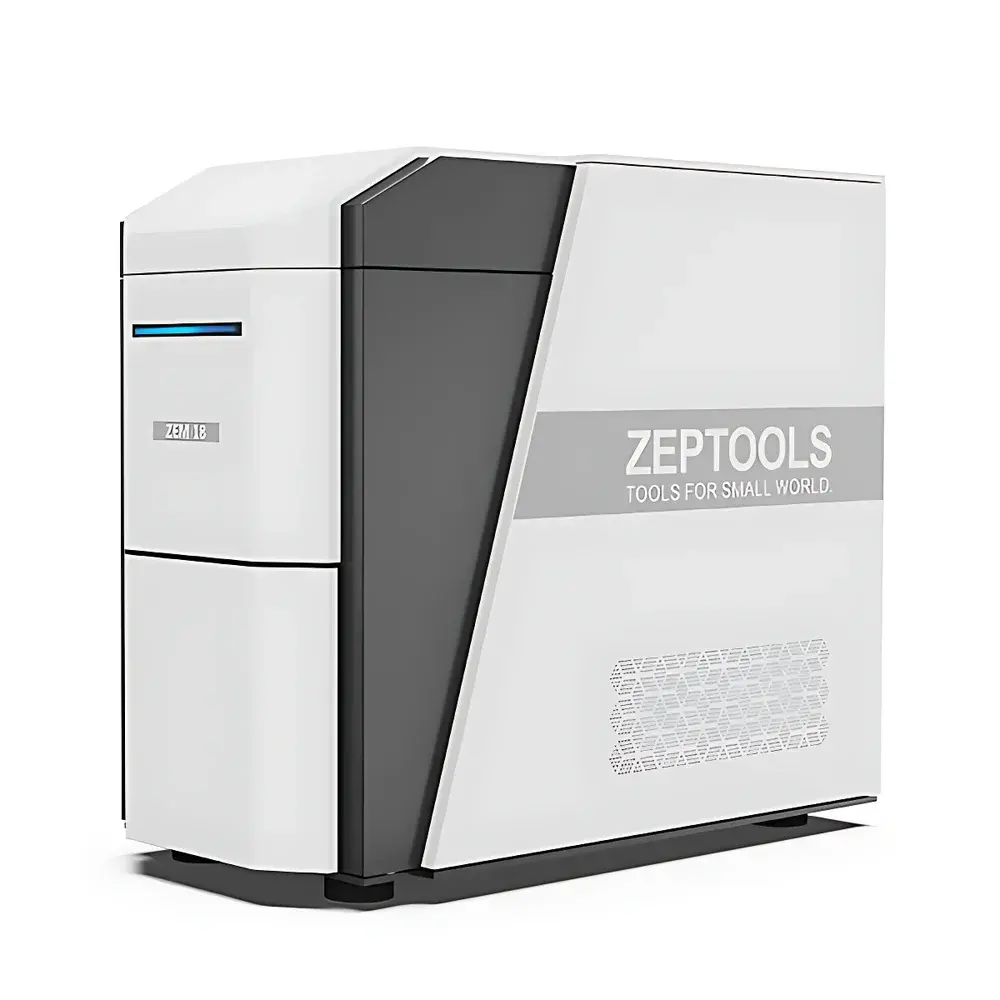
ZEPTOOLS ZEM18 Desktop Scanning Electron Microscope
| Brand | ZEPTOOLS |
|---|---|
| Origin | Anhui, China |
| Manufacturer Type | Original Equipment Manufacturer (OEM) |
| Product Category | Domestic |
| Model | ZEM18 |
| Instrument Type | Desktop SEM |
| Electron Source | Pre-aligned Tungsten Filament |
| SEM Class | Entry-level Tungsten-Filament SEM |
| Secondary Electron (SE) Resolution | <6 nm |
| Backscattered Electron (BSE) Resolution | <6 nm |
| Maximum Magnification | 200,000× |
| Accelerating Voltage Range | 3–18 kV |
| Maximum Sample Dimensions | Ø50 mm × 35 mm (H) |
| Stage | Motorized 2-Axis Automated Stage |
| Signal Acquisition Bandwidth | 10 MHz |
| Vacuum Mode Options | High Vacuum (<5×10⁻³ Pa), Low Vacuum (optional) |
| Pump-down Time (High Vacuum) | <90 s |
| Imaging Modes | Video Mode, Fast Scan Mode, Slow Scan Mode |
| Auto Functions | Auto Focus, Auto Brightness/Contrast |
| Detector Configurations | SE Detector, BSE Detector, Optional EDS Detector |
Overview
The ZEPTOOLS ZEM18 is a high-performance desktop scanning electron microscope engineered for laboratories requiring rapid, reliable nanoscale imaging without the infrastructure demands of floor-standing systems. Based on conventional thermionic emission from a pre-aligned tungsten filament, the ZEM18 delivers stable beam current and consistent signal-to-noise performance across its full accelerating voltage range (3–18 kV). Its compact column architecture integrates an integrated condenser lens system—eliminating manual alignment—and enables reproducible imaging at resolutions better than 6 nm in both secondary electron (SE) and backscattered electron (BSE) detection modes. With a 10 MHz signal acquisition bandwidth, the instrument supports real-time video-rate scanning with negligible motion artifacts—critical for dynamic observation, stage navigation, and user training. Designed for operational simplicity, the ZEM18 achieves high vacuum (<5×10⁻³ Pa) in under 90 seconds and supports optional low-vacuum operation for non-conductive or hydrated specimens.
Key Features
- Pre-aligned tungsten filament electron source with integrated condenser lens—no routine filament alignment required
- Motorized 2-axis automated stage enabling precise X/Y positioning and repeatable region-of-interest navigation
- Dual-detector configuration: In-lens SE detector for high-resolution surface topography and annular BSE detector for atomic-number contrast imaging
- Three operational scan modes: Video mode (real-time preview), Fast Scan (optimized throughput), and Slow Scan (high-SNR acquisition)
- Intelligent auto-functions including autofocus, automatic brightness/contrast adjustment, and stigmator compensation
- Modular expansion capability: Compatible with energy-dispersive X-ray spectroscopy (EDS) add-on, deceleration stage for low-kV surface analysis, and in-situ mechanical/electrical testing stages
- Vibration-insensitive mechanical design—certified for stable operation on standard laboratory benches or office-grade flooring
Sample Compatibility & Compliance
The ZEM18 accommodates samples up to Ø50 mm in diameter and 35 mm in height, supporting diverse specimen geometries without disassembly. Its dual-mode vacuum system permits direct imaging of conductive metals, ceramics, polymers, composites, and biological tissues—either sputter-coated or in low-vacuum mode. The instrument meets ISO 14644-1 Class 8 cleanroom compatibility requirements for installation environments and conforms to IEC 61000-6-3 (EMC emissions) and IEC 61000-6-2 (immunity) standards. All software operations—including parameter logging, image metadata embedding, and detector calibration records—support audit trails aligned with GLP and GMP documentation practices. While not FDA 21 CFR Part 11–validated out-of-the-box, the system architecture allows integration with validated LIMS or ELN platforms via standardized DICOM-SEM and TIFF+XML metadata export protocols.
Software & Data Management
The ZEM18 operates via ZEPTOOLS’ proprietary SEMControl™ v4.x platform—a Windows-based application with intuitive ribbon interface and context-sensitive workflow guidance. Image acquisition, annotation, measurement (line, area, particle count), and report generation are fully scriptable using Python API hooks. Raw data is saved in vendor-neutral TIFF format with embedded EXIF-style metadata (kV, WD, magnification, dwell time, detector gain, stage coordinates). Batch processing modules support automated montage stitching, focus stacking, and multi-detector overlay (SE+BSE+EDS map fusion). Software update cycles follow ISO/IEC 17025–aligned change control procedures; version history, validation summaries, and cybersecurity patch logs are accessible within the Help > Compliance section.
Applications
The ZEM18 serves as a primary characterization tool across academic research, quality control, failure analysis, and materials development workflows. Typical use cases include: morphological evaluation of battery cathode materials (e.g., LiFePO₄ particles at 30 kX), dispersion analysis of nanomaterials (e.g., SiO₂ nanoparticles at 100 kX), defect mapping in printed electronics, grain structure assessment in sintered ceramics, and dimensional metrology of microfabricated features. Its rapid pump-down and auto-acquisition routines make it suitable for teaching labs—enabling students to acquire publication-ready micrographs within introductory SEM training sessions. In industrial QA settings, the system supports ASTM E1558–20 (standard guide for SEM sample preparation) and ISO 16700:2016 (quantitative EDS microanalysis) workflows when equipped with calibrated EDS.
FAQ
What vacuum levels does the ZEM18 support, and how do they affect imaging?
The system operates in high vacuum mode (<5×10⁻³ Pa) for maximum resolution and conductivity-dependent contrast, and optionally in low vacuum mode (10–130 Pa) to image uncoated insulators or hydrated samples without charging artifacts.
Is EDS integration possible, and what level of elemental quantification accuracy can be expected?
Yes—EDS detectors from major vendors (Oxford Instruments, Bruker, EDAX) are mechanically and electronically compatible. Quantitative analysis follows ZAF or φ(ρz) correction models; typical relative standard deviation for major elements (>1 wt%) is ≤2% under optimized conditions.
Can the ZEM18 be used in non-dedicated lab spaces?
Yes—the instrument’s passive vibration isolation base and electromagnetic shielding enable stable operation on standard reinforced concrete floors or steel-framed office floors, per ISO 20816-1 vibration severity class A.
How is beam alignment maintained over time?
The pre-aligned tungsten filament and fixed condenser lens eliminate daily alignment needs; only periodic spot size verification (monthly) and astigmatism correction (per session) are recommended.
Does the software support automated batch acquisition for statistical particle analysis?
Yes—via the ParticleAnalyzer™ module, users define ROI grids, set threshold-based segmentation rules, and export CSV reports containing size distribution, aspect ratio, and circularity metrics compliant with ISO 9276-2.