
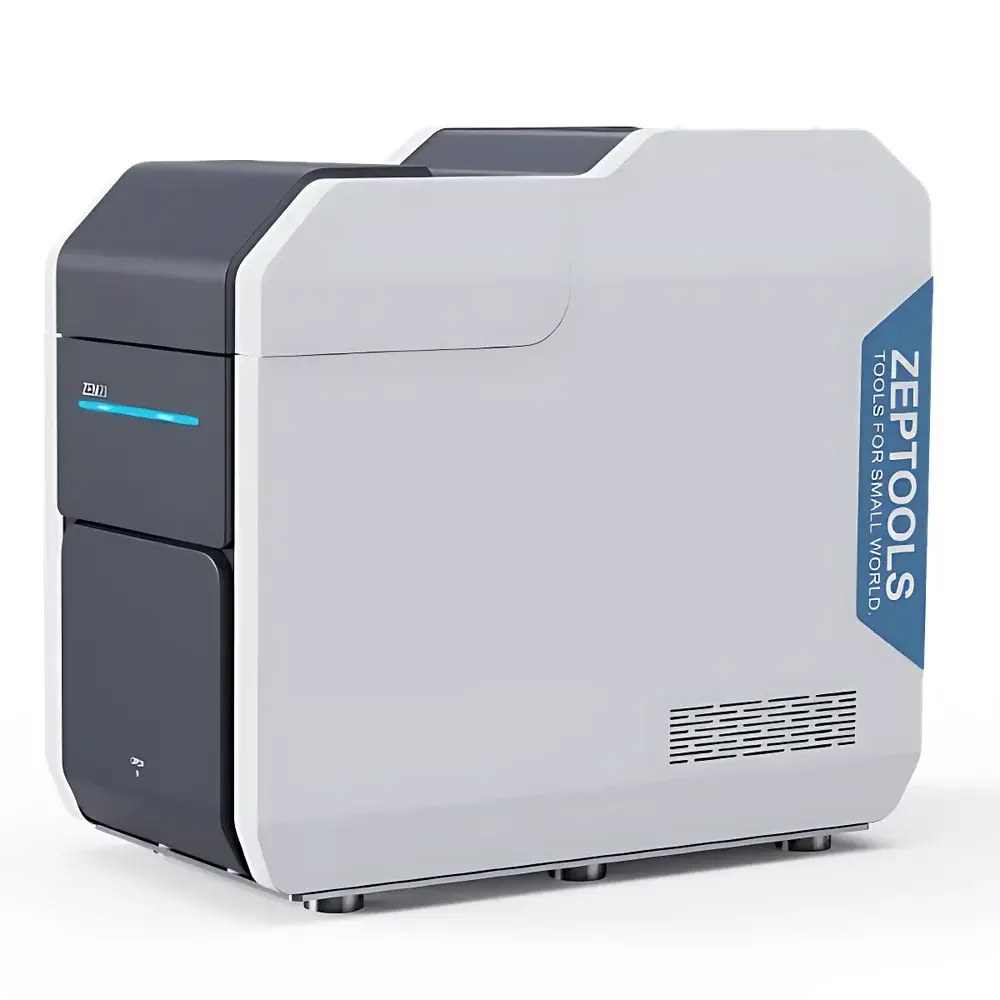
ZEPTOOLS ZEM20 Desktop Scanning Electron Microscope with Integrated EDS System
| Brand | ZEPTOOLS |
|---|---|
| Origin | Anhui, China |
| Manufacturer Type | Direct Manufacturer |
| Product Category | Domestic |
| Model | ZEM20 EDS-integrated Desktop SEM |
| Instrument Type | Desktop / Benchtop SEM |
| Electron Source | Tungsten Filament |
| SEM Class | Entry-level Tungsten-Filament SEM |
| Secondary Electron Image Resolution | 4 nm |
| Maximum Magnification | 360,000× |
| Accelerating Voltage Range | 3–20 kV (1 kV step adjustment) |
| Backscattered Electron Image Resolution | 4 nm |
| Integrated EDS System | Oxford Instruments Xplore Compact 30 |
| EDS Detector Active Area | 30 mm² (SuperATW window) |
| Energy Resolution | ≤129 eV (Mn Kα) |
| Cooling | Peltier-cooled (LN₂-free) |
| Elemental Detection Range | Boron (B, Z=5) to Californium (Cf, Z=98) |
| Analysis Modes | Point, Line, and Area Mapping |
| Software Interface | Fully Localized Chinese UI with Optional English Toggle |
| Vacuum Architecture | Dual-chamber Separated Vacuum System (Gun Chamber & Sample Chamber) |
| Sample Chamber Camera | Integrated HD In-Chamber Camera |
| Sample Stage Mode | Deceleration Mode for Low-Conductivity Specimens |
| Typical Sample Exchange Time | <60 s |
Overview
The ZEPTOOLS ZEM20 Desktop Scanning Electron Microscope (SEM) with Integrated Energy-Dispersive X-ray Spectroscopy (EDS) system is an engineered solution for laboratories requiring high-resolution imaging and elemental microanalysis in a compact, benchtop format. Based on conventional thermionic tungsten-filament electron optics, the ZEM20 delivers stable beam performance across a continuously adjustable accelerating voltage range of 3–20 kV in 1 kV increments—enabling optimized contrast and surface sensitivity for diverse material classes. Its secondary electron (SE) and backscattered electron (BSE) imaging resolution is specified at 4 nm at 20 kV, meeting ISO 16700:2016 requirements for resolution verification under standardized test conditions. The instrument employs a dual-chamber vacuum architecture: the electron gun chamber maintains ultra-high vacuum (UHV) integrity independently from the sample chamber, which operates at medium vacuum (10⁻³–10⁻¹ Pa), significantly reducing sample exchange time to under 60 seconds without compromising filament lifetime or beam stability.
Key Features
- Dual-chamber vacuum design ensures rapid sample loading (<60 s) while preserving electron gun vacuum integrity and extending tungsten filament service life.
- Deceleration mode operation enables high-fidelity SE imaging of non-conductive or semi-conductive specimens—including polymers, ceramics, biological tissues, and as-received geological samples—without mandatory sputter coating.
- Integrated HD in-chamber camera provides real-time optical monitoring of specimen position, stage movement, and in-situ experimental dynamics (e.g., thermal, mechanical, or electrochemical response).
- Benchtop footprint (≤0.8 m²) supports deployment in shared labs, QA/QC facilities, teaching environments, and cleanroom-adjacent spaces without dedicated floor reinforcement or high-capacity pumping infrastructure.
- Robust mechanical stage with motorized X/Y/Z translation and tilt capability accommodates specimens up to Ø100 mm × 50 mm height, compatible with optional in-situ tensile, heating, or cooling stages.
Sample Compatibility & Compliance
The ZEM20 is validated for use with solid, dry, vacuum-compatible specimens ranging from conductive metals and alloys to insulating oxides, composites, and hydrated biological sections (after critical-point drying or freeze-drying). Its deceleration mode mitigates charging artifacts on low-Z materials, supporting compliant workflows aligned with ASTM E1508-21 (Standard Guide for Quantitative Analysis by Energy-Dispersive Spectrometry) and ISO 22309:2021 (Electron probe microanalysis — Guidelines for qualitative and quantitative analysis). While not certified to IEC 61000-6-3 for EMC emissions, its electromagnetic shielding meets CE Annex II essential requirements for laboratory equipment. All vacuum and high-voltage subsystems conform to EN 61010-1:2010 safety standards for electrical equipment used in measurement, control, and laboratory applications.
Software & Data Management
Acquisition and analysis are performed via the localized ZEM20 Control Suite—a Windows-based application featuring full Chinese language support with seamless toggle to English. The software implements audit-trail logging per GLP/GMP principles, recording operator ID, timestamp, acquisition parameters (kV, WD, dwell time, detector bias), and all post-processing actions (contrast adjustment, ROI definition, quantification corrections). EDS data processing leverages Oxford Instruments’ AztecEngine core, supporting standardless quantification (ZAF/φρZ), peak deconvolution, spectral background modeling, and spatial correlation between SE/BSE topography and elemental distribution maps. Export formats include TIFF (8/16-bit), CSV (spectral and mapping data), and industry-standard .msa (EMSpectrum) for third-party analysis interoperability.
Applications
- Materials science: Fractography of metal fatigue surfaces, grain boundary characterization in sintered ceramics, dispersion homogeneity assessment in polymer nanocomposites.
- Geoscience: Mineral phase identification and textural analysis of thin sections, porosity quantification in reservoir rock cores.
- Electronics: Failure analysis of solder joints, intermetallic compound (IMC) layer thickness measurement, contamination source tracing on PCB substrates.
- Life sciences: Morphological evaluation of freeze-dried cells, biofilm architecture on implant surfaces, pollen grain ultrastructure.
- Quality control: Coating thickness verification (via cross-section imaging), inclusion analysis in cast aluminum alloys, fiber diameter distribution in nonwovens.
FAQ
Does the ZEM20 require liquid nitrogen for EDS detector cooling?
No. The Oxford Xplore Compact 30 detector uses Peltier thermoelectric cooling, eliminating LN₂ dependency and associated logistical constraints.
Can the ZEM20 perform EDS quantification without standards?
Yes. It supports standardless quantification using physics-based ZAF and φρZ matrix correction models, validated against NIST SRM reference materials for major and minor elements.
Is remote operation supported?
The system includes Ethernet connectivity and VNC-compatible remote desktop access; however, real-time imaging control requires local network latency <15 ms for optimal responsiveness.
What vacuum pump configuration is supplied?
A two-stage rotary vane pump (oil-sealed) is standard; optional turbomolecular pump upgrades are available for users requiring faster pump-down or extended UHV compatibility.
How is calibration traceability maintained?
Resolution and magnification calibration are verified annually using NIST-traceable grating standards (e.g., SPI QX-1000); calibration reports include uncertainty budgets compliant with ISO/IEC 17025:2017.




