
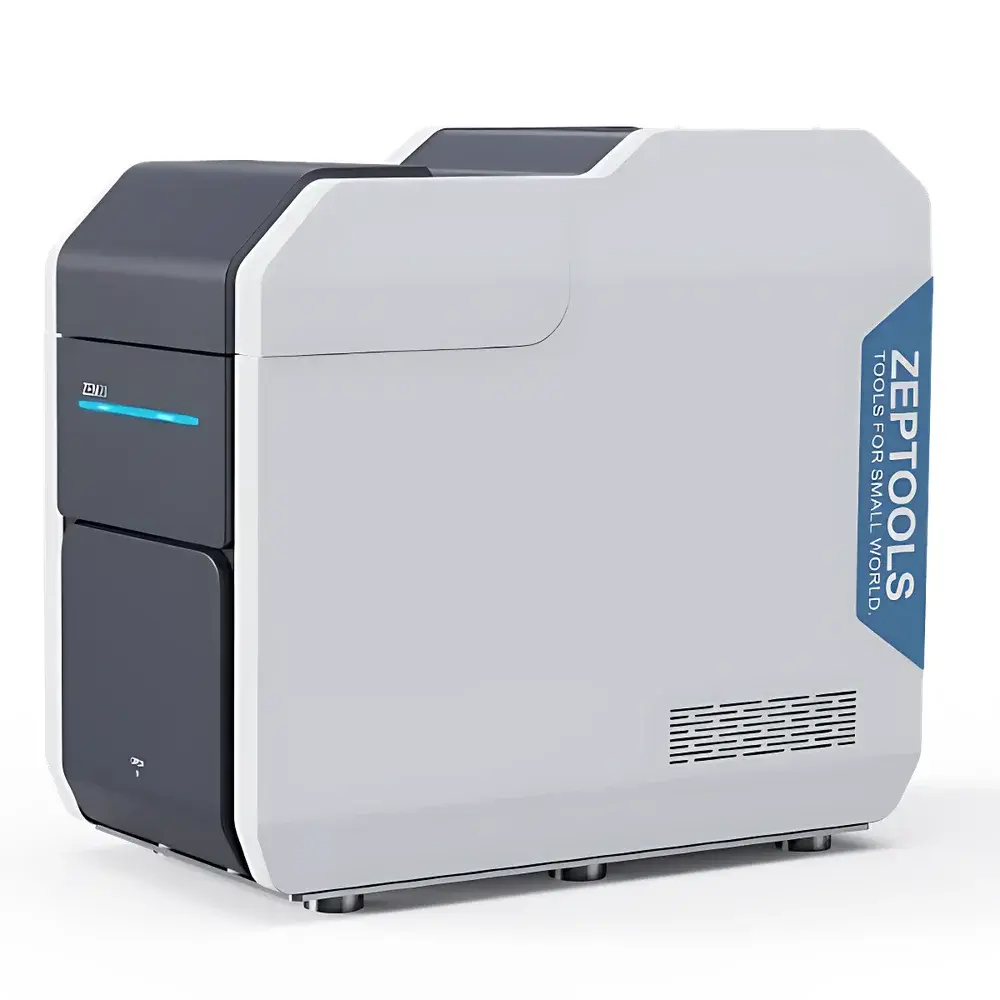
ZEPTOOLS ZEM20 Desktop In-situ Tensile SEM System
| Brand | ZEPTOOLS |
|---|---|
| Origin | Anhui, China |
| Manufacturer Type | Direct Manufacturer |
| Product Origin | Domestic (China) |
| Model | ZEM20 In-situ Tensile Integrated SEM |
| Instrument Type | Desktop SEM |
| Electron Source | Tungsten Filament |
| SEM Class | Entry-level Tungsten-Filament SEM |
| Secondary Electron (SE) Resolution | 4 nm @ 20 kV |
| Maximum Magnification | 360,000× |
| Accelerating Voltage Range | 3–20 kV (1 kV step adjustment) |
| Backscattered Electron (BSE) Resolution | 4 nm @ 20 kV |
| In-situ Stage Load Capacity | 0–1000 N |
| Displacement Resolution | 20 nm |
| Optional Heating Module | Yes |
| Mechanical Testing Modes | Tensile, Compression, Three-point Bending |
| Vacuum Architecture | Dual-chamber (separated electron gun & specimen chamber) |
| Sample Chamber Camera | Integrated HD in-chamber camera |
| Chamber Volume | Extra-large for multi-modal in-situ platform integration |
Overview
The ZEPTOOLS ZEM20 Desktop In-situ Tensile SEM System is a fully integrated, compact scanning electron microscope engineered for high-resolution structural characterization coupled with real-time mechanical testing at the micro- and nanoscale. Unlike conventional benchtop SEMs limited to static imaging, the ZEM20 embeds a precision electromechanical tensile stage directly within its ultra-large-volume specimen chamber—enabling synchronized high-magnification observation (up to 360,000×) and quantitative mechanical loading under controlled vacuum conditions. Its tungsten-filament electron source delivers stable beam current and consistent signal-to-noise performance across the full accelerating voltage range (3–20 kV, adjustable in 1 kV increments), supporting both surface-sensitive secondary electron (SE) imaging and compositional contrast via backscattered electron (BSE) detection—both with a verified resolution of 4 nm at 20 kV. The system employs a dual-chamber vacuum architecture: the electron gun and specimen chamber operate under independently optimized pressures, reducing sample exchange time to under 60 seconds while preserving filament lifetime and beam stability.
Key Features
- Integrated in-situ tensile stage with 0–1000 N load capacity and 20 nm displacement resolution, supporting tensile, compression, and three-point bending protocols
- Dual-chamber vacuum design isolates the electron gun from the specimen chamber, enabling rapid sample exchange (<60 s) without venting the column
- Extra-large specimen chamber accommodates multi-functional in-situ platforms—including optional heating modules (up to 800 °C)—and permits simultaneous EDS or cathodoluminescence integration
- Deceleration mode operation allows direct imaging of weakly conductive or insulating samples (e.g., polymers, ceramics, biological composites) without sputter-coating
- High-definition in-chamber optical camera provides real-time macro-scale monitoring of sample deformation, stage position, and fracture progression during mechanical testing
- Stable tungsten-filament source ensures reproducible beam performance across extended acquisition sessions, ideal for time-resolved in-situ experiments
Sample Compatibility & Compliance
The ZEM20 accommodates specimens up to 100 mm in diameter and 50 mm in height, including bulk metals, thin films, battery electrode cross-sections, fiber-reinforced composites, and MEMS devices. Its deceleration-mode capability eliminates the need for conductive coatings on low-Z materials such as LiFePO₄ cathodes, SiO₂ dielectrics, or carbon nanotube networks—preserving native surface chemistry and avoiding artifacts induced by Au/Pd sputtering. All vacuum, motion control, and image acquisition subsystems comply with IEC 61000-6-3 (EMC emissions) and IEC 61010-1 (safety requirements for electrical equipment). Data integrity workflows support audit-ready metadata logging aligned with GLP and ISO/IEC 17025 documentation frameworks.
Software & Data Management
The proprietary ZEM20 Control Suite provides synchronized acquisition of SEM images, load-displacement curves, and stage positional data at user-defined temporal intervals (down to 100 ms per frame). Image metadata includes timestamp, kV, probe current, working distance, stage coordinates, and real-time load values—all embedded in TIFF/SEM standard format. Export options include CSV for mechanical data, HDF5 for multi-channel time-series stacks, and DIC-compatible displacement maps. Software supports FDA 21 CFR Part 11-compliant user authentication, electronic signatures, and immutable audit trails for regulated environments.
Applications
- In-situ fracture mechanics analysis of metallic alloys and additive-manufactured components under monotonic and cyclic loading
- Real-time observation of lithiation/delithiation-induced strain and cracking in battery electrode materials (e.g., LFP, NMC, silicon anodes)
- Mechano-structural evolution of polymer nanocomposites during uniaxial extension, including filler debonding and matrix yielding
- Three-point bending tests on microscale ceramic beams to quantify flexural strength and crack propagation kinetics
- Correlative analysis of grain boundary sliding and dislocation activity in polycrystalline thin films under thermal-mechanical coupling (with optional heating module)
FAQ
Does the ZEM20 require liquid nitrogen or external water cooling?
No—the tungsten-filament source and stage electronics are air-cooled; no cryogenic or external coolant infrastructure is needed.
Can the in-situ stage be upgraded post-purchase?
Yes—mechanical stages, heating modules, and environmental chambers are field-installable via standardized flange interfaces and firmware updates.
Is EDS compatibility supported?
Yes—the large chamber volume and optimized geometry permit integration of standard silicon drift detector (SDD) systems with take-off angles ≥35°.
What vacuum level is maintained in the specimen chamber during in-situ testing?
Typical operating pressure is 5 × 10⁻³ Pa; the dual-chamber design maintains <1 × 10⁻⁵ Pa in the electron gun region throughout mechanical actuation.
How is image drift compensated during long-duration tensile experiments?
The system applies real-time stage-based drift correction using fiducial markers and closed-loop piezo positioning, maintaining sub-pixel registration over >30-minute acquisitions.




