
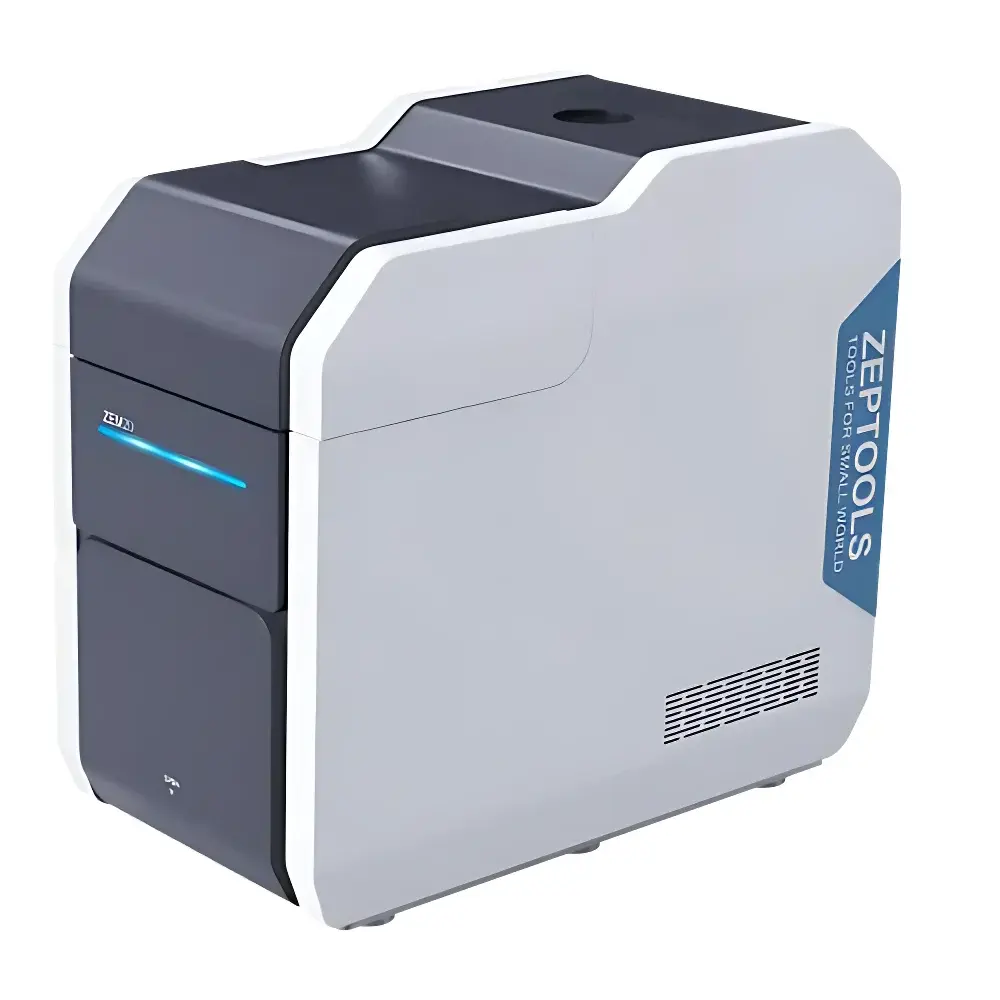
ZEPTOOLS ZEM20Pro Desktop Scanning Electron Microscope
| Brand | ZEPTOOLS |
|---|---|
| Origin | Anhui, China |
| Model | ZEM20Pro |
| Instrument Type | Desktop SEM |
| Electron Source | LaB₆ (Lanthanum Hexaboride) |
| Secondary Electron Resolution | 3 nm |
| Magnification Range | up to 360,000× |
| Accelerating Voltage | 3–30 kV |
| Backscattered Electron Resolution | 3 nm |
Overview
The ZEPTOOLS ZEM20Pro is a high-performance desktop scanning electron microscope engineered for precision imaging and elemental analysis in academic laboratories, quality control facilities, and R&D centers. It employs thermionic emission from a lanthanum hexaboride (LaB₆) electron source, delivering superior brightness and stability compared to tungsten filaments—enabling consistent high-resolution imaging at accelerating voltages ranging from 3 kV to 30 kV. With a secondary electron (SE) and backscattered electron (BSE) resolution of 3 nm at optimal working distance and beam conditions, the ZEM20Pro supports morphological characterization, particle sizing, fracture analysis, and compositional contrast imaging across diverse material classes. Its compact vacuum chamber, integrated stage with precise X-Y-Z tilt capability, and optimized detector geometry are specifically designed to accommodate conventionally prepared samples while maintaining compatibility with standard SEM sample mounting protocols.
Key Features
- LaB₆ thermionic electron gun offering higher brightness and longer operational lifetime than tungsten sources
- 3 nm SE and BSE resolution at 30 kV, with stable low-voltage imaging capability down to 3 kV for beam-sensitive specimens
- Wide accelerating voltage range (3–30 kV) enabling flexible contrast optimization and reduced charging effects on insulators
- Integrated stage with motorized X-Y-Z translation and ±45° tilt for multi-angle imaging and cross-sectional viewing
- Compact column design with optimized electron optics for minimal aberration and high signal-to-noise ratio
- Standard vacuum system compatible with conventional conductive coating and drying workflows
Sample Compatibility & Compliance
The ZEM20Pro accommodates a broad spectrum of specimen types—including metals, ceramics, polymers, geological samples, biological tissues, powders, and nanomaterials—provided they meet fundamental SEM requirements: mechanical stability under vacuum, thermal tolerance during beam exposure, and adequate electrical conductivity or surface charge mitigation. Non-conductive samples require sputter-coating (e.g., Au, Pt, or Au/Pd) to a thickness of 2–10 nm, calibrated via deposition time and current to preserve nanoscale surface topography. Biological specimens must undergo chemical fixation (e.g., glutaraldehyde/osmium tetroxide), graded dehydration (ethanol or acetone series), and critical-point drying or freeze-drying to prevent structural collapse. All preparation steps comply with widely accepted SEM best practices referenced in ASTM E1558 (Standard Guide for Preparation of Specimens for Examination by Scanning Electron Microscopy) and ISO 27208 (Electron microscopy — Vocabulary and definitions). The instrument’s vacuum architecture supports routine maintenance intervals aligned with GLP-compliant laboratory operations.
Software & Data Management
Acquisition and analysis are managed through ZEPTOOLS’ proprietary SEM control software, supporting real-time image capture, stage navigation, automated focus/stigmation routines, and batch acquisition protocols. Image metadata—including kV, WD, dwell time, magnification, detector mode (SE/BSE), and timestamp—is embedded in TIFF and BMP exports. Software architecture supports audit-trail logging per user session, satisfying documentation requirements for ISO/IEC 17025-accredited labs. Exported data integrates with third-party analysis platforms (e.g., ImageJ, MountainsMap, Thermo Avizo) for quantitative morphology, particle distribution, and roughness analysis. No cloud-based storage or remote access functionality is included; all data reside locally on the host PC, ensuring full compliance with institutional data sovereignty policies.
Applications
- Metallographic analysis of alloys, weld zones, and corrosion products using BSE imaging for phase contrast
- Quality inspection of additive-manufactured components, including porosity mapping and powder morphology assessment
- Failure analysis of electronic packaging, PCB traces, and solder joints
- Morphological characterization of catalysts, battery electrode materials, and filtration membranes
- Biological ultrastructure imaging—including plant stomata, insect cuticles, and microbial biofilms—following standardized fixation and drying protocols
- Geological thin-section analysis and mineral identification via topographic and compositional contrast
FAQ
What is the maximum recommended sample height for optimal working distance on the ZEM20Pro?
The ideal working distance is 10 mm; samples exceeding 15 mm in height may limit tilt range and compromise resolution due to increased spherical aberration.
Can the ZEM20Pro image uncoated non-conductive samples?
Yes—under low-kV (≤5 kV) and low-beam-current conditions, combined with charge compensation via beam deceleration or variable pressure mode (if equipped); however, sputter-coating remains the standard for reproducible, high-fidelity imaging.
Is critical-point drying mandatory for all biological specimens?
No—freeze-drying is an acceptable alternative for solvent-sensitive or lipid-rich tissues; air-drying is strictly prohibited due to capillary-force-induced collapse.
Does the ZEM20Pro support energy-dispersive X-ray spectroscopy (EDS)?
The base configuration does not include EDS hardware; optional integration with third-party silicon-drift detectors (SDD) is available upon request and requires mechanical and software interface validation.
How frequently should the LaB₆ filament be replaced under typical usage?
Under normal operation (4–6 hrs/day, 5 days/week), filament lifetime averages 6–12 months; replacement requires vacuum break and alignment recalibration by certified service personnel.





