
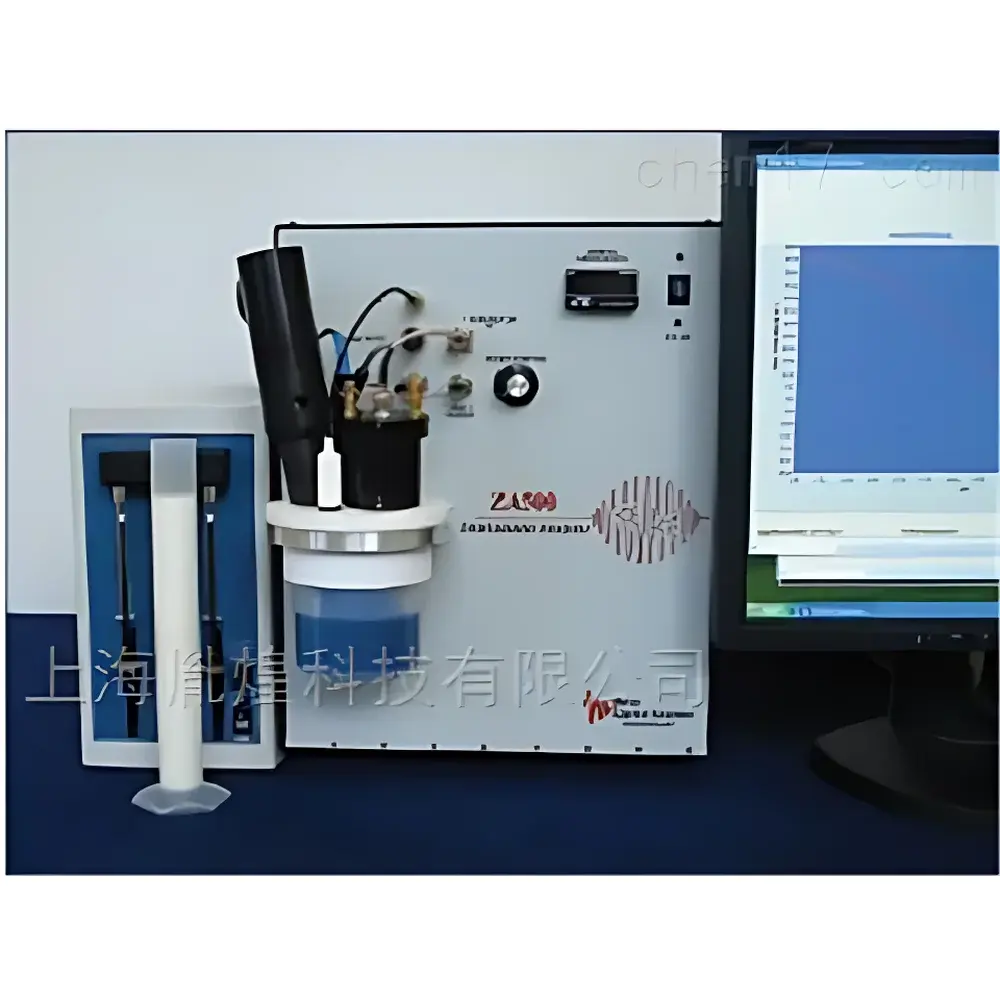
ZetaFinder ZF400 High-Concentration Zeta Potential Analyzer
| Brand | MAS (USA) |
|---|---|
| Origin | USA |
| Model | ZetaFinder ZF400 |
| Zeta Potential Range | ±500 mV |
| pH Range | 0–14 |
| Temperature Range | 0–90 °C |
| pH Resolution | ±0.1 |
| Temperature Resolution | ±0.1 °C |
| Accuracy | ±2% |
| Repeatability | ±2% |
| Sample Concentration Range | 0.1–60% w/v |
| Particle Size Range | 1 nm – 50 µm |
| Minimum Sample Volume | 10 mL |
| Integrated Measurements | Zeta potential, pH, conductivity, temperature |
Overview
The ZetaFinder ZF400 High-Concentration Zeta Potential Analyzer is an electroacoustic instrument engineered for direct, label-free, and dilution-free characterization of colloidal stability in undiluted, opaque, or highly concentrated dispersions. Unlike conventional optical electrophoretic systems—such as laser Doppler microelectrophoresis—that rely on light scattering and require low-concentration, optically transparent samples, the ZF400 employs high-frequency electroacoustic spectroscopy (EAS) to measure the colloid vibration current (CVI) induced by an applied oscillating electric field. This principle enables robust determination of zeta potential across a broad physicochemical spectrum: from aqueous and non-aqueous suspensions to pastes, emulsions, slurries, and even gels—without sample dilution, centrifugation, or filtration. Its operational design eliminates artifacts associated with particle reorientation, electrode polarization, or double-layer compression during measurement, making it especially suitable for quality control in pharmaceutical suspensions, battery cathode slurries, ceramic processing, pigment formulations, and biopolymer dispersions where native-state characterization is critical.
Key Features
- Electroacoustic measurement platform eliminating dependence on optical clarity—enables analysis of turbid, colored, or solid-laden samples without dilution
- Integrated multi-parameter sensing: simultaneous real-time acquisition of zeta potential, pH, conductivity, and temperature
- Dual-mode operation: probe-based immersion in standard lab vessels (e.g., beakers, reaction flasks) or dedicated flow-through cell configuration
- Gold-plated, corrosion-resistant Zeta immersion probe with optimized electrode geometry for high signal-to-noise ratio and long-term stability
- Onboard magnetic stirring and optional peristaltic pumping to maintain homogeneous suspension during measurement—prevents sedimentation and ensures representative sampling
- Automated titration mode for rapid isoelectric point (IEP) determination with programmable acid/base addition and kinetic monitoring
- Short-pulse, high-frequency electric field excitation (<1 ms pulses) minimizes Joule heating and electrochemical side reactions
- Wide dynamic range: supports samples from 0.1% to 60% w/v solids loading and particle sizes spanning 1 nm to 50 µm
- Minimal sample requirement: only 10 mL volume needed; no specialized cuvettes or capillary cells required
Sample Compatibility & Compliance
The ZF400 accommodates diverse material classes—including inorganic oxides (e.g., SiO₂, TiO₂, Al₂O₃), polymeric nanoparticles, liposomes, protein aggregates, carbon nanotubes, and metal-organic frameworks—regardless of optical opacity or solvent polarity. It operates reliably in water, ethanol, isopropanol, DMF, ethylene glycol, and other polar/non-polar media. The system complies with fundamental principles outlined in ISO 13099-3:2019 (Colloidal systems — Methods for zeta-potential determination — Part 3: Electroacoustic methods) and supports GLP/GMP-aligned workflows through audit-trail-enabled software logging. While not certified under FDA 21 CFR Part 11 out-of-the-box, its data export architecture (CSV, XML, PDF) facilitates integration into validated LIMS or electronic lab notebook (ELN) environments requiring full traceability.
Software & Data Management
Controlled via Windows-native application built on Microsoft .NET Framework, the ZF400 software provides intuitive workflow navigation, customizable method templates, and automated report generation. All raw and processed data—including time-resolved zeta potential traces, titration curves, and parameter correlation plots—are timestamped and stored with full metadata (operator ID, instrument serial, environmental conditions). Export options include ASCII-compatible formats compatible with MATLAB, OriginLab, and statistical analysis packages. Version-controlled firmware updates ensure continued alignment with evolving electroacoustic calibration standards. Remote diagnostics and secure remote support are available via encrypted VNC session upon customer authorization.
Applications
- Formulation development of injectable nanomedicines and oral suspensions where dilution alters surface charge behavior
- In-process monitoring of lithium-ion battery slurry stability during electrode coating preparation
- Surface modification validation of silica or polymer nanoparticles following silanization or PEGylation
- Stability assessment of food-grade emulsions (e.g., dairy, plant-based beverages) under varying pH and ionic strength
- Quality-by-Design (QbD) implementation for ceramic slip rheology and green body integrity prediction
- Environmental colloid transport studies involving soil leachates, wastewater flocs, or nanoparticle fate modeling
FAQ
Does the ZF400 require optical transparency for measurement?
No. It uses electroacoustic spectroscopy—not light scattering—so turbid, opaque, or highly pigmented samples can be analyzed directly.
Can I measure zeta potential in non-aqueous solvents?
Yes. The instrument supports organic media including alcohols, ketones, and dipolar aprotic solvents, provided sufficient conductivity exists for CVI detection.
Is sample dilution ever necessary?
Not for routine operation. Dilution is explicitly avoided to preserve native interfacial chemistry and avoid artifact generation.
How is calibration performed?
Calibration is conducted using NIST-traceable reference materials and verified against standardized latex suspensions; factory calibration is documented per ISO/IEC 17025 guidelines.
What maintenance does the gold immersion probe require?
Rinsing with deionized water and mild detergent post-use is sufficient; periodic inspection for surface pitting or adhesion residue is recommended every 200 measurements.



