
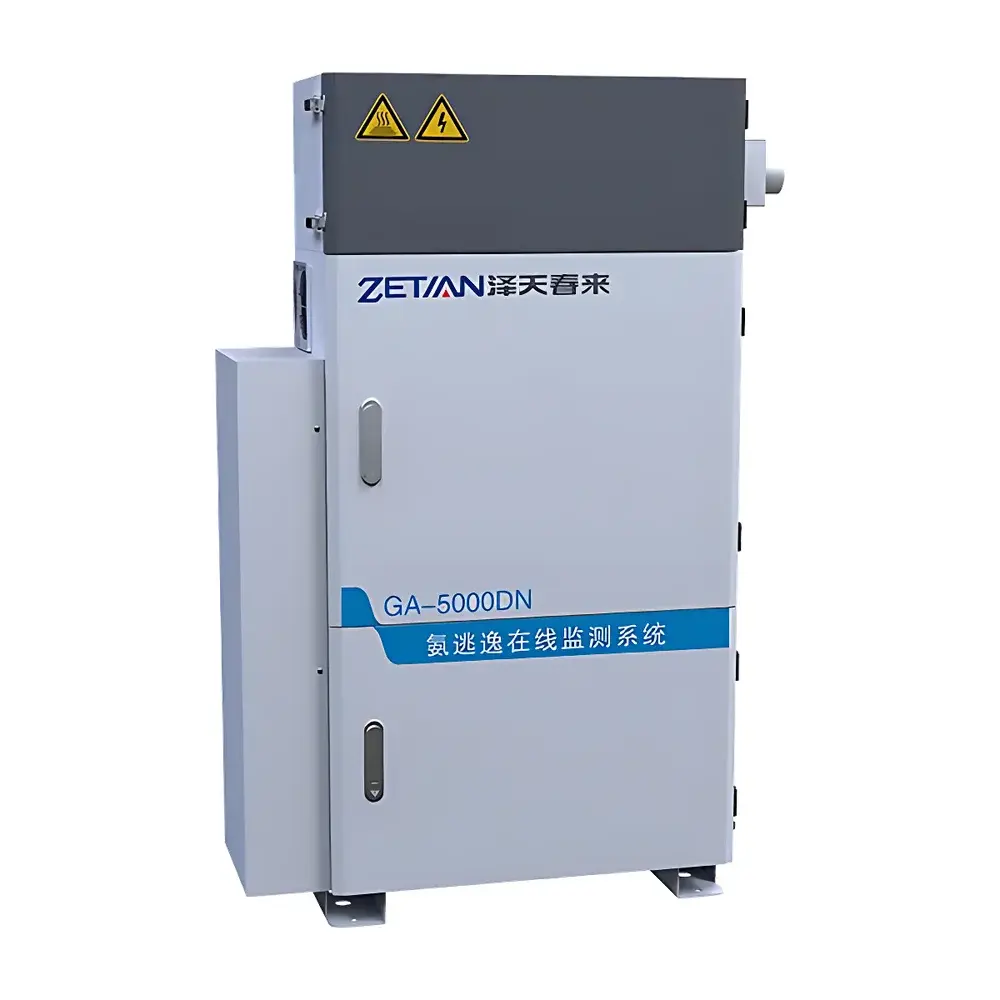
Zetian Chunlai GA-5000DN Ammonia Slip Online Monitoring System
| Brand | Zetian |
|---|---|
| Origin | Zhejiang, China |
| Manufacturer Type | Original Equipment Manufacturer (OEM) |
| Country of Origin | China |
| Model | GA-5000DN |
| Pricing | Available Upon Request |
Overview
The Zetian Chunlai GA-5000DN Ammonia Slip Online Monitoring System is a high-reliability, field-installed continuous emission monitoring system engineered for real-time quantification of residual ammonia (NH₃) concentration downstream of selective catalytic reduction (SCR) and selective non-catalytic reduction (SNCR) denitrification units. It operates on the principle of Tunable Diode Laser Absorption Spectroscopy (TDLAS), a well-established, physics-based optical absorption technique that enables highly selective, interference-free detection of NH₃ in hot, humid, and particulate-laden flue gas streams. Unlike extractive systems relying on cooled sample conditioning or dilution, the GA-5000DN employs a fully heated extractive sampling architecture — with all gas-contacting components maintained above 200 °C — to prevent ammonium salt condensation (e.g., NH₄HSO₄, NH₄NO₃), a primary cause of measurement drift and sensor fouling in conventional analyzers. This design ensures stable baseline performance, minimal zero drift, and long-term measurement integrity under demanding industrial stack conditions.
Key Features
- Fully heated extractive sampling path: All wetted parts—including probe, heated filter, sample line (1–3 m stainless steel 316L), and absorption cell—are actively maintained at ≥200 °C to eliminate ammonium salt deposition and preserve molecular NH₃ integrity.
- TDLAS-based optical detection: Utilizes a narrow-linewidth tunable diode laser targeting a fundamental ro-vibrational absorption line of NH₃ near 1512 nm, providing inherent selectivity against H₂O, CO₂, NOₓ, SO₂, and other common flue gas interferents.
- Multi-pass Herriott-type absorption cell: Increases effective optical path length to enhance sensitivity, enabling sub-ppm detection limits (typical LOD < 0.5 ppm @ 1σ, 1 s response) without chemical conversion or catalytic oxidation.
- Integrated automated maintenance functions: Scheduled reverse-purge cycles clean the high-temperature sintered metal filter and sample inlet using instrument-grade compressed air or nitrogen, significantly extending service intervals in high-dust environments (e.g., coal-fired boiler stacks).
- Zero and span calibration capability: Supports automated daily zero-air injection (via internal zero-gas generator or external source) and optional span gas introduction for traceable, auditable calibration verification per ISO 14956 and EPA Method 30B requirements.
- Robust mechanical architecture: No moving parts in the optical or sampling train; all electronics housed in an IP65-rated, temperature-stabilized enclosure suitable for outdoor mounting adjacent to the stack.
Sample Compatibility & Compliance
The GA-5000DN is validated for continuous operation in flue gas streams with temperatures up to 200 °C (sampled), dust loadings ≤ 50 g/Nm³, and moisture content up to 15 vol%. Its heated design eliminates dependence on flue gas temperature/pressure stability, making it compatible with both forced-draft and induced-draft configurations. The system conforms to key regulatory and quality frameworks including ISO 14956:2022 (air quality — performance criteria for automated measuring systems), EN 15267-3 (QAL1 certification prerequisites), and supports compliance with China’s HJ 75-2017 and HJ 76-2017 CEMS technical specifications. Data logging and audit trails meet GLP/GMP-aligned record retention practices, and optional firmware modules support 21 CFR Part 11 electronic signature and audit trail functionality upon customer configuration.
Software & Data Management
The embedded controller runs a real-time Linux OS with a web-accessible HMI (HTTP/HTTPS), enabling remote configuration, diagnostics, and data visualization via standard browsers. Measurement data — including raw absorbance spectra, calculated NH₃ concentration (ppm), temperature/pressure/flow status, calibration logs, and fault codes — are output via Modbus TCP, 4–20 mA analog outputs (isolated), and optional RS-485/RS-232. Historical data is stored locally (≥30 days at 1-min resolution) and can be exported in CSV or XML format. Optional cloud integration (MQTT/OPC UA) supports centralized fleet monitoring and predictive maintenance analytics across multiple SCR installations.
Applications
The GA-5000DN is deployed primarily in thermal power plants, waste-to-energy facilities, cement kilns, and glass manufacturing lines where precise NH₃ slip control is critical for catalyst protection, NOₓ compliance, and avoidance of downstream air preheater fouling. It serves as the primary analyzer in CEMS-compliant ammonia slip monitoring stations, supports closed-loop SCR ammonia injection control, and provides validation data for environmental reporting under national emission standards (e.g., China’s GB 13223-2011, EU IED BREFs). Its robustness also makes it suitable for R&D applications involving NH₃ kinetics studies in pilot-scale deNOₓ reactors.
FAQ
What is the typical response time (T₉₀) from sample extraction to NH₃ concentration output?
Typical T₉₀ is ≤ 15 seconds under standard installation with a 2-m heated line and optimized flow rate (1.2–1.8 L/min).
Does the system require external zero/span gases for routine operation?
Zero calibration can be performed automatically using ambient air (filtered and dried) or synthetic zero gas; span calibration requires certified NH₃-in-N₂ standard gas (e.g., 5 ppm or 10 ppm) at user-defined intervals.
How is the system protected against corrosion in high-SO₂ or high-Cl flue gas?
All gas-wetted surfaces use ASTM A240 UNS S31603 (316L stainless steel); the ≥200 °C operating temperature further inhibits acidic condensate formation and chloride-induced stress corrosion cracking.
Can the GA-5000DN integrate with existing DCS or PLC systems?
Yes — via native Modbus TCP, 4–20 mA analog outputs, and configurable digital I/O for alarm and status signaling; protocol mapping documentation is provided per IEC 61131-3 conventions.
What maintenance tasks are required during normal operation?
Primary tasks include quarterly inspection of the heated filter element, annual verification of laser wavelength stability and detector linearity, and biannual cleaning of optical windows using certified lint-free wipes and spectroscopic-grade isopropanol — no consumables or reagents required.
Related Products







