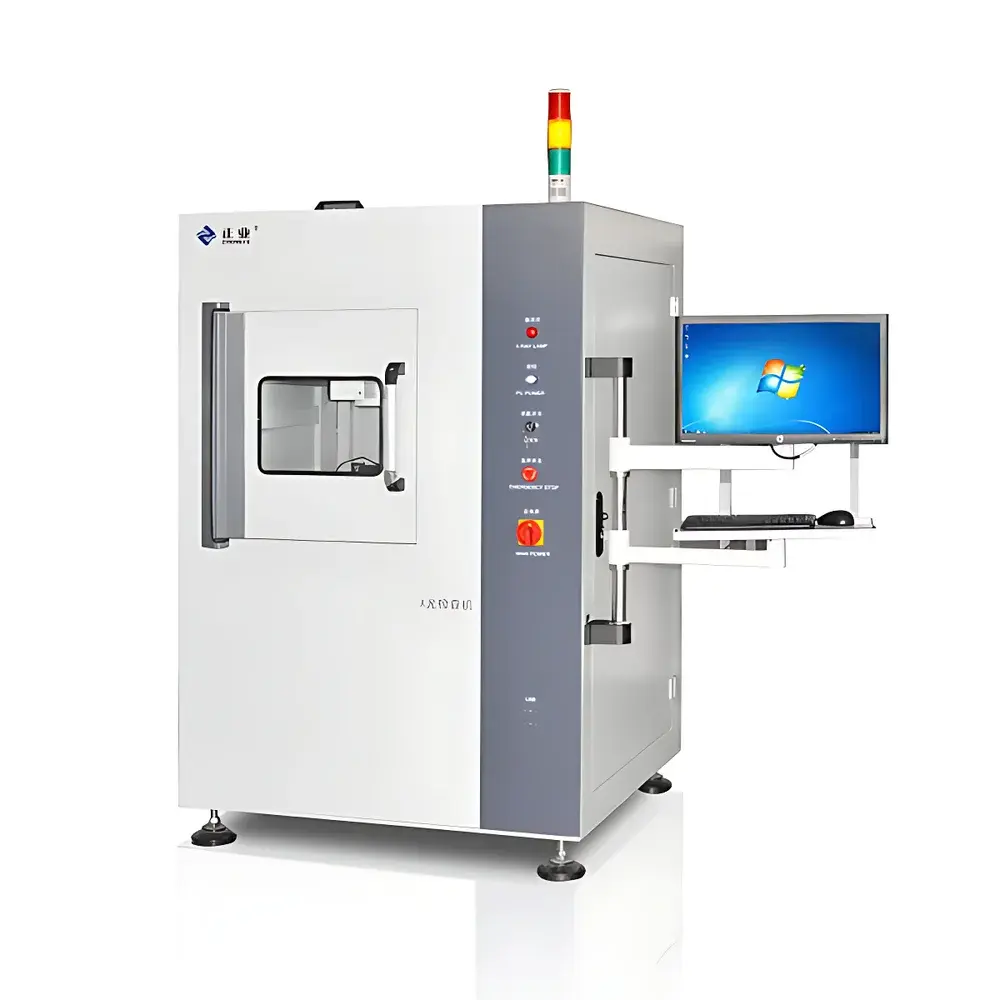
Zhengye XG5010 Industrial X-ray Inspection System for Lithium-ion Battery Cell QC
| Brand | Zhengye |
|---|---|
| Origin | Guangdong, China |
| Manufacturer Type | OEM/ODM Manufacturer |
| Country of Origin | China |
| Model | XG5010 |
| Price | Upon Request |
| X-ray Tube Voltage | 90–130 kV |
| X-ray Tube Current | 89–455 µA |
| Focal Spot Size | 5–15 µm |
| Cooling Method | Forced Air Cooling |
| Detector Type | Image Intensifier / Flat Panel Detector |
| Field of View | Φ100 mm or 114.9 mm × 64.6 mm (configurable) |
| Image Resolution | 1392 × 1040 or 1536 × 864 pixels (configurable) |
| Geometric Magnification | 12×–48× |
| Repeatability Accuracy | ±60 µm |
| Inspection Speed | ≥1.5 points/sec (excluding loading/unloading & stage motion) |
| Stage Dimensions | 515 mm × 460 mm |
| Effective Inspection Area | 450 mm × 410 mm |
| Max Load Capacity | ≤5 kg |
| Radiation Safety Level | ≤1 µSv/hr (compliant with IEC 61331-1 & GBZ 130-2020) |
| Host PC | 22" widescreen LCD/touch display, Intel Core i5, 4 GB RAM, 500 GB HDD |
| System Dimensions | 1136 mm × 1076 mm × 1730 mm |
| Weight | ~750 kg |
| Power Supply | AC 220 V, 10 A |
| Operating Environment | 25 °C ±3 °C, RH 50% ±10% |
Overview
The Zhengye XG5010 Industrial X-ray Inspection System is a purpose-built non-destructive testing (NDT) platform engineered for high-throughput quality control and failure analysis of lithium-ion battery cells in production environments. Leveraging transmission X-ray imaging physics—where differential X-ray attenuation reveals internal structural features—the system enables real-time visualization of electrode alignment, weld integrity, separator wrinkling, foreign object debris (FOD), voids, delamination, and anode/cathode thickness variation. Unlike generic radiography systems, the XG5010 integrates metrology-grade geometric magnification (12×–48×), sub-60 µm repeatability, and programmable motion control to support both 2D defect screening and calibrated 2.5D dimensional verification—critical for ISO/IEC 17025-compliant battery cell acceptance testing and root cause analysis.
Key Features
- Multi-Mode Imaging Architecture: Configurable detector options—including image intensifier and flat-panel detectors—support trade-offs between frame rate, dynamic range, and spatial resolution, optimized for varying cell formats (cylindrical, prismatic, pouch).
- 2.5D Metrology Engine: Embedded measurement algorithms perform calibrated linear distance, circle diameter, concentricity, point-to-center offset, and edge-profile analysis directly on radiographic images—enabling quantitative assessment beyond pass/fail classification.
- CNC Path Programming: Operator-defined inspection sequences (e.g., multi-point weld scans or electrode seam profiling) are stored as repeatable motion programs, reducing setup time for low-volume/high-mix production batches.
- Intuitive Navigation Interface: A large-scale navigation window overlays real-time live imaging with a thumbnail map; mouse-click targeting drives the XY-stage to the selected coordinate within <1.2 seconds, minimizing manual repositioning errors.
- Real-Time Image Processing Pipeline: On-the-fly contrast enhancement, noise suppression, edge sharpening, and grayscale normalization ensure consistent feature visibility across varying material densities and thickness gradients.
Sample Compatibility & Compliance
The XG5010 accommodates standard commercial lithium-ion cell geometries up to 450 mm × 410 mm active area, with a maximum payload of 5 kg. Its radiation shielding meets IEC 61331-1 (Medical X-ray Equipment – Protection Against Ionizing Radiation) and China’s GBZ 130-2020 (Radiation Protection Requirements for Industrial X-ray Equipment), verified at ≤1 µSv/hr at 5 cm from any external surface under full-power operation. All software workflows support audit trail generation per FDA 21 CFR Part 11 requirements when deployed in GMP-regulated battery manufacturing facilities. System calibration certificates traceable to national metrology institutes are available upon request.
Software & Data Management
The proprietary Zhengye VisionInspect™ software provides a unified interface for acquisition, measurement, reporting, and data archival. Each inspection session logs raw DICOM-compatible images, annotated measurement results, stage coordinates, exposure parameters (kV, µA, integration time), and operator ID. Reports export to PDF, CSV, or XML formats—with configurable templates aligned to internal QC checklists or customer-specific PPAP documentation. Optional database integration (ODBC/SQL Server) supports SPC charting, trend analysis, and MES-level traceability via unique cell barcode association.
Applications
- Electrode stacking misalignment detection in jelly-roll and stacked-prismatic cells
- Ultrasonic weld integrity verification (e.g., tab-to-current-collector joints)
- Separator folding, tearing, or displacement analysis
- Foreign particle identification and localization (e.g., metal shavings, aluminum foil fragments)
- Calibrated thickness mapping of anode/cathode coatings (using dual-energy or density calibration curves)
- Post-cycle degradation assessment (e.g., dendrite formation, gas pocket evolution)
FAQ
What regulatory standards does the XG5010 comply with for industrial X-ray safety?
The system conforms to IEC 61331-1 and GBZ 130-2020, with third-party radiation leakage testing confirming ≤1 µSv/hr at 5 cm from all accessible surfaces.
Can the XG5010 integrate with existing factory automation systems?
Yes—via Ethernet/IP or Modbus TCP, the system supports external trigger signals for synchronized inspection cycles and outputs pass/fail status codes to PLCs or SCADA platforms.
Is offline calibration and measurement validation supported?
Calibration artifacts (e.g., tungsten wire grids, step wedges) are provided with NIST-traceable certification; software includes built-in calibration verification routines compliant with ISO 10360-2.
Does the system support automated report generation for ISO 9001 audits?
All inspection records include timestamps, user authentication, parameter logs, and digital signatures—exportable in formats accepted by major automotive OEMs’ Tier-1 supplier quality portals.
What maintenance intervals are recommended for long-term stability?
X-ray tube performance monitoring occurs automatically per scan; annual preventive maintenance—including detector gain calibration, mechanical backlash compensation, and radiation output verification—is advised per manufacturer guidelines.