
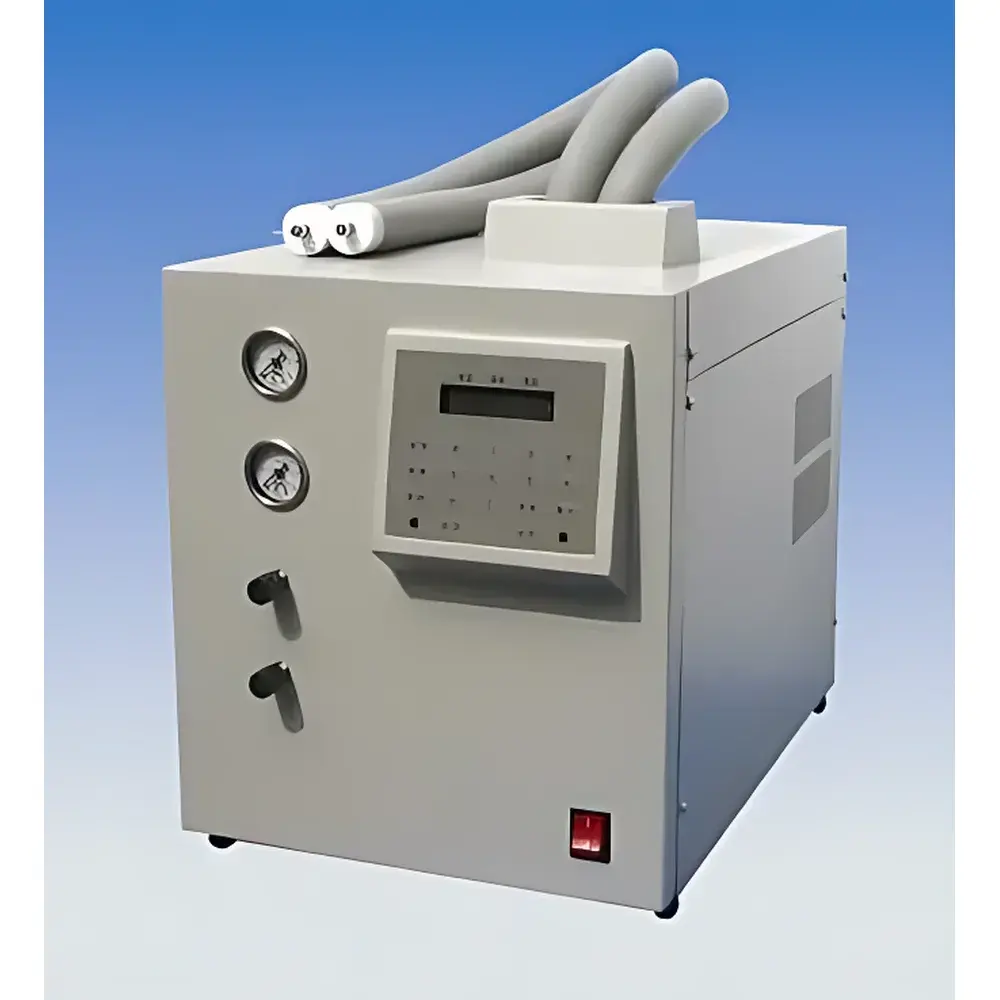
Zhenxinghui Li DK-3001A Static Headspace Sampler
| Brand | Zhenxinghui Li |
|---|---|
| Origin | Beijing, China |
| Manufacturer Type | Authorized Distributor |
| Instrument Type | Static Headspace Sampler |
| Model | DK-3001A |
| Sample Vial Capacity | 20 mL (optional 10 mL) |
| Heating Zone Temperature Range | 5 °C above ambient to 185 °C (1 °C increments) |
| Valve & Loop Temperature Range | 5 °C above ambient to 185 °C (1 °C increments) |
| Transfer Line Temperature Range | 5 °C above ambient to 185 °C (1 °C increments) |
| Quantitative Loop Volume | 1 mL (optional 0.5 mL or 3 mL) |
| Sample Position Capacity | 9 positions |
| GC Synchronization Interface | RS-232 / TTL-compatible digital trigger output |
| Safety Features | Overtemperature cutoff, thermal runaway protection |
Overview
The Zhenxinghui Li DK-3001A Static Headspace Sampler is a precision-engineered, semi-automatic sample introduction system designed for quantitative volatile organic compound (VOC) analysis via gas chromatography (GC). It operates on the static headspace principle: sealed sample vials are thermostatically equilibrated to allow analytes to partition between the liquid/solid matrix and the vapor phase above it; a fixed volume of this equilibrium headspace gas is then withdrawn and injected directly into the GC inlet. This method eliminates solvent interference, minimizes matrix effects, and provides high reproducibility for trace-level VOC quantification in complex matrices such as pharmaceuticals, environmental water, food extracts, and forensic samples. The DK-3001A builds upon its predecessor with an optimized circular heater block layout—reducing radial temperature gradients across all nine vial positions—and independently controllable heating zones for the valve, quantitative loop, and transfer line to prevent condensation and ensure consistent analyte transport.
Key Features
- Circular 9-position heated sample carousel with uniform thermal distribution—achieves <±0.5 °C inter-vial temperature deviation at 120 °C, enhancing inter-run precision.
- Three independently programmable heating zones: sample vial oven (5–185 °C), valve/loop assembly (5–185 °C), and transfer line (5–185 °C), each adjustable in 1 °C increments.
- Negative-pressure sampling mechanism using integrated diaphragm pump and solenoid valve—eliminates carrier gas dilution, preserves analyte concentration integrity, and improves detection sensitivity for low-volatility compounds.
- Replaceable stainless-steel injection needle with standardized conical tip (0.25 mm ID), compatible with Agilent, Thermo Fisher, Shimadzu, and PerkinElmer GC inlets without adapter modification.
- Integrated back-flush functionality for both sampling needle and valve flow path—prevents carryover between injections and supports extended unattended operation.
- Microprocessor-based control with LCD interface and membrane keypad; real-time temperature monitoring and error logging; automatic thermal shutdown on sensor fault or overtemperature event.
Sample Compatibility & Compliance
The DK-3001A accommodates standard 20 mL crimp-top headspace vials (with optional 10 mL support), compatible with industry-standard septa (e.g., PTFE/silicone, butyl rubber). It supports regulated workflows requiring auditability: instrument parameters—including setpoints, dwell times, and trigger events—are logged internally and exportable via serial interface. While not pre-certified to FDA 21 CFR Part 11, the system’s deterministic operation, parameter locking capability (via password-protected mode), and traceable RSD validation data (supplied with each unit, including chromatograms and raw peak area tables) enable straightforward qualification under GLP and GMP environments. Method development aligns with ASTM D7622 (standard test method for VOCs in water by static headspace GC), ISO 15681-2, and USP residual solvents guidelines.
Software & Data Management
The DK-3001A features a hardware-level GC synchronization interface supporting TTL-level trigger output and RS-232 communication for bidirectional handshake with chromatography data systems (CDS) such as OpenLab CDS, Chromeleon, or Empower. It transmits acquisition start commands and receives acknowledgment pulses to ensure precise timing alignment between headspace equilibration completion and GC injection. All temperature profiles, sequence logs, and system status flags are timestamped and stored in non-volatile memory. Export formats include CSV and plain-text diagnostic reports, suitable for integration into LIMS or electronic lab notebooks (ELN). No proprietary software installation is required—configuration is performed locally via front-panel interface.
Applications
- Pharmaceutical quality control: residual solvent testing per ICH Q3C in active pharmaceutical ingredients (APIs) and excipients.
- Environmental analysis: BTEX (benzene, toluene, ethylbenzene, xylenes), chlorinated hydrocarbons, and trihalomethanes in drinking water and wastewater.
- Food and beverage safety: ethanol quantification in non-alcoholic beverages, flavor volatiles profiling in dairy and fruit products.
- Forensic toxicology: blood alcohol concentration (BAC) determination using headspace-GC-FID.
- Materials science: outgassing analysis of polymers, adhesives, and packaging films under controlled thermal stress.
FAQ
What vial sizes does the DK-3001A support?
Standard 20 mL headspace vials are used; 10 mL vials are supported with optional spacer inserts.
Is the quantitative loop volume user-adjustable?
The default loop is 1 mL; 0.5 mL and 3 mL alternatives are available as factory-installed options—not field-replaceable.
Does the system meet regulatory requirements for pharmaceutical testing?
It provides the thermal stability, repeatability (RSD ≤ 1.5%), and documentation traceability required for USP and ICH Q3C compliance when validated per laboratory SOPs.
Can the DK-3001A be integrated with third-party GC data systems?
Yes—via RS-232 serial protocol and hardware TTL trigger; full command syntax and timing diagrams are provided in the technical manual.
How is carryover mitigated during high-concentration sample analysis?
The integrated back-flush circuit purges the needle and valve internal passages with carrier gas post-injection, verified by blank run testing per ASTM D7622 Section 9.3.





