
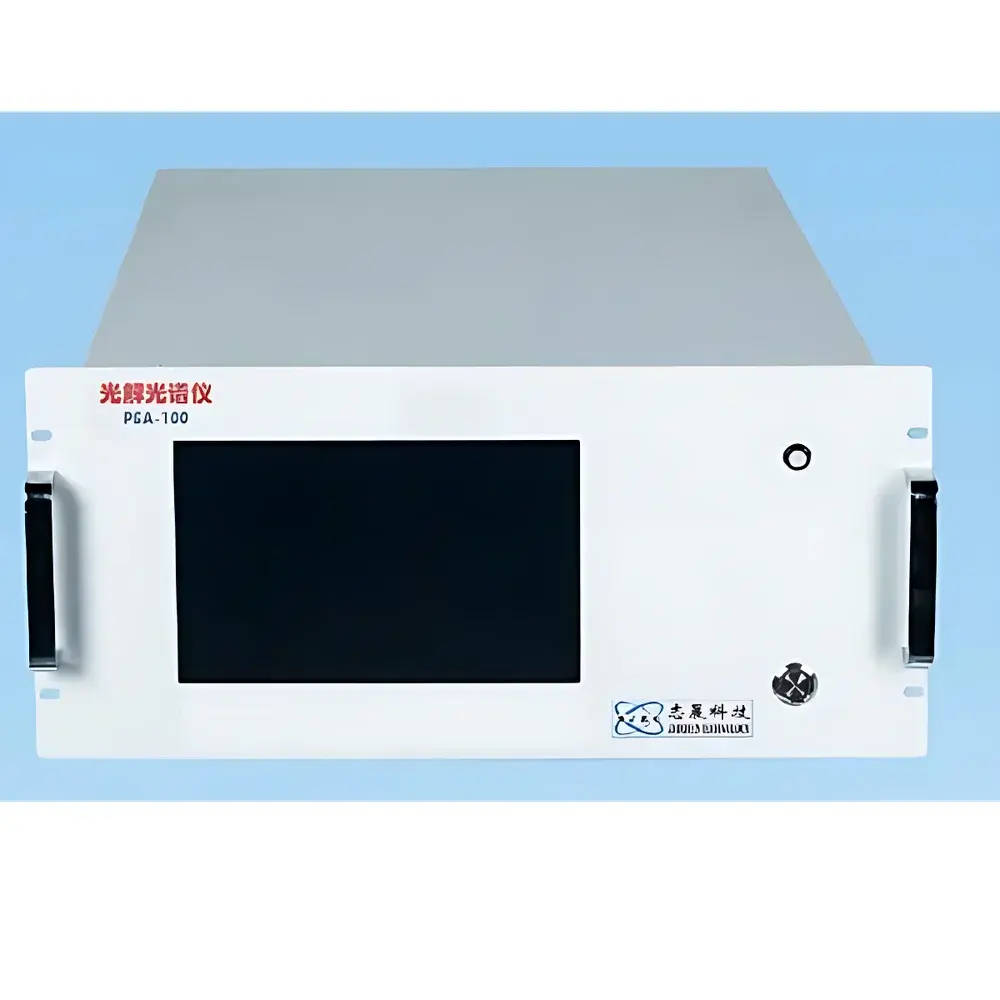
Zhichen Tech PAS-100 Online Photolysis Rate Analyzer
| Brand | Zhichen Tech |
|---|---|
| Origin | Beijing, China |
| Model | PAS-100 |
| Detection Principle | Broadband Solar Spectral Irradiance-Based Photolysis Frequency (j-value) Calculation |
| Measured Species | NO₂, HONO, HNO₃, HCHO, H₂O₂ (expandable) |
| Optical Collector | Spectralon® diffuser probe (2π sr hemispherical field-of-view) |
| Spectral Range | 280–450 nm |
| Spectral Resolution | ≤0.5 nm (FWHM) |
| Data Output | j(NO₂), j(HONO), j(HNO₃), j(HCHO), j(H₂O₂) in s⁻¹ |
| Integration Time | Adjustable from 10 ms to 10 s |
| Detector | Linear CCD array with thermoelectric cooling |
| Interface | Fiber-optic coupling (600 µm core, UV-enhanced) |
| Environmental Rating | IP65 enclosure |
| Operating Temperature | −20 °C to +50 °C |
| Power Supply | 24 V DC / 50 W max |
| Compliance | ASTM D7930–22 (Standard Practice for Measurement of Photolysis Frequencies), ISO 17025-accredited calibration traceable to NIST SRM 2243 |
Overview
The Zhichen Tech PAS-100 Online Photolysis Rate Analyzer is a field-deployable, spectroscopic instrument engineered for continuous, real-time quantification of photolysis frequency (j-value) for key atmospheric photochemical precursors. It operates on the fundamental principle of actinometric spectral irradiance measurement: by capturing total hemispherical solar ultraviolet–visible (UV–Vis) irradiance (280–450 nm) using a calibrated Spectralon® integrating sphere probe, the system delivers high-fidelity spectral radiance data to a thermally stabilized UV-optimized spectrometer. Embedded algorithms—based on published quantum yield cross-sections and solar zenith angle-corrected spectral weighting functions—compute species-specific photolysis rates (e.g., j(NO₂), j(HONO)) in units of s⁻¹ with sub-second temporal resolution. Unlike filter-based or broadband radiometer approaches, the PAS-100 provides wavelength-resolved irradiance, enabling rigorous validation against radiative transfer models (e.g., TUV, libRadtran) and supporting uncertainty propagation per ISO/IEC 17025 guidelines. Its design targets long-term unattended operation in ambient monitoring networks, superseding manual filter-change protocols and offline chemical actinometry.
Key Features
- High-fidelity spectral acquisition: Linear CCD array detector with thermoelectric cooling (−10 °C stabilization), minimizing dark current drift and ensuring <0.5% RMS noise over 24 h.
- Optimized optical train: UV-grade fused silica fiber (600 µm core, solarization-resistant coating) coupled to a Czerny–Turner spectrometer with holographic grating (2400 g/mm), delivering ≤0.5 nm FWHM resolution across 280–450 nm.
- Robust field architecture: IP65-rated aluminum enclosure with passive thermal management; operational range extends from −20 °C to +50 °C without active heating/cooling.
- Adaptive integration control: Software-configurable integration time (10 ms – 10 s) prevents detector saturation under variable solar conditions (e.g., cloud break, snow albedo).
- Traceable calibration: Factory calibration performed against NIST-traceable standard lamps (SRM 2243), with documented uncertainty budgets compliant with ISO/IEC 17025 requirements.
- Integrated data handling: Onboard SD card logging (72 h buffer) and Ethernet/RS-485 interfaces support seamless integration into SCADA or EPA-compliant air quality data systems.
Sample Compatibility & Compliance
The PAS-100 is designed exclusively for ambient outdoor atmospheric measurement. It requires no consumables, reagents, or sample extraction—its measurement is non-invasive and based solely on incident solar radiation. The instrument complies with ASTM D7930–22 (Standard Practice for Measurement of Photolysis Frequencies in Ambient Air) and supports data reporting formats aligned with EEA Air Quality Directive (2008/50/EC) Annex IX requirements. All firmware and data processing algorithms are version-controlled and auditable, facilitating GLP/GMP-aligned deployment in regulatory monitoring stations. Calibration certificates include full uncertainty analysis per GUM (JCGM 100:2008) and are updated annually or after transport-induced shock events.
Software & Data Management
The PAS-100 ships with Zhichen’s proprietary Photolysis Analysis Suite (v4.2+), a Windows-based application certified for FDA 21 CFR Part 11 compliance (electronic signatures, audit trail, role-based access). The software performs real-time j-value computation using peer-reviewed photochemical parameterizations (e.g., JPL 2022 evaluation), applies Langley extrapolation for extraterrestrial calibration correction, and exports netCDF-4 files containing raw spectra, derived j-values, solar geometry metadata (SZA, azimuth), and instrument health diagnostics. Data integrity is enforced via SHA-256 checksums; all user actions—including integration time changes or calibration reloads—are timestamped and immutable in the audit log. Remote firmware updates and spectral diagnostic reports can be scheduled via secure HTTPS API.
Applications
- Urban and regional air quality networks: Quantifying radical initiation pathways (OH production via j(HONO), j(O³→O(¹D)+O₂), j(HCHO)) to constrain photochemical box models.
- Haze and secondary aerosol formation studies: Correlating j-value diurnal cycles with PM₂.₅ composition (e.g., nitrate, sulfate) and VOC oxidation products measured in parallel.
- Model–measurement intercomparison: Providing observational constraints for CTMs (e.g., CMAQ, GEOS-Chem) and satellite validation (e.g., TROPOMI j(NO₂) product).
- Long-term trend analysis: Supporting multi-year photolysis climatology development under evolving aerosol loading and ozone column conditions.
- Field campaign instrumentation: Deployable on mobile labs, towers, or rooftop sites with minimal power and footprint requirements (45 × 35 × 22 cm, 12.5 kg).
FAQ
What photolysis frequencies does the PAS-100 directly compute?
The standard configuration computes j(NO₂), j(HONO), j(HNO₃), j(HCHO), and j(H₂O₂) using built-in quantum yield and absorption cross-section databases. Additional species (e.g., O₃, ClNO₂, BrONO₂) can be enabled via software license upgrade.
Is the instrument suitable for high-altitude or polar deployments?
Yes—the thermal design and low-power electronics have been validated at simulated altitudes up to 4,500 m and ambient temperatures down to −20 °C. Optional desiccant purge ports mitigate condensation risk in high-humidity or freeze–thaw environments.
How is calibration maintained during extended unattended operation?
The system includes automated dark-current correction and optional Langley regression capability using clear-sky periods. Annual recalibration against NIST-traceable standards is recommended; field verification kits (calibrated neutral density filters) are available as accessories.
Can PAS-100 data be integrated with existing air quality data platforms?
Yes—native support for EPA AQS, EU AirBase, and custom MQTT/OPC UA protocols is provided. JSON and netCDF-4 export modules comply with FAIR data principles (Findable, Accessible, Interoperable, Reusable).
Related Products







