
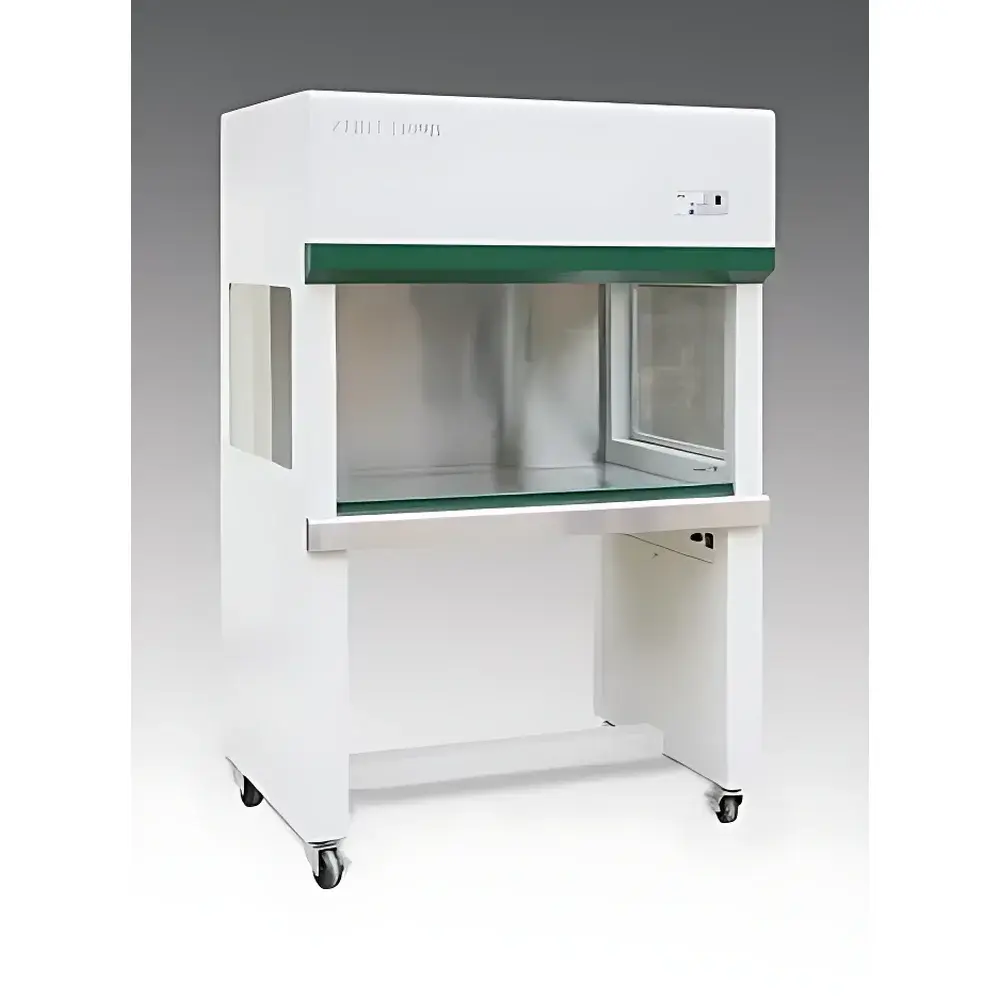
Zhicheng ZHJH-C1109B Premium Vertical Laminar Flow Clean Bench
| Brand | Zhicheng |
|---|---|
| Origin | Shanghai, China |
| Manufacturer Type | Direct Manufacturer |
| Product Category | Domestic |
| Model | ZHJH-C1109B |
| Pricing | Available Upon Request |
| Airflow Pattern | Vertical Laminar Flow |
| Work Surface | Single-sided |
| Filtration Efficiency | ≥99.995% @ 0.3 µm (HEPA H14) |
| Cleanliness Class | ISO Class 5 (US FED STD 209E Class 100) |
| Microbial Recovery | ≤0.5 CFU/plate (90 mm Petri dish) |
| Adjustable Air Velocity | 0.3–0.6 m/s (7-step LED digital control) |
| Noise Level | ≤62 dB(A) |
| Vibration Peak-to-Peak | ≤6 µm |
| Illuminance | ≥300 lx |
| Pre-filter Initial Resistance | ≤120 Pa (at max airflow) |
| Working Area Dimensions (W×D×H) | 900 × 625 × 645 mm |
| Overall Dimensions (W×D×H) | 1020 × 740 × 1700 mm |
| Net Weight | 153 kg |
| Power Consumption | 380 W |
| Electrical Supply | AC 220 V, 50/60 Hz |
| Construction | Electrophoretically coated steel frame with stainless steel work surface |
| Mobility | Four swiveling casters with locking brakes |
Overview
The Zhicheng ZHJH-C1109B Premium Vertical Laminar Flow Clean Bench is an ISO Class 5-certified unidirectional airflow workstation engineered for critical aseptic operations in research and production environments. It employs a vertically downward laminar air stream—generated by a high-efficiency centrifugal blower and conditioned through a two-stage filtration system—to maintain a particle-free microenvironment within the working area. Air enters the unit via a washable pre-filter (G4 grade), is pressurized into the plenum chamber, then passes through an H14-class HEPA filter (≥99.995% efficiency at 0.3 µm), delivering uniform, low-turbulence airflow across the entire 900 mm wide work surface. This architecture complies with fundamental cleanroom engineering principles defined in ISO 14644-1 and aligns with operational requirements for sterility assurance under GLP and GMP-aligned workflows.
Key Features
- Vertical laminar airflow design optimized for operator protection and sample integrity—minimizing cross-contamination risk during open handling of sensitive biological or pharmaceutical materials.
- Seven-step digitally controlled air velocity adjustment (0.3–0.6 m/s), displayed in real time via integrated LED interface for precise process repeatability.
- Self-balancing vertical sash window with frictionless counterweight mechanism—enabling stable positioning at any height between 100 mm and 450 mm above the work surface.
- Dual-side transparent acrylic viewing panels (thickness ≥8 mm) providing wide-angle visibility and enhanced ambient light transmission without compromising structural integrity.
- Electropolished 304 stainless steel work surface (900 × 625 mm) resistant to corrosion, thermal shock, and common disinfectants—including 70% ethanol, sodium hypochlorite, and hydrogen peroxide vapor.
- Dedicated UV-C germicidal lamp (254 nm, ≥15 W) with independent interlock switch and automatic cutoff when sash is raised above safety threshold.
- Integrated dual-lighting system: 300+ lux cool-white fluorescent illumination (IEC 60598-compliant) for visual task clarity and ergonomic workflow continuity.
- Robust electrostatically coated steel enclosure with aerodynamic curvature—designed for long-term durability, ease of decontamination, and compatibility with laboratory facility integration standards.
Sample Compatibility & Compliance
The ZHJH-C1109B supports a broad range of sterile manipulation protocols involving cell culture, microbial isolation, PCR setup, media preparation, and aseptic filling of vials or syringes. Its ISO Class 5 performance is validated per ISO 14644-3:2019 Annex B (particle counting methodology) and verified using calibrated condensation particle counters (CPCs) and isokinetic sampling probes. The unit meets applicable sections of NSF/ANSI 49 (for non-recirculating Class I and II biosafety cabinets), though it is classified as a clean bench—not a biosafety cabinet—and therefore does not provide personnel or environmental protection against biohazards. All electrical components conform to IEC 61010-1 safety standards; UV lamp operation complies with IEC 62471 photobiological safety classification (Risk Group 2). Documentation includes factory calibration certificates for airflow velocity and illuminance, traceable to national metrology institutes.
Software & Data Management
This model operates via embedded hardware-based logic with no external software dependency. All operational parameters—including fan speed setting, UV exposure duration (pre-set timer), and lighting status—are managed through a sealed membrane keypad with tactile feedback. An audit trail is maintained internally for UV activation cycles and sash position events (logged via non-volatile memory), supporting basic GLP documentation requirements. While not FDA 21 CFR Part 11 compliant out-of-the-box, the unit’s deterministic behavior, mechanical interlocks, and physical logbook-ready design facilitate integration into validated systems where electronic records are generated externally (e.g., via LIMS or ELN platforms).
Applications
The ZHJH-C1109B serves as a foundational platform for contamination-sensitive tasks across regulated and academic settings. Typical use cases include: aseptic transfer of mammalian or insect cell lines in bioprocessing labs; inoculation of clinical microbiology specimens under CLIA-certified conditions; preparation of sterile ophthalmic solutions in compounding pharmacies; environmental monitoring media plating in ISO 17025-accredited labs; and assembly of high-reliability electronic components requiring particulate-controlled handling. Its dimensional stability, acoustic performance (<62 dB[A]), and vibration control (≤3 µm half-amplitude) make it suitable for proximity to sensitive instrumentation such as microbalances or optical microscopes.
FAQ
Is this unit certified as a biosafety cabinet?
No. The ZHJH-C1109B is a vertical laminar flow clean bench—not a biosafety cabinet. It provides product protection only and must not be used for work involving infectious agents, toxins, or volatile chemicals.
What HEPA filter standard does it meet?
It uses an H14-rated HEPA filter per EN 1822-1:2019, tested and certified for ≥99.995% particle removal efficiency at the Most Penetrating Particle Size (MPPS) of 0.3 µm.
Can the UV lamp be operated while the sash is open?
No. A mechanical interlock automatically disables UV output when the sash rises above 100 mm to prevent operator exposure to germicidal radiation.
Does it require annual recertification?
Yes. Per ISO 14644-3 and institutional biosafety policies, annual performance verification—including airflow uniformity, velocity mapping, particle count testing, and UV intensity measurement—is recommended and often mandated for continued use in regulated environments.
What maintenance intervals are advised?
Pre-filters should be cleaned every 2–4 weeks depending on ambient dust load; HEPA filters typically require replacement every 3–5 years under normal lab conditions, subject to differential pressure monitoring and integrity testing.



