
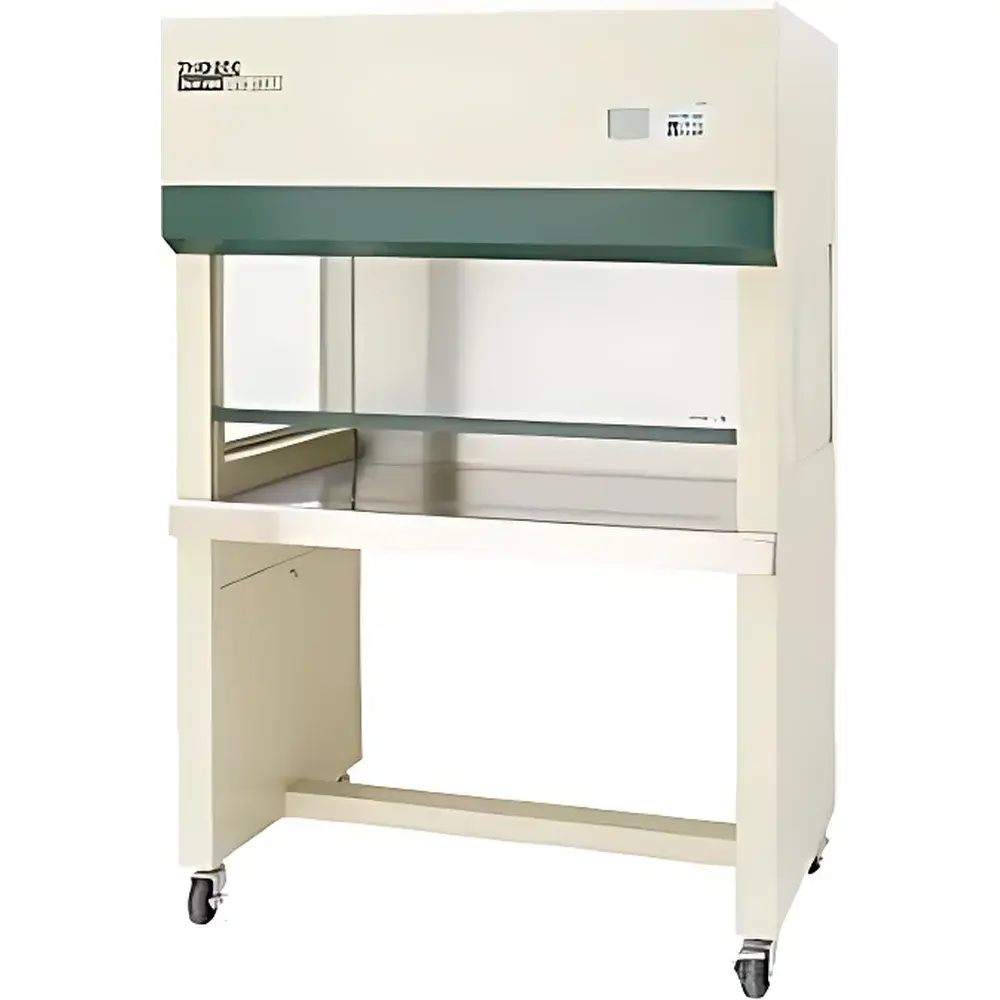
Zhicheng ZHJH-C1109C Intelligent Safety Vertical Laminar Flow Clean Bench with HEPA Failure Alarm
| Brand | Zhicheng |
|---|---|
| Origin | Shanghai, China |
| Manufacturer Type | Direct Manufacturer |
| Instrument Category | Vertical Laminar Flow Clean Bench |
| Cleanliness Class | ISO Class 5 (100 @ ≥0.5 µm, per Fed. Std. 209E) |
| Noise Level | ≤62 dB(A) |
| User Capacity | Single-user, front-facing operation |
| Airflow Pattern | Vertical downward laminar flow |
| Work Area Dimensions | 900 × 625 × 645 mm (W × D × H) |
| Overall Dimensions | 1020 × 740 × 1700 mm (W × D × H) |
| Net Weight | 153 kg |
| Power Supply | AC 220 V, 50/60 Hz |
| Rated Power | 380 W |
| Illumination | ≥300 lx |
| Vibration Peak-to-Peak | ≤3 µm |
| Adjustable Air Velocity Range | 0.1–1.0 m/s (settable), Operational Range: 0.3–0.6 m/s |
| Velocity Control Accuracy | ±0.05 m/s |
| Velocity Resolution | 0.1 m/s |
| HEPA Differential Pressure Range | 0–500 Pa |
| Pressure Display Accuracy | ±1% FS |
| Initial Resistance | ≤120 Pa (at max airflow) |
Overview
The Zhicheng ZHJH-C1109C Intelligent Safety Vertical Laminar Flow Clean Bench is an ISO Class 5-certified (100-level per Fed. Std. 209E) containment workstation engineered for precision microbiological handling, aseptic processing, and low-risk cell culture operations. It employs a vertical downward laminar airflow system—driven by a high-static-pressure, low-noise centrifugal blower—to deliver uniform, particle-free air across the work surface at a user-defined velocity (0.3–0.6 m/s). Unlike conventional clean benches, the ZHJH-C1109C integrates real-time HEPA filter health monitoring as a core safety architecture: continuous differential pressure sensing, automatic integrity verification, and multi-stage failure detection (pre-failure warning, operational failure alarm, and physical breach alert) are embedded into its control logic. This design addresses critical gaps in legacy laminar flow systems—particularly unmonitored filter degradation—and aligns with GLP-compliant laboratory practices where documented air quality assurance is mandatory.
Key Features
- Real-time HEPA status monitoring with three-tiered alerting: visual (LCD icon + full Chinese text), audible (programmable tone), and luminous (LED indicator) signals for pre-failure condition, functional failure, and physical damage
- True constant-velocity airflow control: digitally regulated blower output maintains setpoint velocity within ±0.05 m/s accuracy, independent of filter loading or ambient pressure fluctuations
- 10.1-inch backlit LCD interface displaying live metrics: actual airflow velocity, HEPA differential pressure (0–500 Pa), cumulative runtime, UV lamp operating hours, and filter resistance trend
- Programmable UV sterilization cycle: start time, duration, and auto-shutdown configurable via touch panel; interlocked with sash position to prevent accidental exposure
- Ergonomic dual-layer sliding tempered glass sash: self-balancing counterweight mechanism enables smooth, frictionless positioning at any height; side-view transparent panels enhance peripheral visibility and lighting uniformity
- Stainless steel 304 work surface with radius-rounded internal corners (R ≥ 3 mm) and seamless welds to eliminate microbial harborage zones and support validated cleaning protocols
- Integrated pre-filter + certified HEPA (≥99.995% @ 0.3 µm) filtration system with ≤120 Pa initial resistance at rated airflow
- Low-vibration mechanical design: peak-to-peak vibration amplitude ≤3 µm ensures compatibility with sensitive optical assays and micro-manipulation tasks
Sample Compatibility & Compliance
The ZHJH-C1109C is suitable for non-hazardous biological agents (BSL-1 and select BSL-2 applications under institutional biosafety approval), sterile media preparation, pharmaceutical component assembly, and environmental sample handling. It meets ISO 14644-1 Class 5 airborne particulate limits (≤3,520 particles/m³ ≥0.5 µm) and demonstrates ≤0.5 CFU/plate (90 mm Petri dish, 30-min settle plate test) in accordance with ISO 14698-1. While not a biological safety cabinet (BSC), its vertical laminar flow configuration provides directional protection for samples—not operators—and complies with relevant sections of ASTM E2500 (good practice for equipment qualification) and EU GMP Annex 1 (for Grade A environments when used as a local protection device within controlled rooms). All electrical components conform to IEC 61010-1 safety standards.
Software & Data Management
The embedded firmware supports audit-ready data logging: timestamped records of all parameter changes, alarm events (type, duration, acknowledgment), UV cycle logs, and cumulative runtime are stored internally for ≥12 months. Export is supported via USB port (CSV format); no cloud connectivity or remote access is implemented, preserving data sovereignty and simplifying 21 CFR Part 11 compliance for on-premise validation. The system includes electronic signature-capable operator login (PIN-based), session timeout (configurable 1–30 min), and immutable event history—features aligned with GLP/GMP documentation requirements. No proprietary software installation is required for basic operation or data retrieval.
Applications
- Aseptic transfer of microbial cultures, plant tissue explants, and primary mammalian cells
- Preparation of sterile culture media, reagents, and dilution blanks in QC/QA laboratories
- Assembly of diagnostic assay kits and sterile packaging of medical devices
- Environmental monitoring sample processing (air, water, surface swabs) prior to microbial enumeration
- Electronics manufacturing: handling of dust-sensitive components under particle-controlled conditions
- Academic teaching labs requiring robust, serviceable laminar flow infrastructure with built-in maintenance diagnostics
FAQ
Does this unit qualify as a biological safety cabinet (BSC)?
No. The ZHJH-C1109C is a Class I vertical laminar flow clean bench—designed to protect samples from environmental contamination only. It does not provide personnel or environmental protection against biohazards and must not be used for work involving infectious agents without supplemental engineering controls.
Can the HEPA filter be replaced in-house?
Yes. Filter replacement requires standard tools and follows a documented procedure included in the manual. The system automatically recalibrates baseline pressure after installation and prompts user confirmation of post-replacement integrity check.
Is the UV lamp intensity monitored?
The system monitors UV lamp operational hours and enforces scheduled replacement intervals (typically 1,000–1,500 h), but does not include radiometric intensity sensing. Users should verify irradiance annually using a calibrated UV-C meter per ISO/IEC 17025 guidelines.
What validation documentation is supplied?
Factory-issued IQ/OQ protocols, filter certification (test report per EN 1822), airflow uniformity mapping data, and electrical safety test records are provided. Site-specific PQ must be performed by the end user in accordance with ISO 14644-3.
Is the unit compatible with external building management systems (BMS)?
No analog or digital BMS interface (e.g., Modbus, BACnet) is integrated. Status and alarms are local-only; integration requires third-party hardware gateways and custom scripting.



