
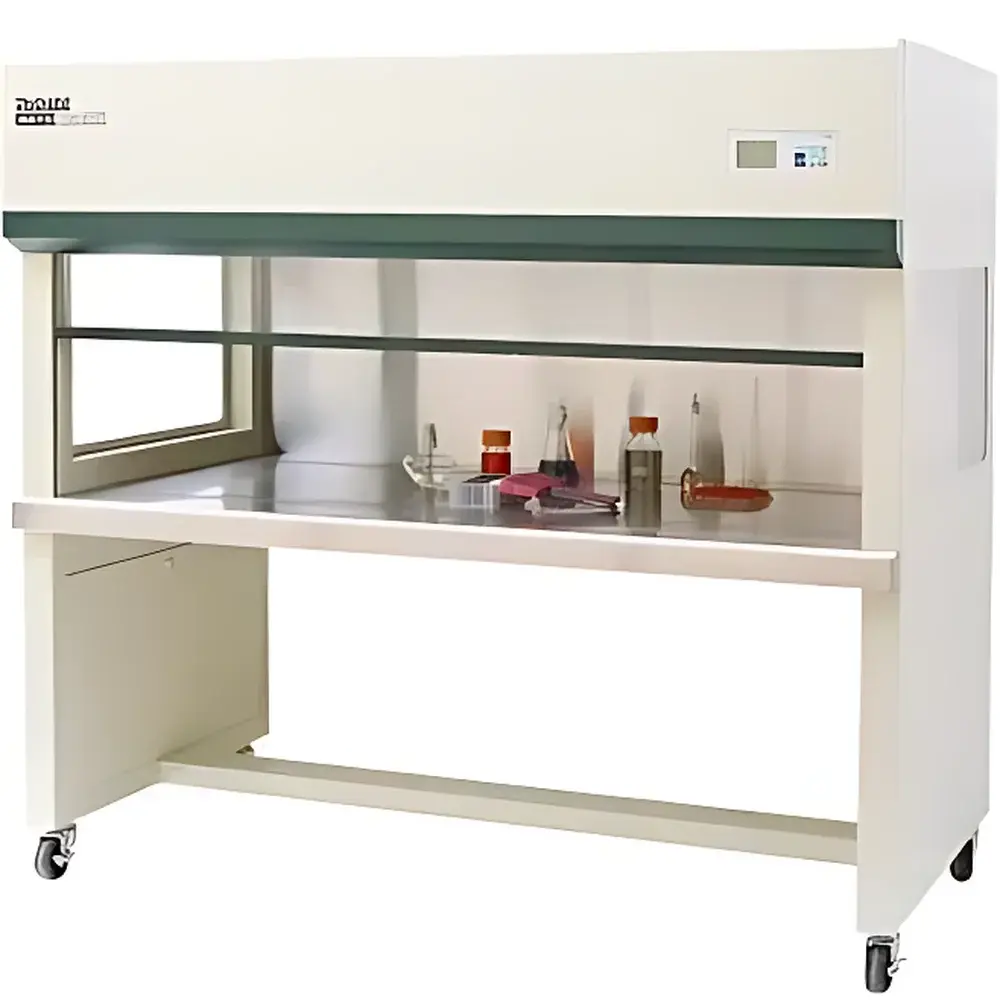
Zhicheng ZHJH-C1115B Vertical Laminar Flow Clean Bench
| Brand | Zhicheng |
|---|---|
| Origin | Shanghai, China |
| Manufacturer Type | Direct Manufacturer |
| Product Category | Domestic |
| Model | ZHJH-C1115B |
| Pricing | Upon Request |
| Airflow Pattern | Vertical Laminar Flow |
| Work Surface | Single-sided |
| Filtration Efficiency | ISO Class 5 (equivalent to Federal Standard 209E Class 100 @ ≥0.5 µm) |
| Microbial Contamination | ≤0.5 CFU/plate (90 mm Petri dish) |
| Adjustable Air Velocity Range | 0.3–0.6 m/s (7-step LED digital control) |
| Noise Level | ≤62 dB(A) |
| Vibration Peak-to-Peak Amplitude | ≤8 µm |
| Illumination | ≥300 lx |
| Pre-filter Initial Resistance | ≤120 Pa (at maximum airflow) |
| Working Area Dimensions (W×D×H) | 1500 × 625 × 645 mm |
| Overall Dimensions (W×D×H) | 1620 × 740 × 1700 mm |
| Net Weight | 250 kg |
| Power Consumption | 680 W |
| Electrical Supply | AC 220 V, 50/60 Hz |
| Construction Materials | Electrophoretically coated steel cabinet, 304 stainless steel work surface, dual-side tempered glass viewing windows |
| Safety Features | Self-balancing vertical sliding sash, UV germicidal lamp with interlock, touch-activated control panel |
Overview
The Zhicheng ZHJH-C1115B Vertical Laminar Flow Clean Bench is an ISO Class 5-certified (Federal Standard 209E Class 100) laboratory containment system engineered for personnel-protective, product-protective, and environment-protective operations in non-hazardous applications. It employs unidirectional vertical laminar airflow—generated by a high-efficiency centrifugal blower and conditioned through a two-stage filtration system—to deliver particle-free air across the entire working area. Ambient air first passes through a washable pre-filter (G4 grade), then through a certified HEPA filter (≥99.995% efficiency at 0.3 µm), ensuring consistent delivery of clean air at velocities between 0.3 and 0.6 m/s. Designed for stability, ergonomics, and long-term operational integrity, the unit complies with IEST-RP-CC002.3 (Testing Protocol for Laminar Flow Clean Benches) and supports adherence to GLP and GMP documentation requirements in regulated environments.
Key Features
- Vertical laminar airflow architecture with digitally controlled, seven-step variable velocity regulation (0.3–0.6 m/s), displayed via integrated LED interface
- Self-balancing vertical sliding sash mechanism enabling precise, tool-free positioning at any height without drift or rebound
- Dual-side tempered glass side panels offering wide-angle visibility, enhanced natural lighting integration, and ergonomic operator access
- Electrostatically coated steel enclosure with corrosion-resistant finish and seamless internal geometry for simplified decontamination
- 304 stainless steel work surface — non-porous, chemically inert, and compatible with common laboratory disinfectants including 70% ethanol and sodium hypochlorite solutions
- Integrated dual-lighting system: 300+ lux daylight-balanced fluorescent illumination for visual clarity and a 254 nm UV-C germicidal lamp with safety interlock (automatically disabled when sash is raised above threshold)
- Low-vibration, high-static-pressure centrifugal fan delivering stable airflow under varying filter loading conditions
- Four swivel casters with locking brakes enabling flexible repositioning within laboratory layouts while maintaining structural rigidity during operation
Sample Compatibility & Compliance
The ZHJH-C1115B is validated for use with microbiological cultures, sterile tissue handling, pharmaceutical aseptic filling preparations, and precision instrumentation assembly where particulate contamination must be minimized. Its ISO Class 5 performance has been verified per ISO 14644-1:2015 Annex B and ASTM F2102-21 (Standard Practice for Testing Laminar Flow Clean Benches). The unit meets electrical safety standards IEC 61010-1 and EMC compliance per EN 61326-1. While not classified as a biosafety cabinet (BSC), its design conforms to NSF/ANSI 49 Annex D guidance for non-recirculating clean benches used in low-risk biological applications. All materials—including gaskets, wiring insulation, and internal coatings—are RoHS-compliant and UL-listed where applicable.
Software & Data Management
This model operates via a microprocessor-based control system with no embedded software or network connectivity. All operational parameters—including real-time air velocity, UV exposure duration, and sash position status—are monitored locally via LED indicators and tactile feedback. For laboratories requiring audit trails or electronic records, optional external data loggers can be interfaced via analog voltage output (0–5 V DC) corresponding to fan speed setting. The control logic supports 21 CFR Part 11–compliant validation protocols when integrated into broader laboratory information management systems (LIMS) using third-party hardware interfaces. Calibration certificates for airflow velocity and illumination intensity are provided upon installation and may be renewed annually per ISO/IEC 17025-accredited service providers.
Applications
The ZHJH-C1115B serves critical roles in academic research laboratories, biopharmaceutical QC/QA labs, clinical diagnostics facilities, and semiconductor manufacturing support areas. Typical use cases include: aseptic transfer of cell lines and primary tissues; preparation of media and reagents for microbial assays; handling of sensitive optical components; calibration of reference standards under particle-controlled conditions; and environmental sampling kit assembly for field deployment. Its 1500 mm work width accommodates multi-position pipetting stations, orbital shakers, and benchtop centrifuges without compromising laminar integrity. The unit is frequently deployed alongside Class II BSCs in hybrid workflows where product protection is prioritized over personnel protection.
FAQ
What is the recommended maintenance schedule for the HEPA filter?
HEPA filters should be integrity-tested semiannually using a photometer-based scan test per ISO 14644-3. Replacement is typically required every 12–24 months depending on ambient particulate load and usage frequency.
Can this clean bench be installed in a room with ceiling-mounted HVAC supply diffusers?
Yes—provided that the local supply air velocity does not exceed 0.15 m/s directly above the unit’s intake plenum and that cross-drafts are mitigated via physical barriers or strategic placement relative to return grilles.
Is UV lamp irradiance calibrated and traceable to NIST standards?
UV lamp output is verified at time of manufacture using a calibrated radiometer; full spectral traceability requires third-party verification per ISO/IEC 17025, which can be arranged separately.
Does the unit comply with EU CE marking requirements?
CE marking applies only to devices falling under the EU Machinery Directive or EMC Directive; as a Class I electrical appliance without programmable logic, it carries a Declaration of Conformity referencing EN 61010-1 and EN 61326-1.
What documentation is supplied with the unit for regulatory audits?
Each shipment includes a Factory Acceptance Test (FAT) report, filter certification (including DOP/NaCl penetration data), electrical safety test record, and dimensional verification sheet—all signed and dated by quality assurance personnel.



