
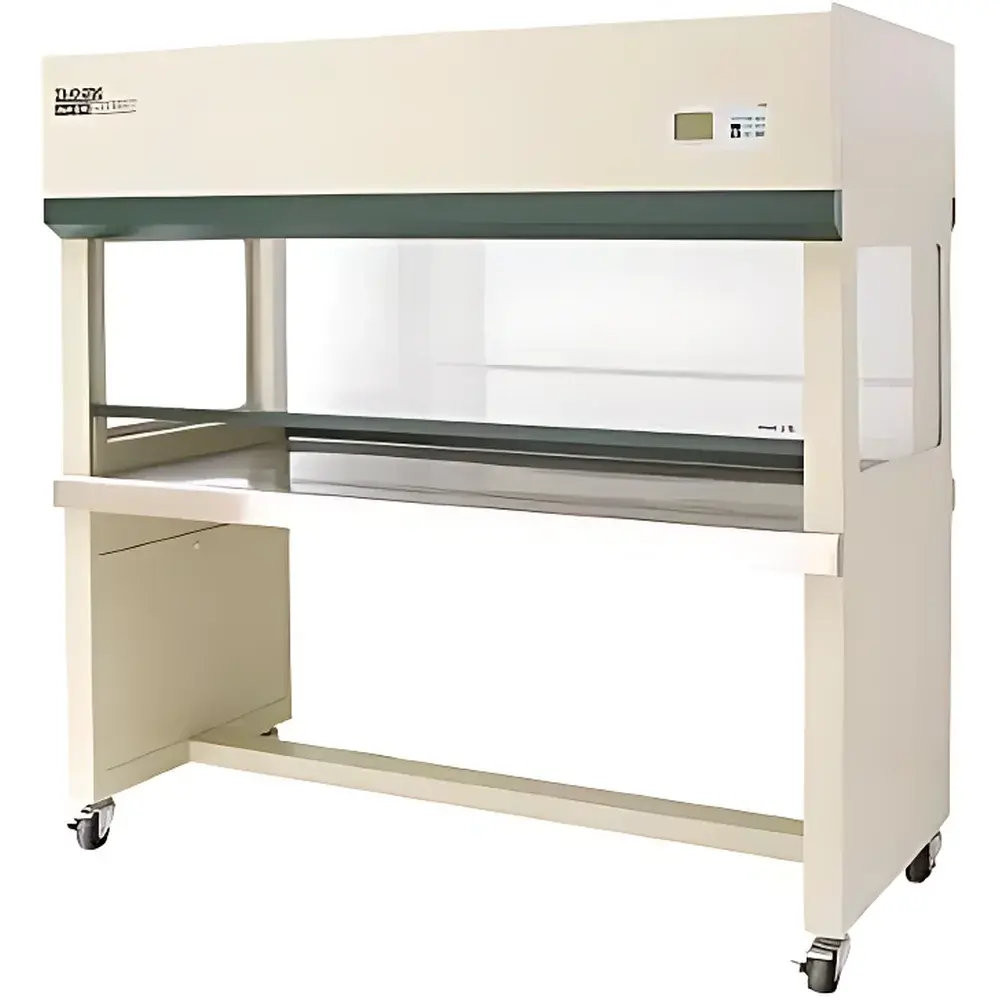
Zhicheng ZHJH-C1214B Premium Vertical Laminar Flow Clean Bench
| Brand | Zhicheng |
|---|---|
| Origin | Shanghai, China |
| Manufacturer Type | Direct Manufacturer |
| Product Category | Domestic |
| Model | ZHJH-C1214B |
| Pricing | Upon Request |
| Airflow Pattern | Vertical Laminar Flow |
| Work Surface Count | Dual |
| Filtration Standard | ISO 14644-1 Class 5 (equivalent to US FED-STD-209E Class 100) |
| Particle Removal Efficiency | ≥99.999% @ 0.3 µm |
| Pre-filter | Synthetic Fiber Panel Filter |
| HEPA Filter | H14 (EN 1822) |
| Adjustable Air Velocity Range | 0.3–0.6 m/s (7-step LED digital control) |
| Noise Level | ≤62 dB(A) |
| Vibration Amplitude (Half-Peak) | ≤3 µm |
| Illumination | ≥300 lx (LED daylight lamp) |
| UV Germicidal Lamp | 2 × 15 W, 253.7 nm |
| Operating Area Dimensions (W×D×H) | 1400 × 650 × 645 mm |
| Overall Dimensions (W×D×H) | 1520 × 790 × 1700 mm |
| Net Weight | 225 kg |
| Power Consumption | 680 W |
| Electrical Supply | AC 220 V, 50/60 Hz |
| Construction Materials | Electrophoretically coated steel frame, 304 stainless steel work surface, tempered glass side and front windows |
| Mobility | Four swivel casters with locking brakes |
| Compliance | Meets ISO 14644-1, GB/T 16292–2010, YY 0569–2011, and supports GLP/GMP environmental control documentation requirements |
Overview
The Zhicheng ZHJH-C1214B Premium Vertical Laminar Flow Clean Bench is an engineered solution for maintaining ISO 14644-1 Class 5 (formerly US FED-STD-209E Class 100) air cleanliness in critical laboratory operations. It operates on the principle of unidirectional vertical laminar airflow: ambient air is drawn through a synthetic fiber pre-filter to capture coarse particulates, then pressurized into a plenum chamber before passing through an EN 1822-certified H14 HEPA filter. This ensures ≥99.999% removal efficiency for particles ≥0.3 µm. The filtered air descends uniformly at a precisely controllable velocity (0.3–0.6 m/s) across the dual-worksurface zone, forming a sterile barrier that protects both samples and personnel from cross-contamination. Designed for sustained operational integrity, the unit integrates structural rigidity, acoustic dampening, and thermal stability—essential attributes for environments requiring reproducible aseptic technique under routine or extended use.
Key Features
- Dual independent work surfaces (1400 mm total width), each fully enclosed within the laminar flow field and supported by seamless 304 stainless steel—corrosion-resistant, non-porous, and compatible with alcohol-, bleach-, and hydrogen peroxide-based decontamination protocols.
- Seven-step digitally controlled air velocity regulation via LED display and touch-sensitive interface, enabling precise adaptation to procedural requirements (e.g., low-velocity settings for delicate cell handling; higher velocities for rapid particle sweep-out).
- Self-balancing vertical sliding sash constructed from 6 mm tempered glass, offering unrestricted ergonomic access while maintaining consistent face velocity and operator safety during variable positioning.
- Integrated dual 15 W germicidal UV-C lamps (253.7 nm wavelength) with interlocked safety cutoff—automatically de-energized when sash is raised above threshold height per IEC 61000-4-2 and YY 0569–2011 requirements.
- High-efficiency centrifugal blower system delivering stable airflow with ≤62 dB(A) acoustic output and ≤3 µm mechanical vibration amplitude—critical for micro-manipulation, micropipetting, and optical microscopy workflows.
- Electrostatically applied epoxy-polyester coating on structural frame; reinforced side-viewing panels maximize peripheral visibility without compromising containment integrity.
- Four heavy-duty swivel casters with dual-action locking mechanism—enabling repositioning within shared lab spaces while ensuring immobility during active operation.
Sample Compatibility & Compliance
The ZHJH-C1214B accommodates standard Petri dishes (90 mm), multiwell plates (6–96-well), culture flasks (T25–T225), biosafety level 1 (BSL-1) open manipulations, and non-aerosol-generating molecular biology procedures including PCR setup, media pouring, and microbial inoculation. It is not rated for BSL-2 or higher applications involving volatile chemicals or infectious aerosols. The unit complies with Chinese national standards YY 0569–2011 (performance requirements for clean benches), GB/T 16292–2010 (cleanroom airborne particle testing), and aligns with ISO 14644-1:2015 classification methodology. Its construction materials, electrical architecture, and UV interlock design support audit readiness for GLP and GMP-regulated laboratories—including traceable calibration logs, maintenance records, and environmental monitoring integration.
Software & Data Management
While the ZHJH-C1214B operates via embedded hardware controls (no external software dependency), its LED digital interface provides real-time feedback on fan speed setting and enables manual logging of operational parameters for internal quality records. The unit supports integration into centralized facility monitoring systems via optional analog voltage output (0–10 VDC) for airflow velocity and status relay signals—facilitating linkage with building management systems (BMS) or electronic lab notebooks (ELNs). All firmware and control logic adhere to IEC 61508 functional safety principles, and configuration changes require physical access and tactile confirmation—ensuring data integrity and minimizing unauthorized modification risk. Audit trails for UV exposure cycles and maintenance intervals are maintained manually per institutional SOPs, consistent with FDA 21 CFR Part 11 documentation expectations for non-computerized systems.
Applications
This clean bench serves as a primary containment platform in academic research laboratories conducting plant tissue culture, stem cell expansion, and recombinant protein expression. In biopharmaceutical QC labs, it supports media fill simulations, sterility test preparation, and lyophilized product handling under ISO Class 5 conditions. Clinical microbiology units utilize it for fungal isolation, antibiotic susceptibility testing plate preparation, and environmental sampling media dispensing. Environmental testing facilities deploy the unit for air and water sample filtration, sediment analysis, and phytoplankton enumeration where particulate interference must be minimized. Its dual-surface layout also supports concurrent parallel workflows—such as simultaneous media preparation and instrument calibration—without spatial compromise.
FAQ
What is the certified cleanroom classification of the ZHJH-C1214B?
It meets ISO 14644-1 Class 5 (≤3,520 particles/m³ ≥0.5 µm), equivalent to US FED-STD-209E Class 100.
Can this unit be used for handling pathogenic agents?
No. It provides personnel and product protection only—not environmental protection—and is unsuitable for BSL-2 or higher biological agents.
Is HEPA filter replacement documented and traceable?
Yes. Each filter carries a serial number and EN 1822 test report; replacement intervals are tracked per manufacturer-recommended usage hours (typically 12–18 months under continuous operation) and validated via upstream/downstream particle challenge testing.
Does the unit comply with electromagnetic compatibility (EMC) standards?
It conforms to GB/T 18268.1–2010 (IEC 61326-1) for laboratory equipment EMC requirements, including radiated and conducted emissions limits.
What maintenance is required beyond filter replacement?
Bi-weekly wipe-down of stainless steel surfaces with 70% ethanol; quarterly verification of UV irradiance intensity using calibrated radiometer; annual static pressure drop measurement across HEPA filter to confirm integrity.



