
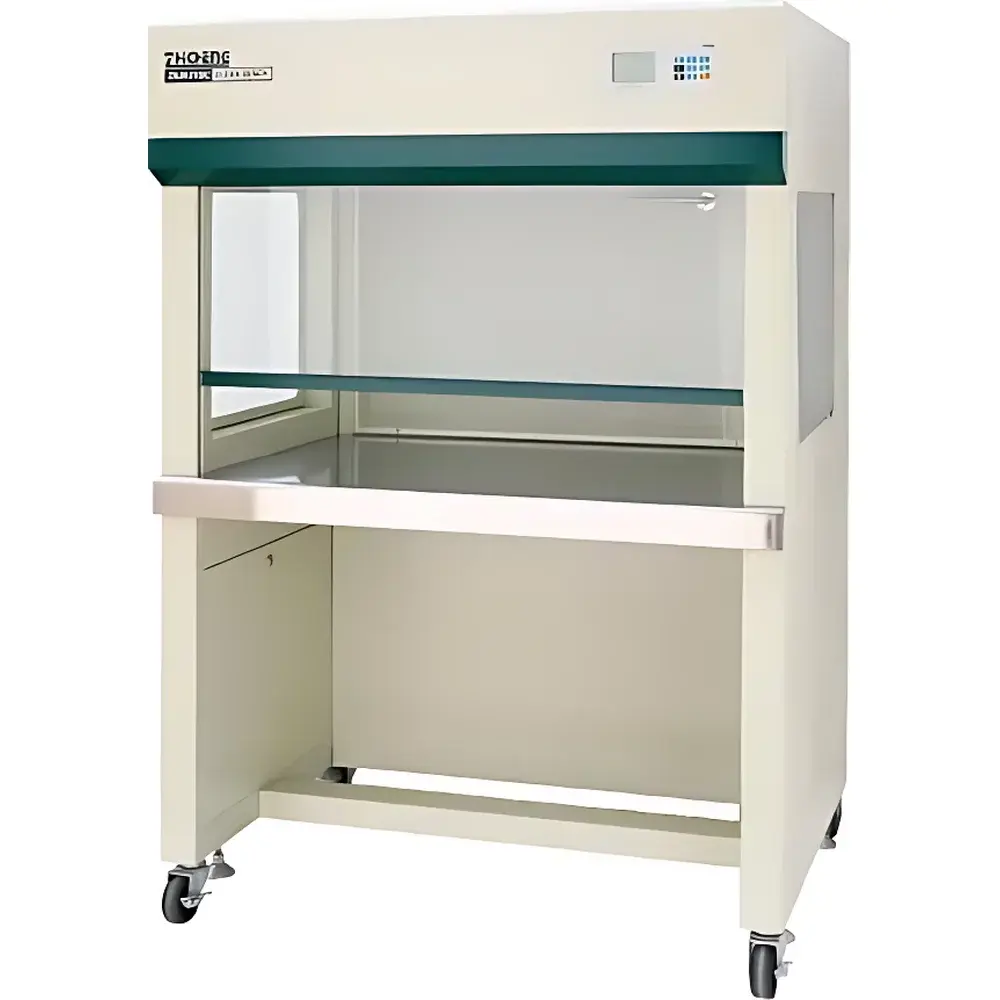
Zhicheng ZHJH-C2109C Intelligent Safety Clean Bench with HEPA Failure Alert
| Brand | Zhicheng |
|---|---|
| Origin | Shanghai, China |
| Manufacturer Type | Direct Manufacturer |
| Model | ZHJH-C2109C |
| Airflow Pattern | Horizontal Flow |
| Work Surface | Single-sided |
| Working Area Dimensions (W×D×H) | 900 × 590 × 570 mm |
| External Dimensions (W×D×H) | 1020 × 830 × 1530 mm |
| Net Weight | 170 kg |
| Power Supply | AC 220 V, 50/60 Hz |
| Maximum Noise Level | ≤62 dB(A) |
| Illumination | ≥300 lx |
| Particle Count (≥0.5 µm) | ≤3.5 particles/L (FS-209E Class 100) |
| Microbial Count | ≤0.5 CFU/plate (90 mm Petri dish) |
| Adjustable Air Velocity Range | 0.1–1.0 m/s |
| Operational Air Velocity Range | 0.3–0.6 m/s (stepless control) |
| Air Velocity Accuracy | ±0.05 m/s |
| Air Velocity Resolution | 0.1 m/s |
| HEPA Filter Differential Pressure Range | 0–500 Pa |
| Differential Pressure Display Accuracy | ±1% FS |
| Initial Pressure Drop (at max airflow) | ≤120 Pa |
| Vibration Half-Peak Amplitude | ≤4 µm |
| UV Lamp Type | High-efficiency quartz germicidal lamp |
| HEPA Integrity Monitoring | Online Status Self-check, Degradation Warning, Failure Alarm, and Rupture Detection |
Overview
The Zhicheng ZHJH-C2109C Intelligent Safety Clean Bench is a horizontally oriented, single-sided laminar flow workstation engineered for ISO Class 5 (FS-209E Class 100) environments. It employs a unidirectional horizontal airflow system in which ambient air is drawn through a pre-filter and subsequently forced through a certified high-efficiency particulate air (HEPA) filter (≥99.995% @ 0.3 µm), delivering particle-free air across the work surface at a precisely controlled velocity between 0.3 and 0.6 m/s. Unlike conventional clean benches that rely solely on passive filtration monitoring, the ZHJH-C2109C integrates real-time HEPA integrity diagnostics—including differential pressure tracking, degradation forecasting, and rupture detection—enabling proactive maintenance and eliminating risk of undetected filter failure. Its design complies with core principles outlined in ISO 14644-1 for cleanroom performance verification and aligns with biosafety best practices recommended by WHO Laboratory Biosafety Manual (4th ed.) for non-recirculating containment devices used in low-risk microbiological handling.
Key Features
- Real-time HEPA health monitoring: Continuous differential pressure measurement (0–500 Pa range, ±1% accuracy) with automated visual, audible, and on-screen alerts for filter degradation, blockage, or physical rupture
- Stepless air velocity control: Digital setpoint adjustment from 0.1 to 1.0 m/s; closed-loop feedback ensures operational stability within ±0.05 m/s tolerance
- Integrated UV disinfection scheduling: Programmable start/stop times for quartz germicidal lamps (254 nm), supporting GMP-aligned decontamination protocols
- Full-parameter LCD interface: Simultaneous display of actual air velocity, HEPA ΔP, cumulative runtime, illumination level (≥300 lx), and system status icons
- Ergonomic tempered glass sash: Vertically sliding front window with self-balancing mechanism and dual side-view panels for enhanced visibility and operator comfort
- Hygienic stainless steel work surface: Seamless, radius-cornered construction compliant with ISO 14644-3 cleaning validation requirements
- Low-noise centrifugal blower: Optimized impeller design delivering high static pressure (>120 Pa initial resistance) at ≤62 dB(A) sound pressure level
- Dual operation mode: Toggle between manual override and fully automated sequences including timed UV activation, sash position memory, and shutdown routines
Sample Compatibility & Compliance
The ZHJH-C2109C is validated for use in applications requiring ISO Class 5 particulate cleanliness and microbial control below 0.5 CFU/plate (90 mm TSA agar, 30-min settle plate method per ISO 14698-1). It supports sterile handling of cell cultures, pharmaceutical intermediates, diagnostic reagents, and environmental sampling media. While not a biological safety cabinet (BSC), its horizontal airflow configuration meets ANSI/NSF 49 Annex A criteria for “clean benches” intended for non-hazardous materials. The unit’s construction adheres to IEC 61000-6-3 (EMC emissions) and IEC 61000-6-2 (immunity), and its electrical safety conforms to IEC 61010-1. All firmware logic—including alarm logging, UV timer execution, and parameter history—is traceable and supports GLP-compliant record retention when paired with external audit-ready data loggers.
Software & Data Management
The embedded microcontroller operates without external PC dependency but supports RS-232 serial output for integration into centralized lab monitoring systems. All alarm events—including HEPA pressure deviation exceeding threshold, UV lamp end-of-life detection, and sash mispositioning—are timestamped and stored locally for ≥10,000 cycles. The LCD interface logs cumulative runtime per subsystem (fan, UV, lighting) and displays last calibration date. Though not natively 21 CFR Part 11 compliant, the device’s deterministic behavior, immutable event timestamps, and hardware-enforced write-once alarm flags provide foundational elements for regulated environments when deployed with validated third-party data acquisition software meeting ALCOA+ principles.
Applications
- Aseptic preparation of microbiological culture media and inoculation plates in clinical and research laboratories
- Handling of sterile pharmaceutical components during formulation development and quality control testing
- Environmental monitoring sample processing—including air, water, and surface swab analysis—in compliance with ISO 14698-2
- Assembly and inspection of precision optical and electronic components sensitive to sub-micron particulates
- Preparation of reference standards and calibration materials under controlled particulate conditions
- Supporting ISO/IEC 17025-accredited testing workflows where documented environmental control is required
FAQ
Does this unit meet ISO Class 100 (ISO 5) certification requirements?
Yes—the ZHJH-C2109C achieves ≤3.5 particles/L (≥0.5 µm) in the working area per FS-209E and ISO 14644-1, verified during factory acceptance testing using calibrated light-scattering particle counters.
Can the HEPA filter status be integrated into a facility-wide BMS?
Via optional RS-232 interface, analog voltage outputs (0–5 V) for air velocity and ΔP are available; full digital alarm states require protocol translation through a gateway module.
Is UV irradiance intensity monitored or validated?
No—UV lamp output is time-based only. Users must perform periodic radiometric validation per ISO 15858 using NIST-traceable UV-C meters.
What maintenance intervals are recommended for the HEPA filter?
Filter replacement frequency depends on ambient air quality; typical service life is 18–24 months under ISO Class 8 (100,000) upstream conditions, with mandatory replacement upon ΔP exceeding 450 Pa or alarm activation.
Does the unit include documentation for IQ/OQ qualification?
Factory test reports (including airflow uniformity maps, particle counts, and noise measurements) are supplied. Full qualification protocols must be developed per user’s SOPs and regulatory scope (e.g., EU GMP Annex 1, USP ).



