
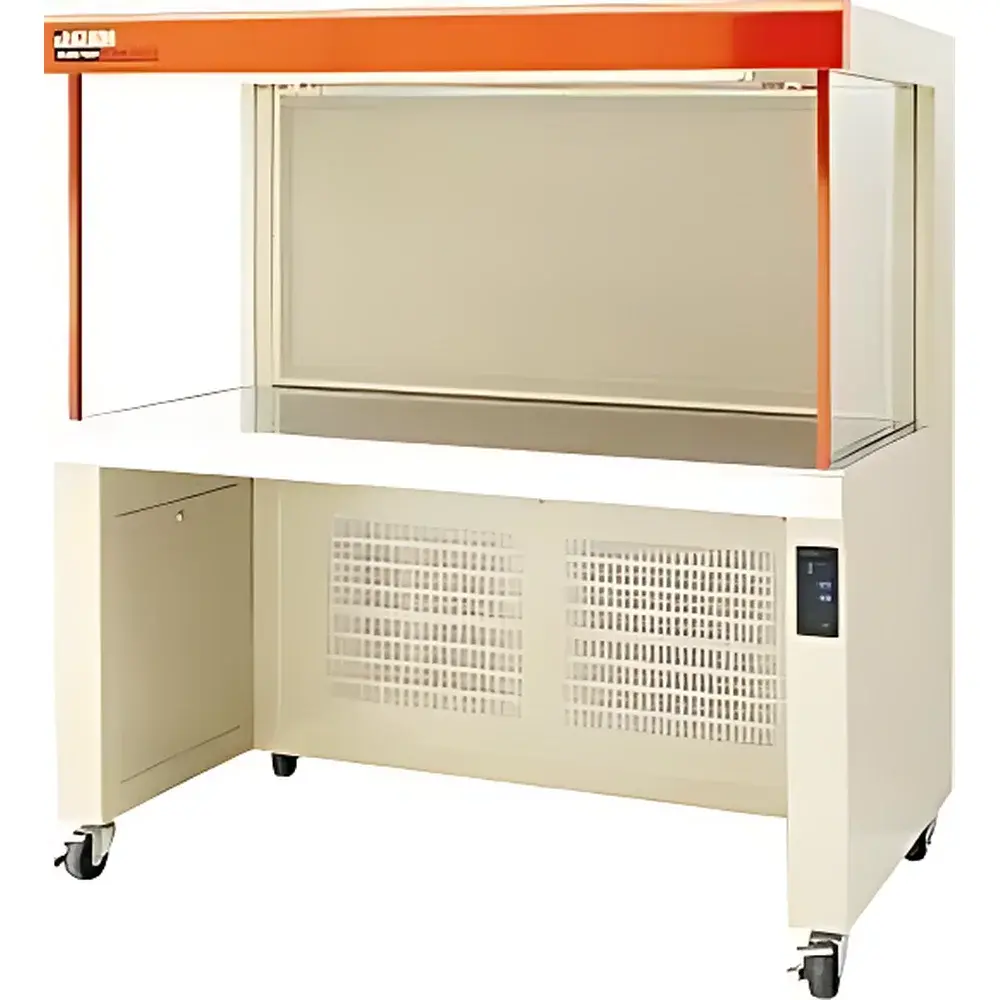
Zhicheng ZHJH-C2112B Horizontal Laminar Flow Clean Bench
| Brand | Zhicheng |
|---|---|
| Origin | Shanghai, China |
| Manufacturer Type | Direct Manufacturer |
| Product Category | Domestic |
| Model | ZHJH-C2112B |
| Quotation | Available Upon Request |
| Airflow Direction | Horizontal |
| Working Surface | Single |
| Filtration Efficiency | ISO Class 5 (100 @ ≥0.5 µm, Fed. Std. 209E) |
| Microbial Contamination | ≤0.5 CFU/plate (90 mm Petri dish) |
| Adjustable Air Velocity | 0.3–0.6 m/s (7-step LED digital control) |
| Noise Level | ≤62 dB(A) |
| Vibration Half-Peak | ≤4 µm |
| Illumination | ≥300 lx |
| Pre-filter Initial Resistance | ≤120 Pa (at max airflow) |
| Work Area Dimensions | 1200 × 590 × 570 mm |
| Overall Dimensions | 1280 × 790 × 1440 mm |
| Net Weight | 185 kg |
| Power Consumption | 680 W |
| Voltage/Frequency | AC 220 V, 50/60 Hz |
Overview
The Zhicheng ZHJH-C2112B Horizontal Laminar Flow Clean Bench is an ISO Class 5-certified laboratory containment system engineered for precision aseptic operations requiring unidirectional, particle-free airflow across the work surface. Unlike vertical flow hoods, this bench directs HEPA-filtered air horizontally—parallel to the work plane—from the rear plenum toward the operator, minimizing turbulence and cross-contamination risk during open handling of sterile samples, sensitive reagents, or non-hazardous biological materials. Its design complies with core principles of laminar flow physics as defined in ISO 14644-1 and aligns with U.S. Federal Standard 209E for cleanroom classification. The unit integrates a high-static-pressure centrifugal blower, dual-stage filtration (pre-filter + H14-grade HEPA), and a fully sealed airflow path to sustain consistent velocity uniformity (±15% across the work area) at setpoints between 0.3 and 0.6 m/s. It is not intended for use with volatile chemicals or toxic aerosols; its primary role is environmental isolation—not personnel or product protection against hazardous agents.
Key Features
- HEPA filtration system (H14, ≥99.995% @ 0.3 µm) with integrated pre-filter to extend main filter service life and maintain stable pressure drop
- Seven-step digitally controlled air velocity adjustment via LED display and tactile self-locking interface—enabling precise optimization for specific procedural requirements
- Electrostatically powder-coated steel enclosure with streamlined aesthetic profile and seamless stainless-steel work surface (304 grade), featuring radiused internal corners for effective decontamination
- Vertically sliding sash window with friction-based positioning mechanism—allowing stable height adjustment without mechanical locks or counterweights
- Dual-side transparent acrylic side panels providing wide field-of-view and natural ambient light integration while maintaining structural integrity and UV transparency
- Integrated dual-lighting system: 300+ lux cool-white fluorescent illumination for visual clarity and germicidal UV-C lamp (254 nm) with safety interlock to prevent accidental exposure
- Four swivel casters with locking brakes—facilitating repositioning within lab spaces while ensuring operational stability during use
Sample Compatibility & Compliance
The ZHJH-C2112B supports aseptic manipulation of cell cultures, microbiological media plates, PCR setup, pharmaceutical compounding (non-sterile), and electronics assembly where particulate control is critical. It meets ISO 14644-1:2015 Class 5 performance criteria under static and operational conditions. Particle counts are validated using calibrated light-scattering particle counters per ISO 21501-4. Microbial validation follows ISO 14698-1 and EU GMP Annex 1 guidance for cleanroom monitoring. UV irradiance output is verified per IEC 62471 for photobiological safety. While not certified to NSF/ANSI 49 or EN 12469 (standards applicable to biosafety cabinets), it conforms to general laboratory ventilation best practices outlined in ASHRAE 110 and CLSI GP31-A5 for non-hazardous applications.
Software & Data Management
This model operates via embedded hardware controls only—no external software or network connectivity is provided. All operational parameters (air velocity, UV timer, lighting status) are managed locally through the front-panel LED interface with non-volatile memory retention. For laboratories operating under GLP or GMP frameworks, manual logbooks or electronic lab notebooks (ELNs) must be used to record daily startup checks, UV exposure duration, filter replacement dates, and periodic certification reports. Optional calibration certificates traceable to NIST standards can be supplied upon request for metrological audit readiness.
Applications
Typical deployment includes upstream bioprocessing support (media preparation, seed train expansion), clinical diagnostics sample staging, semiconductor wafer handling prior to lithography, analytical reference standard weighing, and environmental microbiology plate pouring. It is widely adopted in QC/QA labs across Chinese pharmaceutical manufacturers complying with NMPA GMP Annex 1 and in academic core facilities supporting NIH-funded grants requiring documented environmental control. Its 1200 mm work width accommodates multi-position pipetting stations, orbital shakers, and modular incubator integration—making it suitable for medium-throughput workflows without compromising laminar integrity.
FAQ
What is the recommended HEPA filter replacement interval?
Filter life depends on ambient particulate load and usage frequency; typical service intervals range from 12 to 24 months. Pressure differential monitoring across the filter is advised—replacement is indicated when ΔP exceeds 120 Pa at nominal airflow.
Can this unit be installed in a room with ceiling-mounted HVAC supply vents?
Yes, but installation must avoid direct impingement of room air onto the intake grille. Maintain ≥1 m clearance from walls, equipment, or obstructions to ensure undisturbed airflow into the rear plenum.
Is UV sterilization validated for endospore inactivation?
UV-C at 254 nm achieves ≥3-log reduction of vegetative bacteria and viruses; however, bacterial endospores (e.g., Bacillus atrophaeus) require extended exposure times beyond standard cycles and are not guaranteed without supplementary chemical disinfection.
Does the unit include audible or visual alarms for filter failure or airflow deviation?
No alarm system is integrated. Users must perform routine visual inspection of the LED velocity readout and conduct annual third-party airflow mapping per ISO 14644-3.
What documentation is provided for regulatory submissions?
Factory test reports—including particle count verification, airflow uniformity maps, and electrical safety compliance (GB 4793.1)—are included. Custom IQ/OQ protocols can be developed in collaboration with qualified validation partners.



