
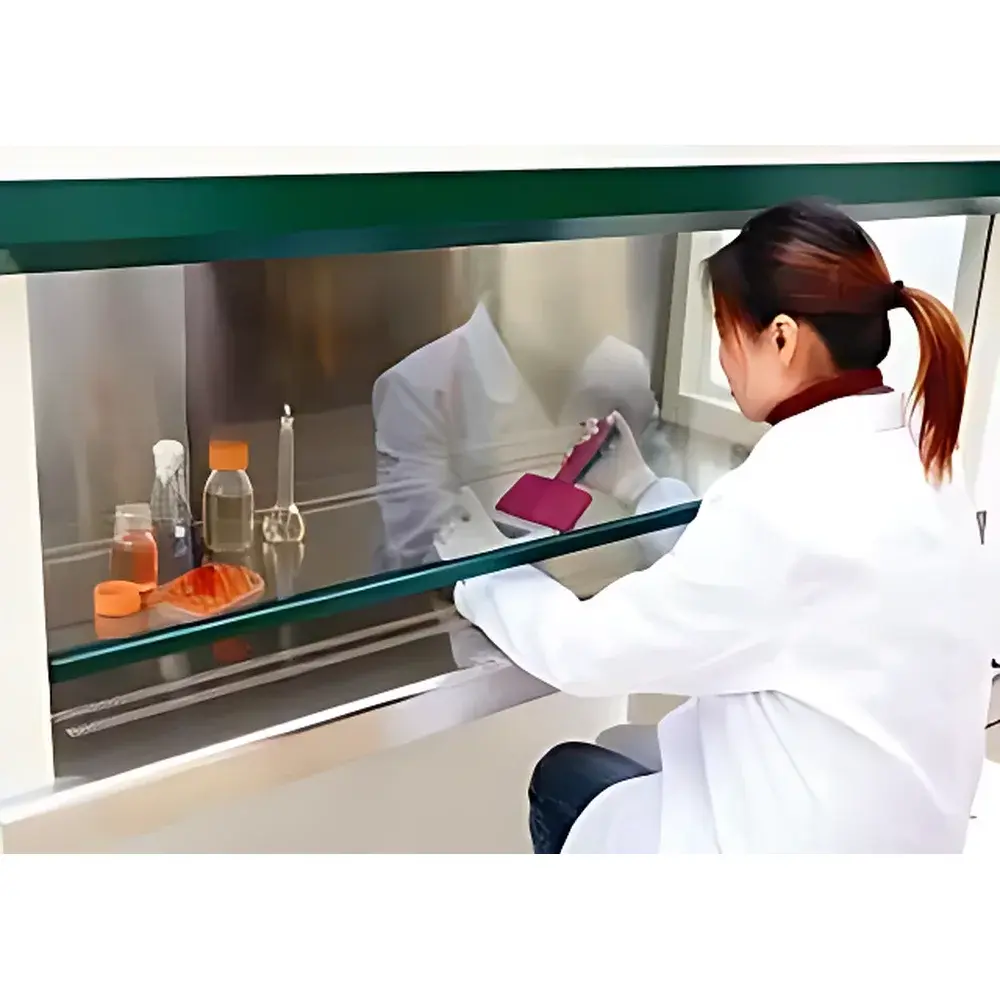
Zhicheng ZHJH-C2112C Intelligent Safety Clean Bench with HEPA Failure Alert
| Brand | Zhicheng |
|---|---|
| Origin | Shanghai, China |
| Manufacturer Type | Direct Manufacturer |
| Country of Origin | China |
| Model | ZHJH-C2112C |
| Airflow Direction | Horizontal Flow |
| Work Surface | Single-sided |
| Working Area Dimensions (W×D×H) | 1200 × 590 × 570 mm |
| Overall Dimensions (W×D×H) | 1320 × 830 × 1530 mm |
| Net Weight | 210 kg |
| Power Supply | AC 220 V, 50/60 Hz |
| Rated Power | 680 W |
| Noise Level | ≤62 dB(A) |
| Illumination | ≥300 lx |
| Vibration Half-Peak | ≤4 µm |
| HEPA Filter Class | ISO Class 5 (FS209E Class 100) |
| Particle Count | ≤3.5 particles/L (≥0.5 µm) |
| Microbial Count | ≤0.5 CFU/plate (90 mm Petri dish) |
| Air Velocity Range | 0.3–0.6 m/s (infinitely variable, ±0.05 m/s control accuracy, 0.1 m/s resolution) |
| Pre-filter Initial Resistance | ≤120 Pa (at max airflow) |
| HEPA Differential Pressure Range | 0–500 Pa (±1% display accuracy) |
| UV Lamp Type | High-efficiency quartz germicidal lamp |
| Control Interface | LCD touchscreen with Chinese UI |
| Operational Modes | Manual / Auto-selectable |
| Pre-set UV Disinfection Timer | Yes |
| Runtime Accumulator | Yes |
| Clock Display | Yes |
| Safety Features | Dual-side tempered glass viewing window, self-balancing vertical sash, stainless steel work surface (radiused corners), integrated UV and fluorescent lighting |
Overview
The Zhicheng ZHJH-C2112C Intelligent Safety Clean Bench is a horizontally oriented, single-sided laminar flow workstation engineered for ISO Class 5 (FS209E Class 100) environments. It employs a unidirectional horizontal airflow system in which ambient air is drawn through a pre-filter, pressurized by a low-noise, high-static-pressure centrifugal blower, and then passed through a certified HEPA filter (≥99.995% @ 0.3 µm) before entering the work area as a uniform, particle-free laminar stream. Unlike conventional clean benches, the ZHJH-C2112C integrates real-time HEPA integrity monitoring—leveraging differential pressure sensing and dynamic airflow calibration—to deliver proactive failure detection rather than passive filtration assurance. This architecture supports critical aseptic operations where operator safety, sample protection, and process continuity are interdependent requirements.
Key Features
- Real-time HEPA health monitoring: continuous differential pressure measurement (0–500 Pa range, ±1% accuracy) with automated visual, audible, and on-screen alerts for filter degradation, breach, or end-of-life conditions
- Infinitely adjustable, closed-loop controlled airflow: user-defined velocity setpoints from 0.1–1.0 m/s; maintains operational range of 0.3–0.6 m/s with ±0.05 m/s stability and 0.1 m/s resolution
- Dual-mode operation: fully configurable manual or auto mode with programmable UV sterilization cycles, timed blower activation/deactivation, and cumulative runtime logging
- Human-centered HMI: 5.7-inch backlit LCD touchscreen with intuitive icon-driven interface, clock display, and bilingual (Chinese-English capable) status feedback
- Structural integrity design: seamless 304 stainless steel work surface with radiused internal corners; dual side-view tempered glass panels (wide-angle, high-transmittance); self-balancing vertical sash with frictionless counterweight mechanism
- Acoustic optimization: noise emission ≤62 dB(A) at 1 m distance; vibration half-peak ≤4 µm—validated per ISO 2041 for laboratory equipment
- Integrated illumination: ≥300 lx uniform fluorescent lighting + high-output quartz UV-C germicidal lamp (253.7 nm), independently switchable and timer-programmable
Sample Compatibility & Compliance
The ZHJH-C2112C is validated for use in biosafety Level 1 (BSL-1) and select BSL-2 applications involving non-aerosolized agents, including microbial culture handling, sterile media preparation, pharmaceutical formulation, and environmental sampling. Its horizontal airflow configuration minimizes cross-contamination risk between operator and sample while maintaining operator exposure below occupational limits (ACGIH TLV® compliant). The unit meets structural and performance requirements outlined in ISO 14644-1 (Class 5), ISO 14644-3 (testing protocols), and GB/T 16292–16294 (Chinese national standards for cleanroom testing). All electrical components comply with IEC 61010-1 for laboratory equipment safety. While not a biological safety cabinet (BSC), its HEPA integrity alerting system aligns with GLP/GMP principles for preventive maintenance documentation and audit readiness.
Software & Data Management
The embedded microcontroller firmware provides deterministic real-time control without external PC dependency. All operational parameters—including airflow velocity, HEPA ΔP, total runtime, UV cycle logs, and alarm history—are timestamped and stored in non-volatile memory. The LCD interface displays live metrics with color-coded status indicators (green/yellow/red) for immediate interpretability. Audit-ready event logs include HEPA warning timestamps, velocity deviation events, and manual override actions—supporting traceability under FDA 21 CFR Part 11 when paired with external lab information management systems (LIMS). No proprietary software installation is required; data export is facilitated via optional RS-485 or USB-to-serial adapters for integration into centralized facility monitoring platforms.
Applications
- Aseptic processing of cell cultures, tissue explants, and primary isolates in academic and industrial life science labs
- Preparation of sterile pharmaceutical intermediates, excipients, and analytical reference standards
- Environmental microbiology workflows: air and surface sampling plate incubation, waterborne pathogen isolation
- Electronics manufacturing support: PCB handling, sensor calibration, and microassembly under particulate-controlled conditions
- Quality control laboratories performing USP –compliant non-hazardous sterile compounding (when used in conjunction with appropriate gowning and procedural controls)
- Teaching laboratories requiring robust, serviceable infrastructure for microbiology and molecular biology instruction
FAQ
Does the ZHJH-C2112C meet international cleanroom classification standards?
Yes—it is certified to ISO Class 5 (equivalent to FS209E Class 100) for particle concentration (≤3.5 particles ≥0.5 µm per liter) and microbial recovery (≤0.5 CFU per 90-mm settle plate), verified per ISO 14644-3 test methods.
Can the HEPA alarm thresholds be customized?
No—the alarm logic is factory-calibrated to detect deviations exceeding ±15% from nominal ΔP baseline, consistent with ISO 14644-3 Annex B guidance for HEPA integrity verification.
Is UV irradiance intensity monitored or logged?
UV lamp status is binary (on/off); intensity decay is inferred indirectly via HEPA ΔP trends and runtime accumulation—but no radiometric sensor is included.
What maintenance intervals are recommended for the pre-filter and HEPA?
Pre-filters should be replaced every 3–6 months depending on ambient particulate load; HEPA filters typically last 3–5 years under normal use—extended lifespan is confirmed by stable ΔP readings and periodic particle challenge testing.
Is the unit compatible with external building management systems (BMS)?
Yes—via optional Modbus RTU over RS-485, enabling remote status polling, alarm forwarding, and scheduled power cycling within facility-wide HVAC control networks.



