
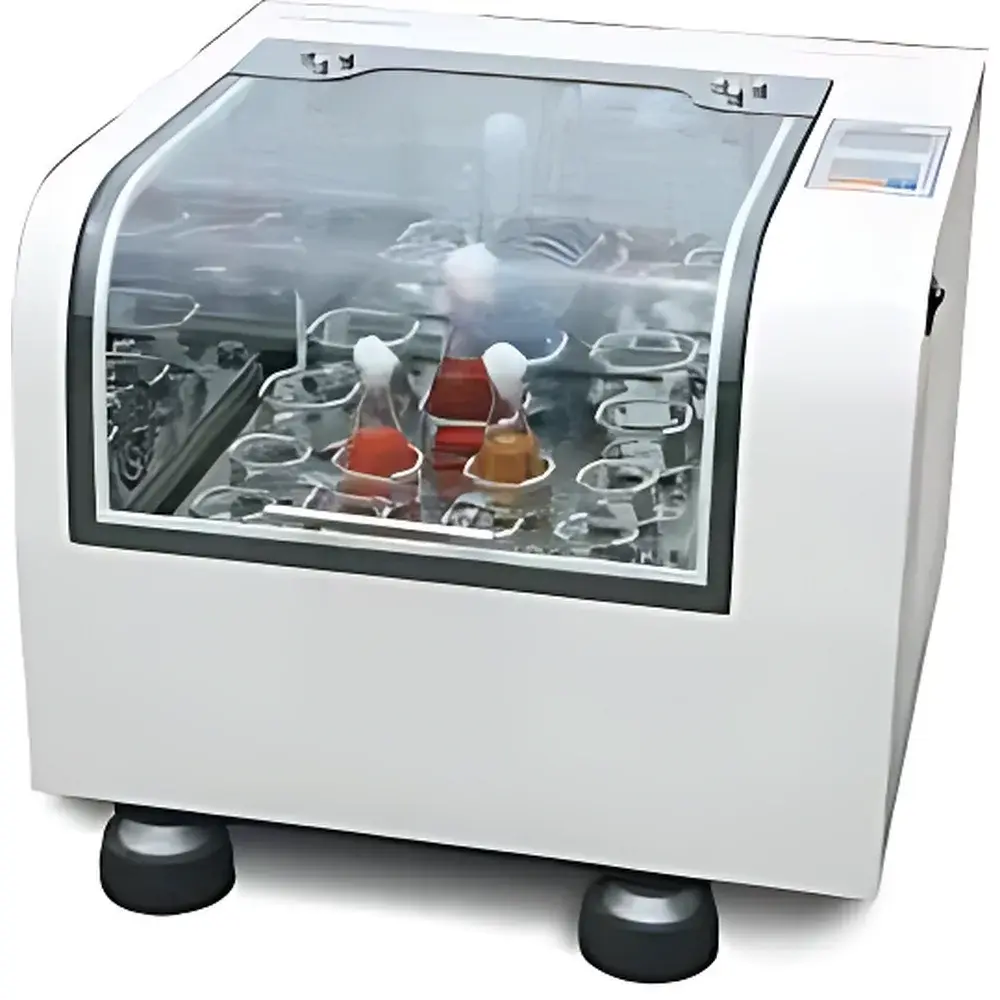
Zhicheng ZWF-100 Reciprocal Multi-Amplitude Orbital Shaker
| Origin | Shanghai, China |
|---|---|
| Manufacturer Type | Authorized Distributor |
| Origin Category | Domestic (China) |
| Model | ZWF-100 |
| Pricing | Upon Request |
| Oscillation Mode | Reciprocal |
| Drive Mechanism | Orbital (Eccentric Cam) |
| Amplitude | 40 mm (Φ) |
| Speed Range | 30–240 rpm |
| Speed Accuracy | ±1 rpm |
| Temperature Control Range | Ambient +5°C to 60°C |
| Temp. Resolution | 0.1°C |
| Temp. Uniformity | ≤±1°C (at 37°C) |
| Temp. Stability | ≤±0.1°C (at 37°C) |
| Timer Range | 0–500 h |
| Platform Size | 346 × 400 mm |
| Chamber Volume | 63 L |
| Interior Dimensions | 445 × 450 × 315 mm |
| Net Weight | 72 kg |
| Power Supply | AC 220 V, 50/60 Hz |
| Rated Power | 540 W |
| Max. Load Capacity | 50 mL × 18 / 100 mL × 18 / 250 mL × 11 / 500 mL × 9 / 750 mL × 6 / 1000 mL × 5 |
Overview
The Zhicheng ZWF-100 Reciprocal Multi-Amplitude Orbital Shaker is an engineered platform for precise, reproducible agitation of biological and biochemical samples under controlled thermal conditions. Designed specifically for applications requiring consistent oxygen transfer—such as aerobic microbial culture, enzyme kinetics assays, cell suspension maintenance, and hybridization protocols—the instrument employs a robust eccentric cam-driven orbital mechanism to generate smooth, linear reciprocating motion at selectable amplitudes. Unlike conventional rotary shakers that rely on circular motion, the ZWF-100’s reciprocal oscillation pattern enhances gas–liquid interfacial area and promotes uniform mixing in flasks and tubes without inducing excessive shear stress. Its PID-controlled temperature system maintains chamber setpoints from ambient +5°C to 60°C with ±0.1°C stability at 37°C, meeting critical requirements for mammalian cell propagation and thermosensitive protein expression workflows. The unit complies with IEC 61010-1 safety standards for laboratory equipment and is constructed with electrostatically sprayed steel housing and tempered glass viewing window for durability and operational transparency.
Key Features
- Eccentric cam-based multi-amplitude drive system enabling continuous, stepless amplitude adjustment—optimized for variable oxygen demand across culture densities and vessel geometries.
- PID microprocessor controller with environmental scanning capability ensures high-fidelity regulation of both speed (30–240 rpm, ±1 rpm accuracy) and temperature (0.1°C resolution, ≤±0.1°C fluctuation at 37°C).
- Intelligent soft-start circuitry eliminates mechanical shock during motor initiation; acceleration is linear and programmable to protect fragile cultures and prevent media splashing.
- Large backlit LCD display presents real-time values for speed, temperature, elapsed time, and remaining timer duration—fully configurable via membrane keypad.
- Parameter lock function prevents accidental modification of critical settings during unattended operation; all user-defined configurations are retained after power interruption.
- Integrated dual-safety architecture includes over-temperature alarm (audible/visual), motor thermal cutoff, and automatic power disconnection upon sensor failure or sustained deviation beyond tolerance limits.
- Energy-efficient AC induction motor delivers constant torque across full speed range—brushless, maintenance-free, and rated for >20,000 hours of continuous duty.
Sample Compatibility & Compliance
The ZWF-100 accommodates standard microbiological and molecular biology vessels—including Erlenmeyer flasks (50–1000 mL), test tubes, and deep-well plates—on its single 346 × 400 mm stainless steel platform. Maximum load capacity supports up to five 1000 mL flasks or eighteen 100 mL flasks simultaneously, with balanced weight distribution ensured by reinforced platform mounting. The chamber’s 63 L internal volume and forced-air convection system provide uniform thermal distribution (≤±1°C at 37°C), satisfying ISO 20387:2018 recommendations for biobanking environment consistency. While not certified for GLP/GMP production environments, the device meets essential validation prerequisites for QC laboratories conducting ASTM D2578 (surface tension testing), USP environmental monitoring prep, and ISO 13485-aligned R&D sample preparation. All electrical components conform to CE marking directives and RoHS 2011/65/EU material restrictions.
Software & Data Management
The ZWF-100 operates autonomously via embedded firmware without external PC dependency. However, optional RS-232 or USB-to-serial interface modules (sold separately) enable integration with laboratory information management systems (LIMS) and data logging software compliant with FDA 21 CFR Part 11 requirements. Audit trail functionality records timestamped entries for parameter changes, alarm events, and runtime interruptions—exportable in CSV format for traceability in regulated environments. Firmware updates are performed via secure bootloader protocol, preserving calibration integrity and ensuring backward compatibility with existing validation documentation.
Applications
- Aerobic bacterial and yeast cultivation requiring tunable O2 transfer rates (e.g., Escherichia coli, Saccharomyces cerevisiae).
- Cell line expansion and suspension culture of CHO, HEK293, and insect cells under temperature-permissive conditions.
- Antibody purification buffer exchange, dialysis setup, and affinity chromatography column equilibration.
- DNA/RNA hybridization, ELISA plate washing, and antigen–antibody binding optimization studies.
- Enzymatic reaction profiling including lipase, protease, and kinase assays where mixing homogeneity directly impacts kinetic fidelity.
- Environmental microbiology sampling preparation, including waterborne pathogen enrichment and soil extract agitation.
FAQ
Is the ZWF-100 suitable for use in CO2 incubator environments?
No—the unit is designed for ambient air operation only and lacks gas-tight sealing or CO2-compatible sensors.
Can multiple platforms be stacked or daisy-chained for synchronized control?
Not natively; each ZWF-100 operates independently. Synchronization requires external PLC-level coordination via digital I/O modules.
What calibration documentation is provided with shipment?
A factory-issued Certificate of Conformance (CoC) is included, listing as-tested speed and temperature performance against NIST-traceable references.
Does the shaker support ramp-and-soak temperature profiles?
No—it maintains a single user-defined setpoint; multi-stage thermal programming is not supported in base configuration.
Is the platform compatible with magnetic stir bars or vacuum-sealed vessels?
The orbital motion is incompatible with magnetic stirring; vacuum-rated flasks may be used if rated for mechanical oscillation stresses at specified rpm and amplitude.
Related Products



