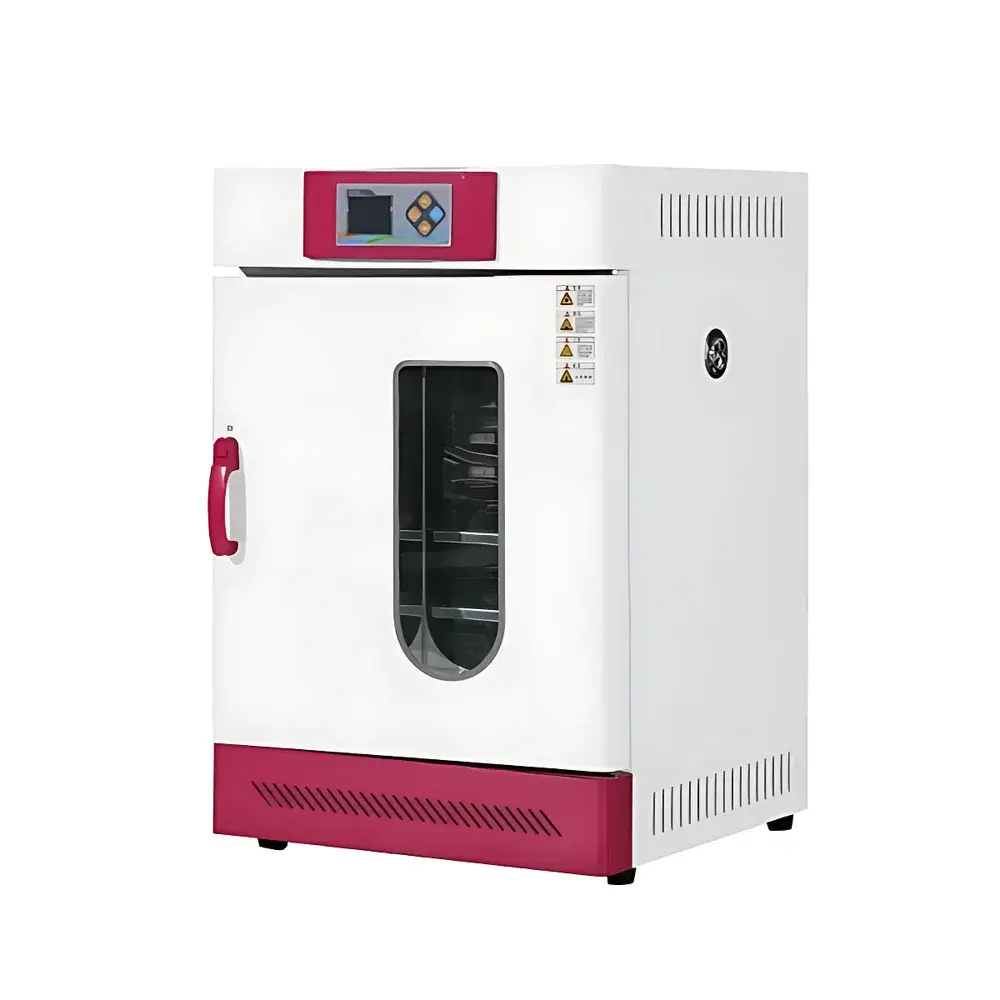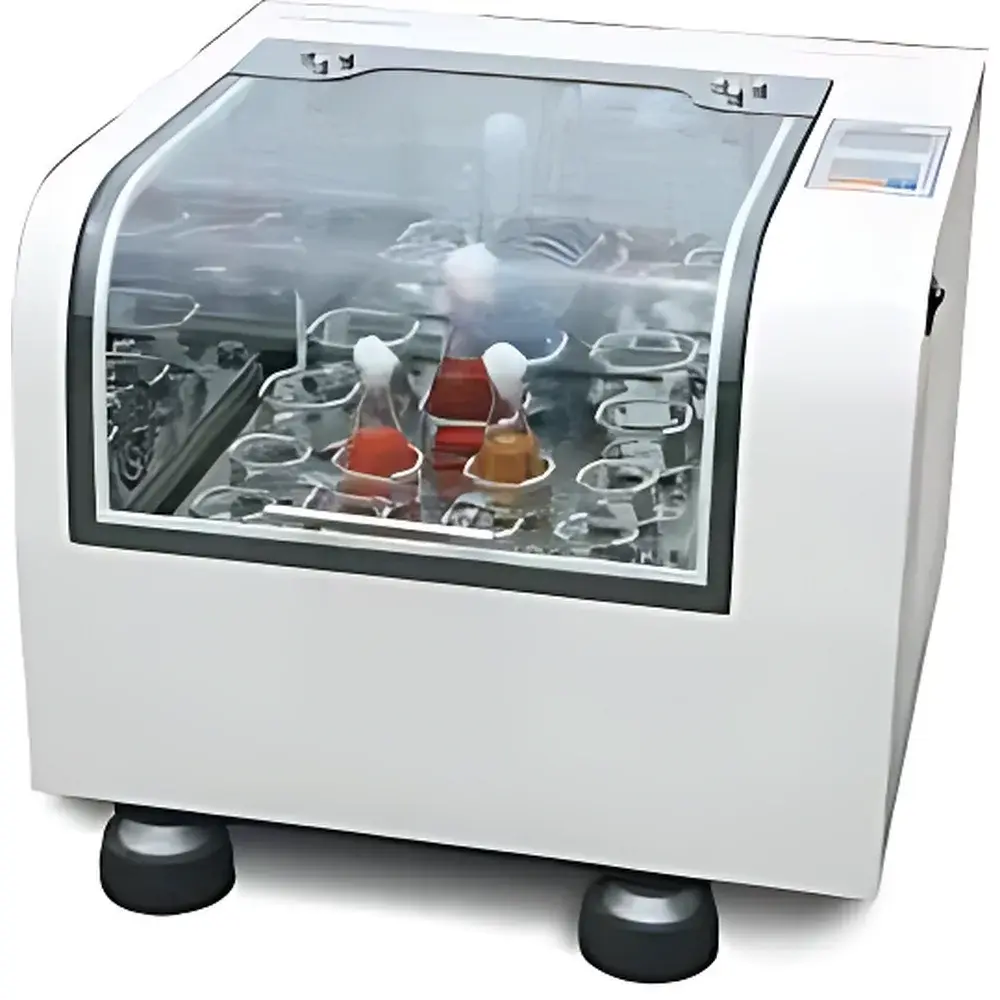
Zhicheng ZWFR-200 Multi-Amplitude Orbital Shaker with Touchscreen Color LCD
| Origin | Shanghai, China |
|---|---|
| Manufacturer Type | Distributor |
| Origin Category | Domestic (China) |
| Model | ZWFR-200 |
| Pricing | Upon Request |
| Control Method | PID Microprocessor-Based Environmental Scanning |
| Display | Full-Color TFT Touchscreen LCD |
| Air Circulation | Forced Convection |
| Oscillation Mode | Reciprocating |
| Drive Mechanism | Orbital Drive |
| Ambient Temp. Range | 5–25 °C |
| Temp. Control Range | 4–60 °C |
| Temp. Resolution | 0.1 °C |
| Temp. Stability | ≤ ±0.1 °C (at 37 °C) |
| Temp. Uniformity | ≤ ±1 °C (at 37 °C) |
| Speed Range | 30–240 rpm |
| Speed Accuracy | ±1 rpm |
| Orbit Diameter | Φ40 mm |
| Timer Range | 0–500 h |
| Shelf Dimensions | 435 × 420 mm |
| Number of Shelves | 1 |
| Net Weight | 100 kg |
| Gross Weight | 132 kg |
| Chamber Volume | 69 L |
| Interior Dimensions | 490 × 450 × 315 mm |
| External Dimensions | 730 × 732 × 555 mm |
| Packaging Dimensions | 850 × 852 × 725 mm |
| Max. Capacity | 1000 mL × 5 |
| Power Consumption | 700 W |
| Electrical Supply | AC 220 V, 50/60 Hz |
Overview
The Zhicheng ZWFR-200 Multi-Amplitude Orbital Shaker is an advanced benchtop incubator-shaker engineered for precision-controlled microbial cultivation, enzymatic assays, hybridization protocols, and cell-based biochemical studies. It operates on a robust orbital drive mechanism with a fixed 40 mm circular orbit, delivering uniform, low-shear agitation ideal for suspension cultures, protein expression systems, and sensitive eukaryotic cell lines. Temperature regulation employs a PID microprocessor-based environmental scanning algorithm coupled with forced-air convection—ensuring rapid thermal equilibration and exceptional stability (≤ ±0.1 °C at 37 °C) across the full operating range of 4–60 °C. Designed for ISO 13485-aligned laboratories and compliant with GLP documentation requirements, the ZWFR-200 integrates hardware-level audit trails via its embedded RS-232 interface and optional thermal printer—supporting traceable, reproducible experimental conditions in regulated life science environments.
Key Features
- Full-color 7-inch TFT touchscreen HMI with intuitive graphical interface, supporting multi-language display (English default) and animated status feedback for real-time parameter visualization
- Nine-segment programmable protocol architecture—each segment comprises independent ramp and hold phases, with time resolution of 0.1 minute (0–999.9 min per phase), enabling up to 99 nested cycles for complex kinetic experiments
- Six configurable operational modes: setpoint vs. program control, temperature enable/disable, refrigeration toggle, power-failure recovery logic, door interlock activation, and print-on-demand data logging
- High-fidelity speed control (30–240 rpm, ±1 rpm accuracy) maintained across load variations; optimized motor-damping system minimizes vibration transmission to adjacent instrumentation
- Stainless-steel chamber interior (490 × 450 × 315 mm) with seamless welding and rounded corners for easy decontamination; reinforced aluminum alloy housing ensures structural rigidity and long-term mechanical stability
- Dual-point temperature calibration capability (user-accessible via service menu) supports laboratory-specific validation workflows aligned with ISO/IEC 17025 and ASTM E2500 standards
Sample Compatibility & Compliance
The ZWFR-200 accommodates diverse vessel formats—including Erlenmeyer flasks (up to 1000 mL), test tubes, deep-well plates, and custom bioreactor vessels—on its single 435 × 420 mm platform with non-slip silicone matting. Its 69 L chamber volume and uniform airflow design ensure consistent thermal and mixing performance regardless of fill level or flask orientation. The unit conforms to IEC 61010-1:2010 safety standards for laboratory equipment and meets electromagnetic compatibility (EMC) requirements per EN 61326-1. For regulated applications, its RS-232 serial port enables integration into LIMS environments and supports FDA 21 CFR Part 11-compliant electronic record generation when paired with validated third-party software.
Software & Data Management
While the ZWFR-200 operates autonomously via its onboard firmware, it provides native ASCII protocol support over RS-232 for bidirectional communication with external PCs. Users may export runtime logs—including timestamped temperature, speed, and program state—to CSV or TXT files for post-hoc analysis in MATLAB, Python (Pandas), or statistical packages such as JMP or GraphPad Prism. Optional thermal printer output delivers hard-copy records suitable for audit review, meeting GLP Annex 11 and USP analytical instrument qualification criteria. Firmware updates are performed via USB flash drive, with version rollback capability and checksum verification ensuring integrity during maintenance cycles.
Applications
- Bacterial and yeast fermentation under controlled thermal and agitation profiles for metabolic engineering studies
- Protein solubility screening and refolding optimization using gradient temperature programs
- Hybridization kinetics in nucleic acid probe development, where precise amplitude and frequency modulation reduce nonspecific binding
- Cell line expansion and transfection efficiency enhancement through oscillatory shear stress tuning
- Enzyme activity assays requiring simultaneous temperature ramping and continuous mixing to minimize substrate depletion artifacts
- Environmental microbiology sample enrichment under simulated diurnal temperature cycling
FAQ
Does the ZWFR-200 support remote monitoring or Ethernet connectivity?
No—this model features only RS-232 serial and USB host interfaces. Ethernet or Wi-Fi modules are not available as standard or optional accessories.
Can multiple ZWFR-200 units be synchronized for parallel protocol execution?
Synchronization is not supported at the hardware level; each unit runs independently. Protocol alignment must be managed externally via time-stamped scheduling software.
Is the internal chamber humidity controlled?
No—humidity is unregulated. Users requiring controlled RH should integrate the unit within an environmental chamber or use sealed vessel lids with internal humidification inserts.
What validation documentation is supplied with the instrument?
Factory calibration certificates (temperature and speed), IQ/OQ templates, and electrical safety test reports are included. PQ support materials are available upon request for site-specific qualification.
Are replacement shelves or custom platforms available?
Yes—Zhicheng offers optional stainless-steel perforated shelves, clamp fixtures for microplate carriers, and low-profile platforms for high-density tube racks (part numbers available in the Accessories Catalog v3.2).