
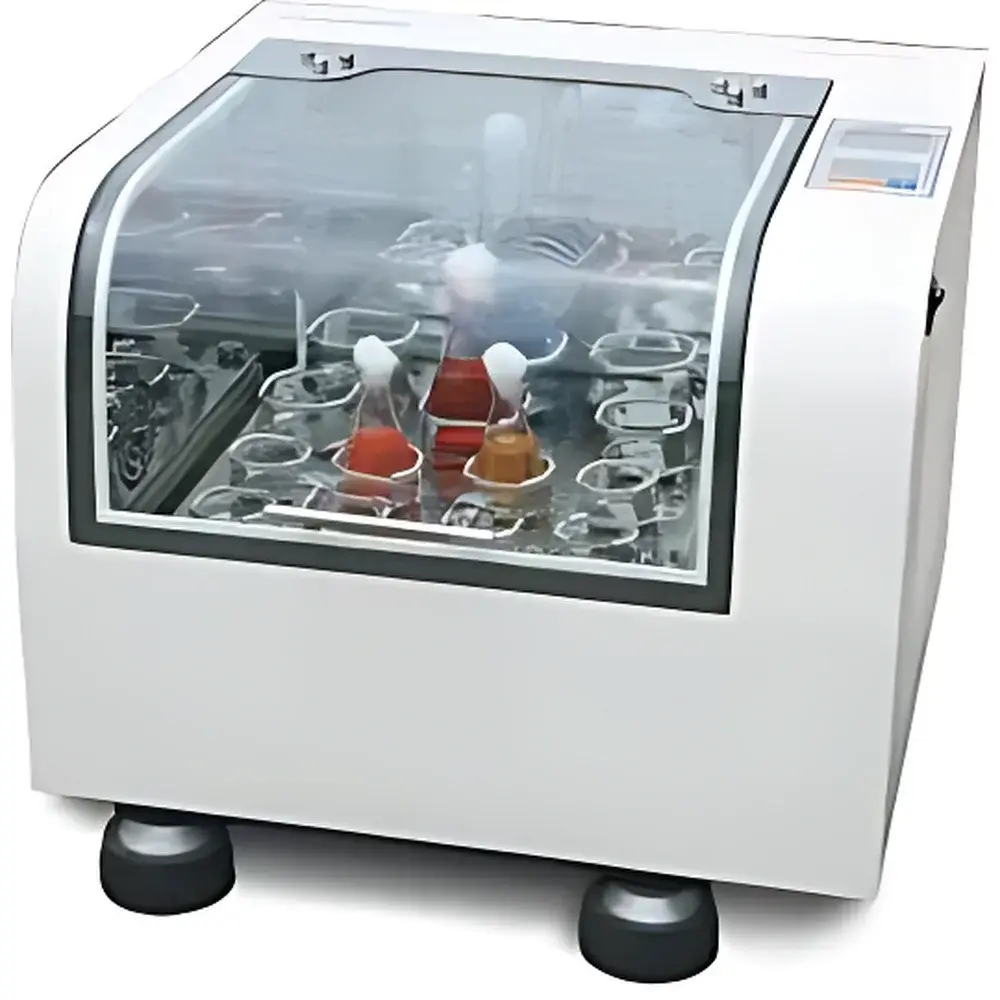
Zhicheng ZWY-100D Classic Multi-Amplitude High-Speed Orbital Shaker
| Origin | Shanghai, China |
|---|---|
| Manufacturer Type | Distributor |
| Origin Category | Domestic (China) |
| Model | ZWY-100D |
| Price | Upon Request |
| Max Speed | 30–600 rpm |
| Amplitude Range | Φ0–50 mm (infinitely adjustable) |
| Temperature Control Range | RT +5°C to 60°C |
| Temp. Resolution | 0.1°C |
| Temp. Uniformity | ≤±1°C (at 37°C) |
| Temp. Stability | ≤±0.1°C (at 37°C) |
| Timer Range | 0–500 h |
| Platform Size | 340 × 370 mm |
| Chamber Volume | 63 L |
| Internal Dimensions | 445 × 450 × 315 mm |
| Net Weight | 72 kg |
| Power | 540 W |
| Voltage/Frequency | AC 220 V, 50/60 Hz |
Overview
The Zhicheng ZWY-100D Classic Multi-Amplitude High-Speed Orbital Shaker is an engineered solution for precise, reproducible orbital agitation in life science laboratories requiring controlled aeration, suspension homogeneity, and thermal stability. Based on the Couette-type orbital motion principle—where platform rotation induces uniform shear and gas–liquid mass transfer—the instrument delivers consistent oxygen transfer rates (OTR) across diverse culture volumes and viscosities. Unlike fixed-amplitude shakers, its patented eccentric cam-driven multi-amplitude mechanism enables continuous adjustment of oscillation diameter (Φ0–50 mm), allowing users to decouple agitation intensity from rotational frequency. This dual-parameter control supports both low-speed, high-amplitude gentle mixing (e.g., for fragile mammalian cell cultures) and high-speed, low-amplitude vigorous aeration (e.g., for aerobic bacterial fermentation). The integrated PID-controlled microprocessor continuously scans environmental feedback—including motor load, chamber temperature, and platform inertia—to dynamically regulate acceleration profiles, ensuring smooth ramp-up without mechanical shock or sample splashing.
Key Features
- Infinitely adjustable orbital amplitude (Φ0–50 mm) via precision eccentric cam mechanism—enabling independent optimization of shear stress and dissolved oxygen (DO) transfer
- Wide speed range: 30–600 rpm with ±1 rpm accuracy, calibrated traceable to NIST-traceable standards
- PID-based microprocessor controller with real-time environmental scanning and adaptive acceleration control for shock-free startup and stable operation
- LCD backlit display showing setpoints and real-time values for speed, amplitude, temperature, and timer
- Programmable timer (0–500 h) with auto-restart function after power interruption—compliant with GLP data integrity requirements
- Brushless AC induction motor: maintenance-free, constant torque across full speed range, no carbon dust contamination risk
- Over-temperature protection with dual-stage alarm (audible + visual) and automatic power cutoff upon sensor fault or thermal runaway
- Secure parameter locking via password protection to prevent unauthorized modification during unattended runs
- Electrostatically coated steel chassis with tempered glass viewing window and ergonomic front-access design
Sample Compatibility & Compliance
The ZWY-100D accommodates standard microbiological and biochemical vessels including Erlenmeyer flasks (50–1000 mL), test tubes, deep-well plates, and custom bioreactor sleeves. Its 340 × 370 mm platform supports up to 18 × 50 mL tubes or 4 × 1000 mL flasks simultaneously while maintaining uniform thermal distribution (≤±1°C at 37°C). The chamber’s forced-air convection system ensures rapid equilibration and minimal thermal gradient across the working volume. The unit complies with IEC 61010-1:2010 for laboratory electrical safety and meets electromagnetic compatibility (EMC) requirements per EN 61326-1. While not certified for ISO Class 5 cleanroom use, its sealed motor housing and non-shedding surface finish support GMP-aligned environments when operated within validated SOPs. Temperature control performance aligns with ASTM E2925-22 guidelines for incubator/shaker qualification.
Software & Data Management
The ZWY-100D operates as a standalone instrument with embedded firmware supporting full audit trail functionality. All parameter changes—including speed, amplitude, temperature setpoint, timer activation, and alarm events—are timestamped and stored in non-volatile memory for ≥10,000 cycles. Data export is available via USB port (CSV format) for integration into LIMS or ELN systems. The controller supports 21 CFR Part 11–compatible user authentication (role-based access levels), electronic signature logging, and immutable event history—enabling compliance with FDA-regulated QC/QA workflows. No proprietary software installation is required; exported logs are natively readable in Excel or statistical analysis platforms (e.g., JMP, Python pandas).
Applications
- Aerobic microbial cultivation (E. coli, Pseudomonas, Bacillus spp.) under defined DO conditions
- Mammalian and insect cell suspension culture requiring low-shear agitation
- Enzyme kinetics assays where substrate homogeneity and thermal consistency are critical
- DNA hybridization and immunoassay plate washing protocols
- Biochemical reaction optimization (e.g., protein refolding, ligand binding studies)
- Environmental microbiology: wastewater treatment simulation, biodegradation screening
- Pharmaceutical stability testing per ICH Q1A(R2) guidelines using temperature-agitation stress profiles
FAQ
Does the ZWY-100D support external temperature probes for chamber validation?
Yes—two PT100 sensor ports are provided for independent verification of internal temperature uniformity during IQ/OQ protocols.
Can amplitude and speed be programmed independently in timed sequences?
No—the amplitude is manually set prior to operation and remains fixed during a run; however, speed and temperature can be scheduled in up to 3-step programs.
Is the unit suitable for CO₂-enriched environments?
The chamber is not gas-tight; it is designed for ambient air operation only. For CO₂ applications, consider models with sealed gasketed doors and gas inlet/outlet fittings.
What calibration documentation is supplied?
Each unit ships with a factory calibration certificate covering speed (traceable to rotary encoder standard), temperature (NIST-traceable PT100), and timer accuracy (±0.1% over 24 h).
How is motor overload protection implemented?
Current sensing circuitry monitors real-time draw; sustained >110% rated load triggers immediate deceleration and thermal lockout until manual reset.




