
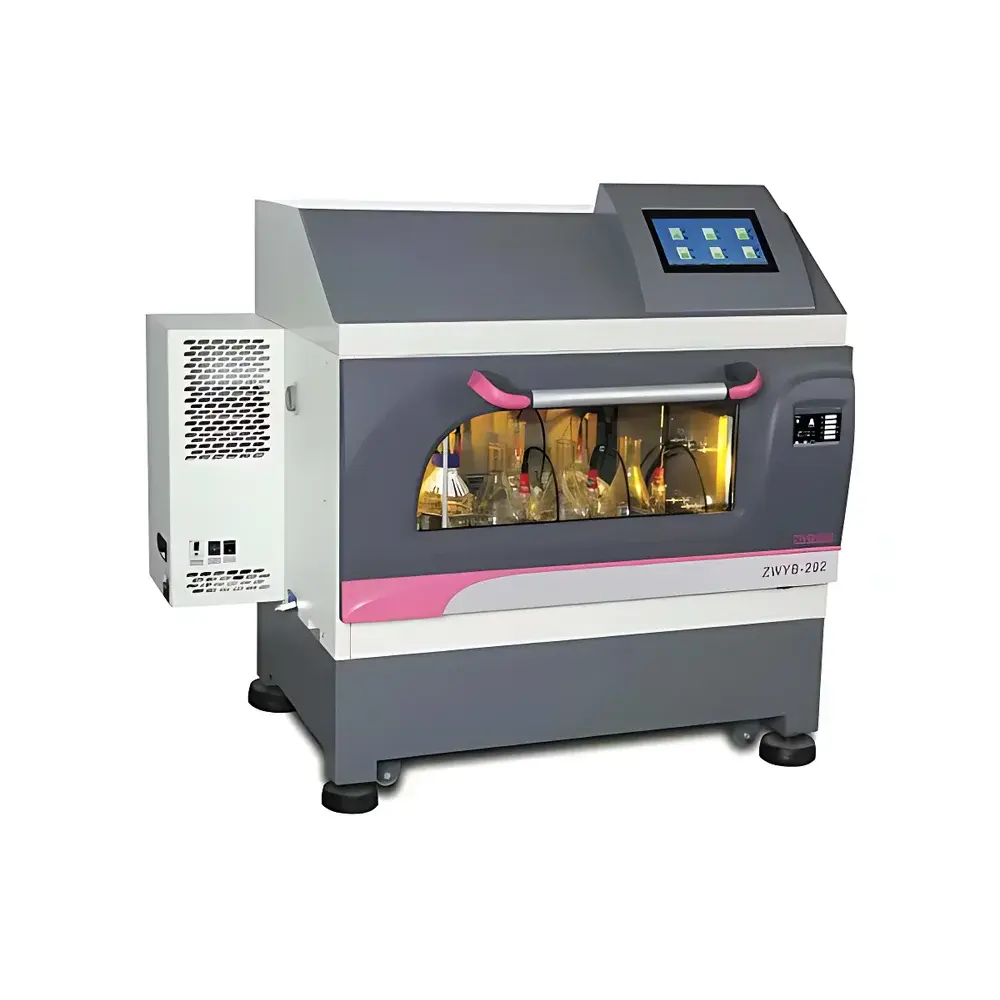
Zhicheng ZWYB-292 Precision pH-Controlled Pulsed Fed-Batch Bioreactor Shaker
| Brand | Zhicheng |
|---|---|
| Origin | Shanghai, China |
| Manufacturer Type | Direct Manufacturer |
| Product Category | Domestic |
| Model | ZWYB-292 |
| Instrument Type | Multi-Station Programmable Orbital Shaker with Integrated pH Control and Pulsed Feed System |
| Timer Range | 0–500 h |
| Oscillation Frequency | 30–250 rpm |
| Orbital Amplitude | Φ0–50 mm, infinitely adjustable |
| Temperature Range | 4–60 °C |
| Number of Platforms | 1 |
| pH Measurement Range | 2.00–12.00 |
| pH Accuracy | ≤ ±0.1 |
| pH Control Stability | ≤ ±0.05 |
| Max. Flask Capacity | 1000 mL (custom bioreactor flasks with integrated pH probe & feed ports) |
| Max. Flask Configuration | 6 units |
| Temp. Uniformity | ≤ ±0.2 °C at 37 °C |
| Temp. Fluctuation | ≤ ±0.1 °C |
| Rotational Speed Accuracy | ≤ ±1 rpm |
| Display | 10.2″ industrial-grade capacitive touchscreen (1024×600 resolution) |
| Cooling Method | Air-cooled R134a refrigeration system with power-regulated compressor |
| Power Supply | AC 220 V, 50/60 Hz, 1450 W |
Overview
The Zhicheng ZWYB-292 Precision pH-Controlled Pulsed Fed-Batch Bioreactor Shaker is an integrated benchtop bioprocessing platform engineered for high-resolution microbial cultivation under dynamically controlled physiological conditions. Unlike conventional orbital shakers, the ZWYB-292 embeds real-time pH monitoring and closed-loop pulsed nutrient delivery into a single, programmable shaking environment—enabling precise maintenance of extracellular pH via automated acid/base addition while synchronizing feed pulses with metabolic demand signals. This architecture implements a feedback-driven fed-batch strategy grounded in microbial stoichiometry: as glucose or nitrogen sources deplete, characteristic pH drift (e.g., upward shift during organic acid consumption or downward shift during ammonium assimilation) triggers precisely metered replenishment of defined media components. The system operates on a microprocessor-based PID control architecture with environmental scanning capability, ensuring thermal, mechanical, and chemical stability across all six independent reaction stations.
Key Features
- Six independently addressable bioreactor stations, each equipped with dedicated pH sensing, acid/base dosing, and pulsed feed actuation—enabling parallel parameter screening without cross-talk.
- High-fidelity pH control loop with ≤ ±0.05 pH setpoint deviation, supported by calibrated glass-body electrodes and temperature-compensated measurement circuitry.
- Micro-dispense pulse feeding mechanism delivering sub-milliliter precision per event (adjustable pulse volume, frequency, and trigger threshold), minimizing osmotic shock and substrate inhibition.
- Programmable multi-segment incubation profiles: up to 100 time steps per program, with independent ramping of temperature (4–60 °C), speed (30–250 rpm), and amplitude (Φ0–50 mm).
- Industrial 10.2″ touchscreen interface with 65,535-color display, supporting real-time overlay of pH curves, feed event markers, temperature trajectories, and rotational speed trends.
- Custom 1000 mL bioreactor flasks featuring dual Luer-lock ports (pH/DO sensor insertion + sterile feed line), reinforced borosilicate glass body, and optimized baffle geometry for enhanced oxygen transfer (kLa > 120 h−1 at 200 rpm, 25% fill).
- Comprehensive safety architecture: dual independent overtemperature cutoffs (mechanical and electronic), motor stall detection, door-interlocked operation, leakage current protection, and configurable alarm thresholds for all critical parameters.
Sample Compatibility & Compliance
The ZWYB-292 accommodates standard microbiological culture formats—including E. coli, Bacillus, Pichia pastoris, Aspergillus, and mammalian suspension cells—in volumes ranging from 100 to 1000 mL per station. Its modular flask design supports integration of optional dissolved oxygen (DO) and exhaust gas analysis (O2/CO2) modules via standardized port interfaces. All control logic and data logging comply with GLP principles: audit-trail-enabled parameter changes, time-stamped event logs, and non-volatile memory retention of ≥30 days’ continuous operation data. While not certified for GMP manufacturing environments, the system meets ISO 13485-aligned design practices for laboratory-scale process development and satisfies key requirements of ASTM E2500-22 (verification of laboratory equipment) and USP <1058> (analytical instrument qualification).
Software & Data Management
Data acquisition occurs at 1 Hz sampling rate for all primary variables (pH, temperature, speed, feed volume, alarm status). Raw time-series data are stored internally in CSV-compliant format with embedded metadata (user ID, experiment ID, calibration timestamps). USB export and optional RS-232 serial output enable direct ingestion into LIMS or MATLAB/Python-based kinetic modeling workflows. The embedded software provides built-in calculation modules for specific growth rate (µ), yield coefficients (YX/S), and acid/base consumption rates—visualized as derivative plots alongside raw signals. All configuration files support password-protected encryption and version-controlled backup, fulfilling baseline requirements for FDA 21 CFR Part 11 compliance when paired with external identity management systems.
Applications
- Strain selection and phenotypic characterization across combinatorial pH/feeding regimes.
- Empirical optimization of fed-batch protocols prior to scale-up in stirred-tank bioreactors.
- Enzyme production studies requiring strict pH-dependent expression control (e.g., alkaline proteases, acid phosphatases).
- Whole-cell biocatalysis where cofactor regeneration correlates directly with extracellular proton balance.
- Metabolic flux analysis using pH-triggered pulse labeling with 13C-glucose or 15N-ammonium.
- Quality-by-Design (QbD) studies supporting regulatory filings for biopharmaceutical intermediates.
FAQ
Does the ZWYB-292 support DO (dissolved oxygen) monitoring?
Yes—via optional retrofit with Clark-type polarographic sensors mounted through the same dual-port flask configuration used for pH probes.
Can feed solutions be heated or cooled before delivery?
No—the system delivers ambient-temperature feeds only; however, pre-conditioned media can be loaded into sterile reservoirs prior to run initiation.
Is remote monitoring possible over Ethernet or Wi-Fi?
The base model includes RS-232; Ethernet/Wi-Fi connectivity requires third-party serial-to-network converters compatible with Modbus RTU protocol.
What calibration standards are required for pH accuracy verification?
NIST-traceable buffer solutions at pH 4.01, 7.00, and 10.01 are recommended for two-point or three-point calibration prior to each experimental campaign.
How is sterility maintained during repeated feeding cycles?
All fluid paths use single-use, gamma-irradiated silicone tubing with Luer-lock fittings; autoclavable stainless-steel manifolds are available as an upgrade option.





