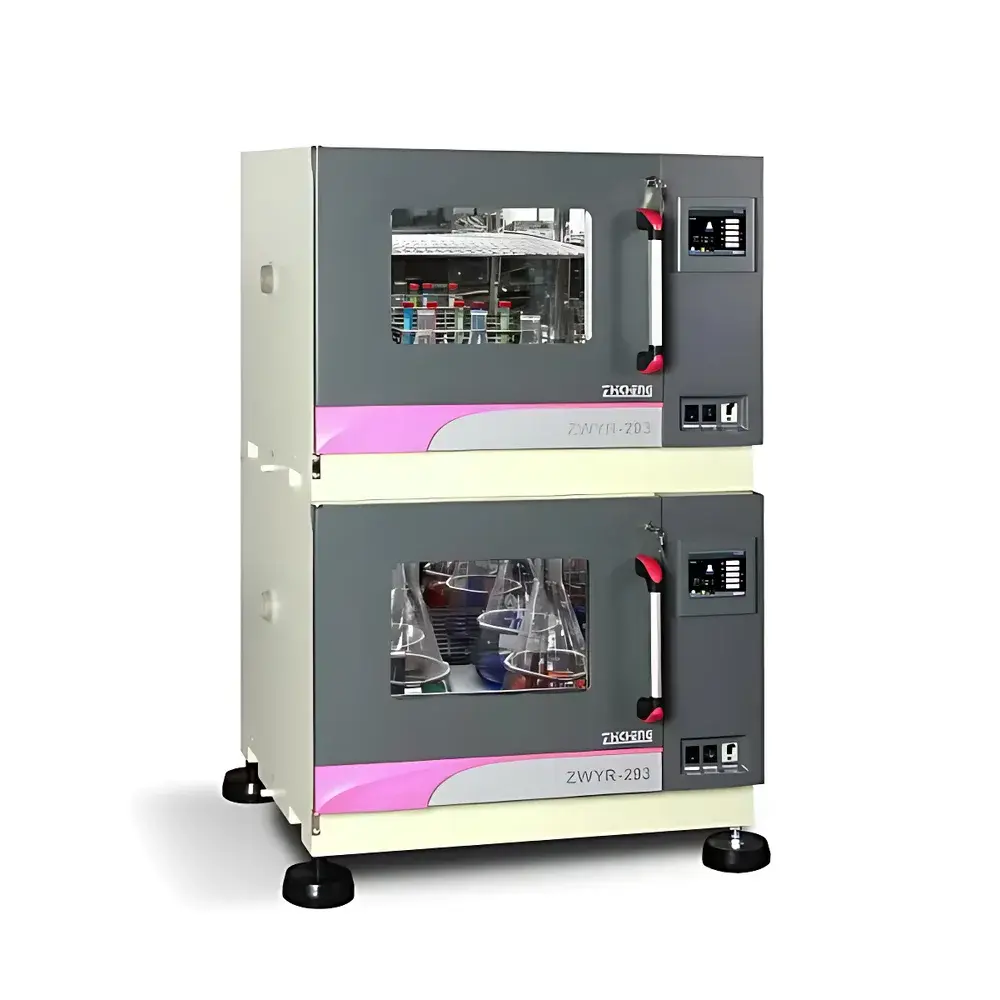
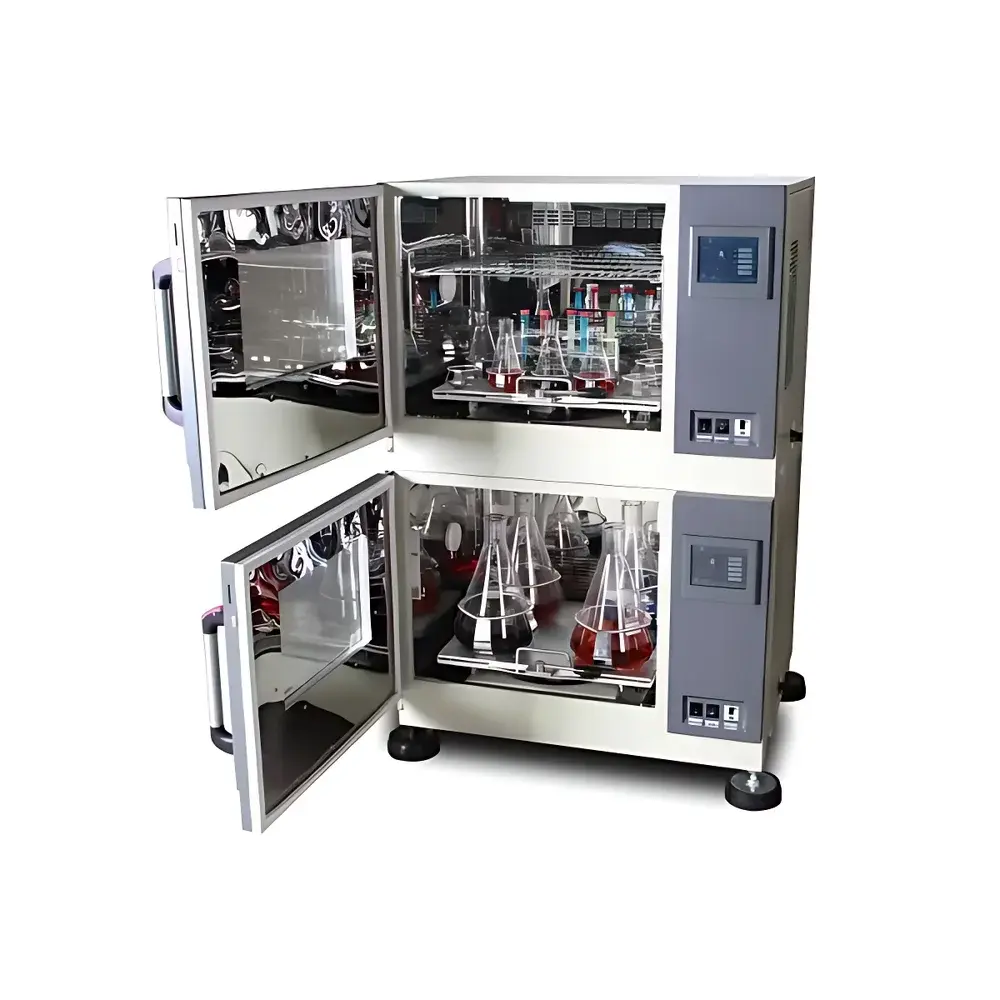
Zhicheng ZWYC-293 Compact Stackable Temperature-Controlled Orbital Shaker
| Brand | Zhicheng |
|---|---|
| Origin | Shanghai, China |
| Manufacturer Type | Direct Manufacturer |
| Product Category | Domestic |
| Model | ZWYC-293 |
| Price Range | USD 2,800–7,000 |
| Instrument Type | Full-Temperature Orbital Shaker |
| Timer Range | 0–9999 min |
| Oscillation Frequency | 30–300 rpm |
| Oscillation Amplitude | 0–30 mm (infinitely adjustable) |
| Temperature Control Range | 4–60 °C |
| Number of Shaking Platforms | 1–2 (stackable) |
| Platform Dimensions | 500 × 420 mm |
| Chamber Volume per Unit | 120 L |
| Max Load Capacity per Unit | 2000 mL × 6 or 5000 mL × 2 |
| Temperature Uniformity | ≤ ±0.3 °C at 37 °C |
| Temp. Resolution | 0.1 °C |
| Temp. Fluctuation | ≤ ±0.1 °C |
| Air Circulation Rate | 360 m³/h |
| Cooling Method | Air-cooled, R134a refrigerant |
| Power | 900 W |
| Noise Level | <65 dB(A) |
| Safety Features | Independent overtemperature cutoff, leakage/overcurrent protection, sensor fault alarm, upper/lower limit alarms for temp & speed, auto-restart after power recovery, PID control with environmental scanning microprocessor |
Overview
The Zhicheng ZWYC-293 Compact Stackable Temperature-Controlled Orbital Shaker is engineered for laboratories where spatial constraints and experimental flexibility coexist as primary operational challenges. Designed around the principle of orbital shaking—where platform motion follows a circular path at a defined amplitude and frequency—the instrument delivers precise, reproducible agitation under tightly regulated thermal conditions. Its core architecture integrates forced-air convection cooling and heating, enabling stable temperature maintenance from 4 °C to 60 °C with resolution of 0.1 °C and uniformity ≤±0.3 °C at 37 °C. The dual-unit stackable configuration allows vertical expansion without footprint increase—each unit occupies only 0.6 m²—making it ideal for high-density lab environments including academic core facilities, QC labs in biopharma, and contract research organizations (CROs). Unlike conventional shakers limited to single-mode operation, the ZWYC-293 supports concurrent dynamic and static culture modes via its standardized, removable stainless-steel support trays—enabling simultaneous incubation of suspension cultures and adherent cell plates within one chamber.
Key Features
- 5.6-inch true-color TFT touchscreen (640 × 480 pixels, 65K colors) with intuitive graphical interface and multi-level password protection for parameter locking
- PID-based microprocessor control with environmental scanning algorithm ensures adaptive response to ambient fluctuations and load-dependent thermal inertia
- Single-axis orbital drive system delivering consistent torque across full speed range (30–300 rpm, ±1 rpm accuracy) and infinitely adjustable amplitude (0–30 mm)
- 304 stainless-steel interior chamber with seamless arc-corner construction for corrosion resistance and ease of decontamination
- Fully independent safety architecture: dual overtemperature cutoffs (adjustable and fixed), real-time sensor diagnostics, leakage/overcurrent circuit breakers, and refrigeration overload protection
- Soft-start acceleration profile minimizes mechanical stress on samples and extends motor service life
- Modular tray system compatible with standard ANSI/SLAS microplate formats, Erlenmeyer flasks (up to 5000 mL), and petri dishes—supporting both orbital agitation and passive incubation in same cycle
- Optional add-ons include CO₂ control module (0–20% v/v), humidity regulation (30–95% RH, non-condensing), embedded thermal printer, and RS-232 serial interface for LIMS integration
Sample Compatibility & Compliance
The ZWYC-293 accommodates diverse sample vessels—from 250 mL to 5000 mL Erlenmeyer flasks (maximum loading: 2000 mL × 6 or 5000 mL × 2 per unit)—and supports common sterile cultureware including T-flasks, roller bottles, and multiwell plates when used with appropriate adapters. Its temperature and agitation stability meet requirements for ISO 13485-certified medical device manufacturing environments and GLP-compliant preclinical studies. While not inherently FDA 21 CFR Part 11 compliant, audit-trail-capable data logging (via optional RS-232 + external software) enables traceability for regulated workflows. The unit complies with IEC 61010-1:2010 for laboratory electrical safety and EN 60335-1 for household/commercial appliances, with CE marking valid for EU market deployment.
Software & Data Management
Onboard firmware supports up to 10 programmable segments with 20 steps per segment—including ramp-hold profiles, temperature staircases, and cyclic timing sequences. All parameters—including setpoints, actual values, alarms, and runtime logs—are retained during power interruption and restored automatically upon recovery. Optional PC-based software (compatible with Windows 10/11) provides remote monitoring, real-time graphing, CSV export, and user-defined report templates. When equipped with RS-232, the shaker interfaces directly with laboratory information management systems (LIMS) or electronic lab notebooks (ELN), supporting metadata tagging (operator ID, batch number, protocol version) for full audit readiness.
Applications
This shaker serves critical roles in microbial physiology (E. coli, yeast, and filamentous fungal cultivation), mammalian cell expansion (HEK293, CHO, iPSC-derived lines), enzymatic assay development, protein expression optimization, and fermentation process screening. It is routinely deployed in upstream bioprocess development, vaccine adjuvant formulation, antibiotic susceptibility testing, and environmental microbiology (e.g., BOD assays, bioremediation strain evaluation). In food safety labs, it supports enrichment protocols per ISO 6579 and AOAC methods; in clinical diagnostics, it facilitates nucleic acid extraction buffer equilibration and immunoassay plate washing steps requiring gentle agitation.
FAQ
Can the ZWYC-293 operate continuously for extended periods (e.g., >72 hours)?
Yes—designed for unattended long-term operation with redundant thermal protection, continuous fan monitoring, and self-diagnostics activated every 15 minutes.
Is calibration documentation available for GxP environments?
Factory calibration certificates (temperature, speed, amplitude) are provided; users may perform field verification using NIST-traceable probes per ASTM E2500-22 guidelines.
What is the maximum flask size supported in stacked configuration?
Each unit independently supports 5000 mL flasks; stacking does not affect individual chamber load capacity or airflow integrity.
Does the unit support validation protocols such as IQ/OQ/PQ?
Yes—comprehensive validation templates (including test scripts, acceptance criteria, and blank execution records) are supplied with optional qualification support package.
How is condensation managed during low-temperature operation?
The air-cooled refrigeration system employs frost-free cycling and internal condensate evaporation channels—no manual drainage required.