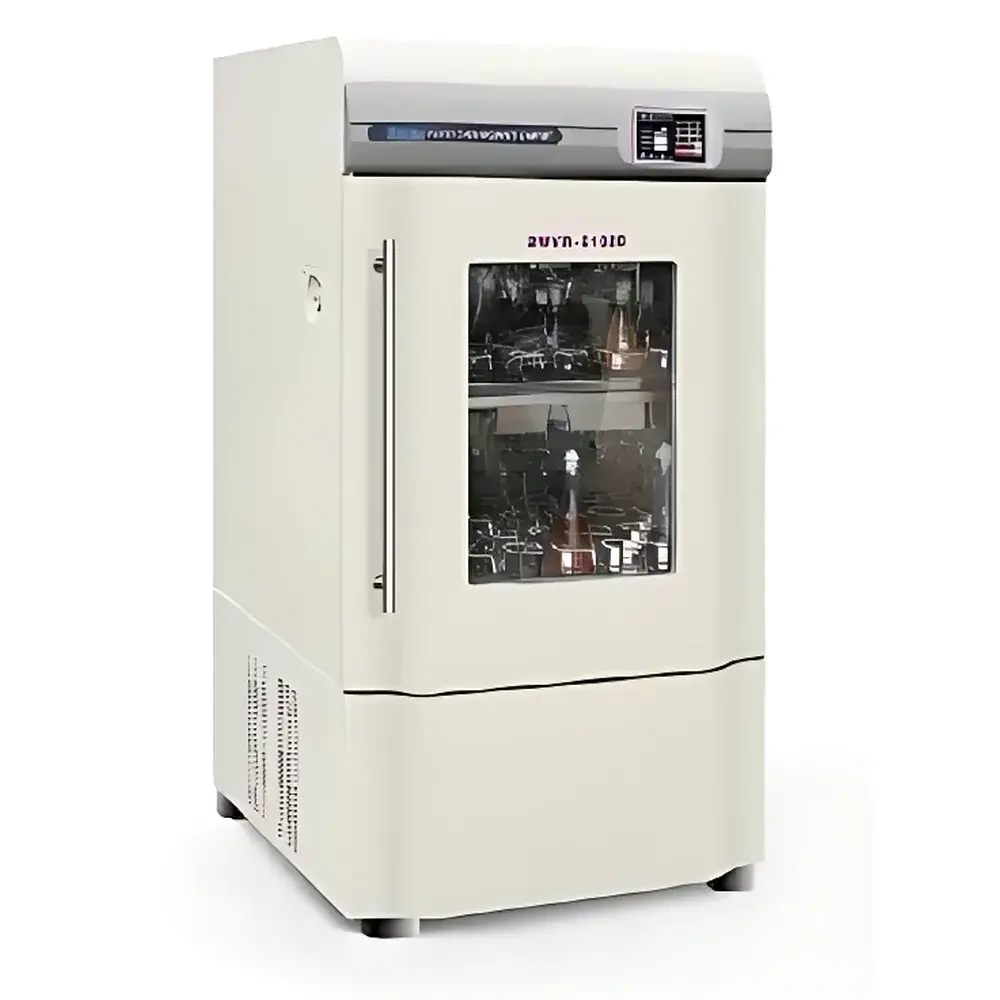
Zhicheng ZWYR-2102C Dual-Deck Programmable Temperature-Controlled Orbital Shaker
| Brand | Zhicheng |
|---|---|
| Origin | Shanghai, China |
| Manufacturer Type | OEM Manufacturer |
| Product Category | Domestic |
| Model | ZWYR-2102C |
| Pricing Range | USD 2,800–7,000 (FOB Shanghai) |
| Instrument Type | Orbital Shaker |
| Timer Range | 0–9999 min |
| Oscillation Frequency | 30–300 rpm |
| Orbit Diameter | Φ26 mm |
| Temperature Range | 4–60 °C |
| Shelf Count | 2 |
| Display | 4.3″ 480×272-pixel 65K-color TFT touch screen |
| Control System | PID microprocessor with environmental scanning algorithm |
| Air Circulation | Forced convection |
| Oscillation Mode | Orbital |
| Drive Mechanism | Multi-dimensional balanced drive |
| Temp. Resolution | ±0.1 °C |
| Temp. Stability | ≤±0.1 °C at 37 °C |
| Temp. Uniformity | ≤±1.0 °C at 37 °C |
| Speed Accuracy | ±1 rpm |
| Safety Features | Dual over-temperature cutoff (independent mechanical & electronic), door-open stop, leakage current protection, compressor overload protection, speed deviation alarm, temperature deviation alarm |
| Programming | 9-segment / 18-step program with ramp-hold cycles, up to 99 repeats per segment |
| Data Interface | RS-232 serial port |
| Power | 950 W |
| Voltage/Frequency | AC 220 V, 50/60 Hz |
| Internal Chamber Volume | 173 L |
| Chamber Dimensions (W×D×H) | 615×440×640 mm |
| Deck Size (W×D) | 496×350 mm |
| Net Weight | 165 kg |
| Gross Weight | 190 kg |
| External Dimensions (W×D×H) | 720×650×1310 mm |
| Packaging Dimensions (W×D×H) | 840×770×1480 mm |
| Refrigeration | Air-cooled R134a compressor with frost-free, power-modulated cooling |
Overview
The Zhicheng ZWYR-2102C is a dual-deck, programmable orbital shaker engineered for precision-controlled microbial cultivation, cell suspension culture, enzyme kinetics, and biochemical reaction optimization under tightly regulated thermal and mechanical conditions. It operates on the principle of orbital motion—generating uniform, low-shear agitation ideal for aerobic growth of bacteria, yeast, and mammalian cells—while integrating active refrigeration and PID-driven temperature regulation across a wide operational range (4–60 °C). Its forced-convection airflow system ensures rapid thermal equilibration and high spatial uniformity (≤±1.0 °C at 37 °C), critical for reproducible biological assays and GLP-compliant workflows. Designed for continuous unattended operation in core facilities and QC laboratories, the unit complies with IEC 61010-1 safety standards for laboratory equipment and incorporates redundant hardware-level safeguards aligned with ISO/IEC 17025 risk management expectations.
Key Features
- Dual independent decks (496 × 350 mm each) enabling simultaneous parallel experiments with distinct temperature and agitation profiles
- 4.3″ high-resolution (480 × 272) 65K-color TFT touchscreen interface with intuitive icon-based navigation and real-time animated status feedback
- 9-segment / 18-step programmable controller supporting ramp-hold sequences, multi-cycle repetition (up to 99 loops per segment), and temperature gradient protocols
- PID microprocessor with environmental scanning logic for adaptive compensation against ambient fluctuations (5–25 °C operating room range)
- Compressor-based R134a refrigeration system with modulated power control and frost-free operation—enabling stable sub-ambient incubation down to 4 °C
- Triple-layer safety architecture: (1) Personnel protection via Class I insulation, leakage current detection, and automatic circuit disconnection; (2) Sample integrity assurance through independent backup emergency shutdown upon speed or temperature runaway; (3) Facility protection via dual over-temperature cutoff (mechanical bimetal + electronic sensor) and compressor overload monitoring
- RS-232 serial interface compliant with standard SCPI command syntax for integration into LIMS or automated lab platforms
- Built-in thermal printer for GLP-auditable hard-copy record generation—including timestamped parameter logs, alarm events, and program execution history
Sample Compatibility & Compliance
The ZWYR-2102C accommodates standard microbiological vessels including Erlenmeyer flasks (50–2000 mL), deep-well plates, test tubes, and custom bioreactor sleeves. Its Φ26 mm orbital diameter and 30–300 rpm speed range support viscous media (e.g., Pseudomonas cultures in glycerol-rich broth) while maintaining laminar flow characteristics essential for shear-sensitive hybridoma or stem cell suspensions. The chamber’s 173 L internal volume and reinforced stainless-steel interior meet ASTM E1510 requirements for corrosion resistance in humid environments. All electrical and thermal safety systems conform to IEC 61010-1:2010 Ed.3 and UL 61010-1. Firmware supports audit trail logging per FDA 21 CFR Part 11 when paired with validated third-party data acquisition software.
Software & Data Management
While the onboard HMI provides full local control and real-time visualization, the RS-232 interface enables bidirectional communication with Windows-based host applications using ASCII protocol. Users may export runtime logs (temperature setpoint vs. actual, speed profile, alarm timestamps) as CSV files for statistical process control (SPC) analysis. Parameter encryption and password-protected configuration prevent unauthorized modification—supporting ISO 13485 documentation requirements for medical device manufacturing labs. The embedded thermal printer generates time-stamped, non-erasable records suitable for internal QA review and external regulatory audits (e.g., EU Annex 11, WHO TRS 961).
Applications
- High-yield recombinant protein expression in E. coli and Pichia pastoris under controlled dissolved oxygen surrogates
- Standardized antibiotic susceptibility testing (AST) per CLSI M07-A10 guidelines using broth microdilution with agitation
- Enzyme immobilization studies requiring precise thermal ramping during covalent coupling reactions
- Environmental microbiology: enrichment cultures for heterotrophic plate count (HPC) and coliform enumeration per EPA Method 1604
- Pharmaceutical stability testing of liquid formulations under ICH Q1A(R3) accelerated conditions (e.g., 40 °C/75% RH simulated via thermal + agitation stress)
- Tissue dissociation protocols involving collagenase or trypsin digestion with timed agitation pulses
FAQ
Is the ZWYR-2102C compatible with CO2 supplementation?
No—this model lacks gas inlet/outlet ports and humidity control; it is designed exclusively for air-based thermal-agitation applications.
Can both decks operate at different temperatures simultaneously?
No—the unit maintains a single uniform chamber temperature; dual decks share identical thermal conditions but support independent speed programming.
What validation documentation is provided?
Factory calibration certificates for temperature (NIST-traceable probe) and speed (laser tachometer) are included; IQ/OQ templates compliant with GAMP5 are available upon request.
Does the built-in printer support barcode label output?
No—it prints only alphanumeric text and basic graphical status icons; external label printers must be integrated via RS-232 host software.
Is remote monitoring possible without third-party software?
Not natively—the RS-232 port requires host-side terminal emulation or custom scripting; no Ethernet/WiFi module is integrated.
Related Products