
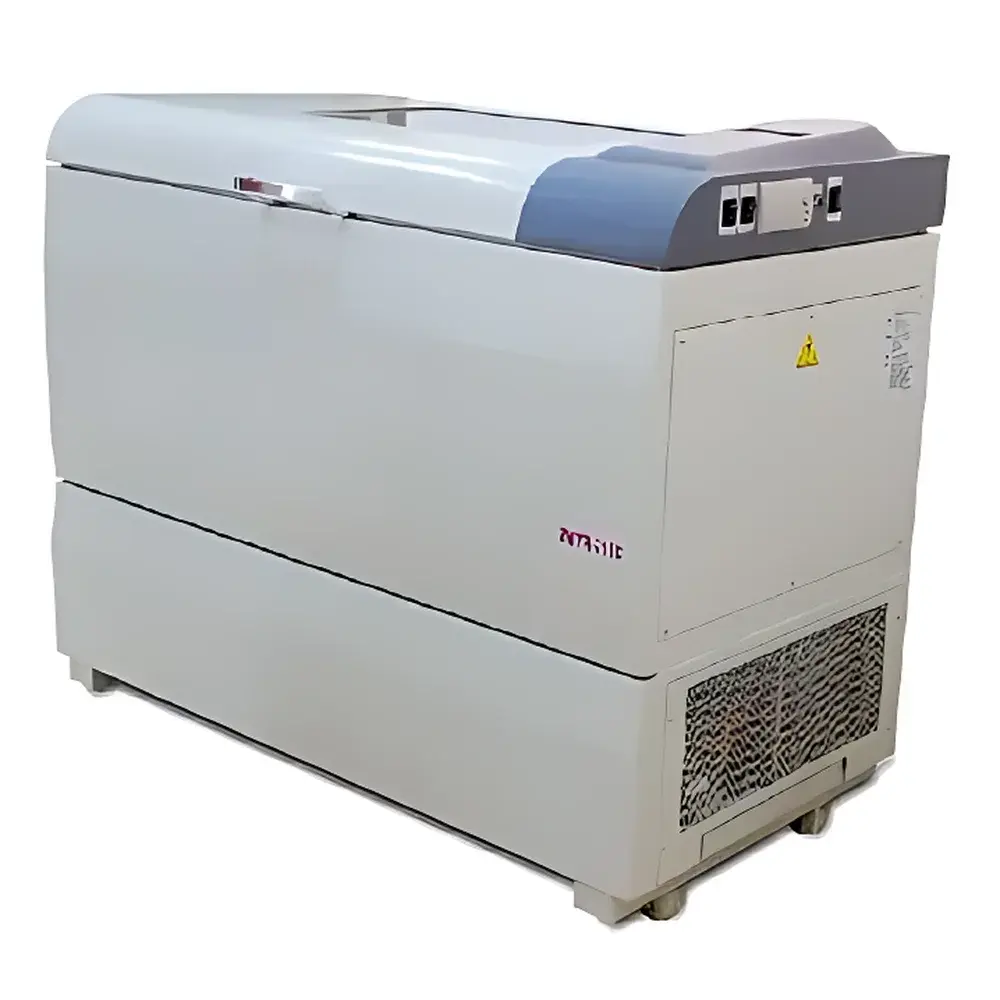
Zhicheng ZWYR-211C Horizontal Full-Color Touchscreen Incubator Shaker
| Brand | Zhicheng |
|---|---|
| Origin | Shanghai, China |
| Manufacturer Type | OEM/ODM Manufacturer |
| Product Category | Domestic |
| Model | ZWYR-211C |
| Instrument Type | Orbital Incubator Shaker |
| Timer Range | 0–9999 min |
| Oscillation Frequency | 30–300 rpm |
| Orbit Diameter | Φ26 mm |
| Temperature Range | 4–60 °C |
| Shelf Quantity | 1 |
| Display | 4.3″ 480×272-pixel 65K-color TFT capacitive touchscreen |
| Control System | PID microprocessor with environmental scanning algorithm |
| Programming | 9-segment / 18-step programmable sequence (each segment: 0–999.9 min |
| Temperature Resolution | 0.1 °C |
| Temperature Uniformity | ≤±1 °C at 37 °C |
| Temperature Stability | ≤±0.1 °C at 37 °C |
| Air Circulation | Forced convection |
| Drive Mechanism | Multi-dimensional balanced drive |
| Cooling System | R134a-based air-cooled refrigeration with frost-free operation and auto-load modulation |
| Safety Features | Dual independent overtemperature cutoff (main + backup), door-open stop, leakage current protection, overcurrent trip, motor overspeed detection, refrigeration overload protection |
| Power Supply | AC 220 V, 50/60 Hz |
| Rated Power | 1120 W |
| Chamber Volume | 256 L |
| Interior Dimensions (W×D×H) | 975 × 565 × 465 mm |
| Shelf Dimensions (W×D) | 920 × 500 mm |
| Net Weight | 183 kg |
| Gross Weight | 228 kg |
| External Dimensions (W×D×H) | 1230 × 760 × 1050 mm |
| Packaging Dimensions (W×D×H) | 1350 × 880 × 1220 mm |
| Data Interface | RS-232 serial port |
| Optional Output | Built-in thermal printer |
Overview
The Zhicheng ZWYR-211C Horizontal Full-Color Touchscreen Incubator Shaker is an engineered solution for precision-controlled orbital shaking under regulated temperature conditions. Designed for demanding life science workflows—including microbial culture, enzymatic assays, hybridization protocols, and cell-based studies—the instrument integrates a high-stability P.I.D. microprocessor control system with forced-air convection and R134a-based refrigeration to deliver consistent thermal performance across its full operating range of 4–60 °C. Its horizontal orbital motion (Φ26 mm orbit diameter, 30–300 rpm) ensures uniform suspension and oxygen transfer in Erlenmeyer flasks, test tubes, and multi-well plates. Unlike basic shakers, the ZWYR-211C employs an environmental scanning algorithm that continuously monitors ambient conditions and dynamically adjusts heating/cooling output—critical for maintaining ±0.1 °C stability at 37 °C and ≤±1 °C uniformity across the 256 L chamber.
Key Features
- 4.3″ capacitive touchscreen display (480×272 pixels, 65K-color) with intuitive graphical interface supporting real-time animation of temperature, speed, and program status
- 9-segment / 18-step programmable logic: each segment supports ramp-and-hold profiles with configurable time (0–999.9 min), enabling complex thermal-shaking sequences such as temperature gradients, stepwise incubation, or cyclic recovery protocols
- Dual-layer safety architecture: primary PID controller backed by independent hardware-level overtemperature cutoff (mechanical thermostat), door-open interlock, earth-leakage circuit breaker (ELCB), and refrigeration compressor overload protection
- Intelligent cooling management: R134a refrigerant system with variable-speed fan control and frost-free operation ensures stable sub-ambient performance down to 4 °C—even during extended runs at high ambient temperatures (5–25 °C)
- RS-232 serial interface compliant with standard SCPI command sets for integration into laboratory automation frameworks; optional embedded thermal printer supports GLP-compliant hardcopy logging of setpoints, actual values, and alarm events
- Six configurable operational modes: fixed vs. programmed control, heating-only vs. heating/cooling, power-loss recovery, door-sensor activation, print-on-event, and parameter encryption for multi-user environments
Sample Compatibility & Compliance
The ZWYR-211C accommodates standard laboratory vessels including 500 mL to 5 L Erlenmeyer flasks (clamped on a single 920 × 500 mm stainless-steel shelf), stacked microplate carriers, and custom fixtures. Its forced-convection airflow design minimizes thermal stratification, satisfying ISO 13408-1 requirements for uniform environmental conditioning in bioprocess development. The device meets IEC 61010-1:2010 for electrical safety in laboratory equipment and incorporates design elements aligned with FDA 21 CFR Part 11 expectations—including audit-trail-capable parameter logging (via RS-232), user-access controls, and non-volatile memory for program retention after power interruption. All safety circuits are independently certified per UL 61010-1 and GB 4793.1 standards.
Software & Data Management
No proprietary software installation is required: the built-in HMI handles all configuration, execution, and monitoring tasks locally. However, the RS-232 interface enables seamless integration with third-party LIMS or ELN platforms using ASCII-based command protocols. Logged data—including timestamped temperature, speed, program stage, and fault codes—can be exported as CSV files for traceability. The embedded thermal printer generates tamper-evident records compliant with GLP documentation practices, featuring automatic header stamping (date/time/model/serial number) and error-code annotation. Parameter encryption and role-based access (admin/operator) support multi-shift laboratory governance models without external authentication dependencies.
Applications
- Bacterial and yeast fermentation studies requiring precise temperature ramping and sustained agitation
- Protein expression in E. coli cultures where dissolved oxygen transfer correlates directly with orbital frequency and amplitude
- Nucleic acid hybridization protocols (e.g., Southern/Northern blotting) demanding uniform thermal kinetics across large-format membranes
- Cell line expansion and suspension culture under controlled hypothermic or febrile conditions (e.g., 30–42 °C)
- Enzyme kinetic assays involving temperature-sensitive catalysts (e.g., Taq polymerase, restriction endonucleases)
- Stability testing of biopharmaceutical intermediates per ICH Q5C guidelines, leveraging programmable thermal cycling capability
FAQ
Does the ZWYR-211C support validation documentation (IQ/OQ/PQ)?
Yes—factory calibration certificates (traceable to NIST standards), electrical safety test reports, and temperature uniformity mapping data are provided upon request. Optional on-site OQ services include chamber mapping per ASTM E2297-20 and speed verification per ISO 8573-1.
Can the unit operate continuously at 4 °C with full-speed shaking?
Yes. The air-cooled R134a system maintains stable 4 °C operation at 300 rpm in ambient environments ≤25 °C, verified via 72-hour continuous stress testing per internal QA protocol ZC-QA-087.
Is firmware upgrade supported remotely?
Firmware updates require local USB flash drive loading via service menu; no network connectivity or cloud dependency is implemented—ensuring air-gapped security for regulated environments.
What is the mean time between failures (MTBF) for the drive mechanism?
Based on accelerated life testing (n = 42 units, 10,000-hour cycle simulation), MTBF exceeds 25,000 hours under nominal load (200 rpm, 37 °C).
Are replacement shelves or custom fixtures available?
Standard accessories include universal flask clamps (100–2000 mL) and microplate holders. Custom CNC-machined aluminum shelves with integrated fluid channels or RFID-tagged mounting points can be commissioned under Zhicheng’s OEM engineering support program.




