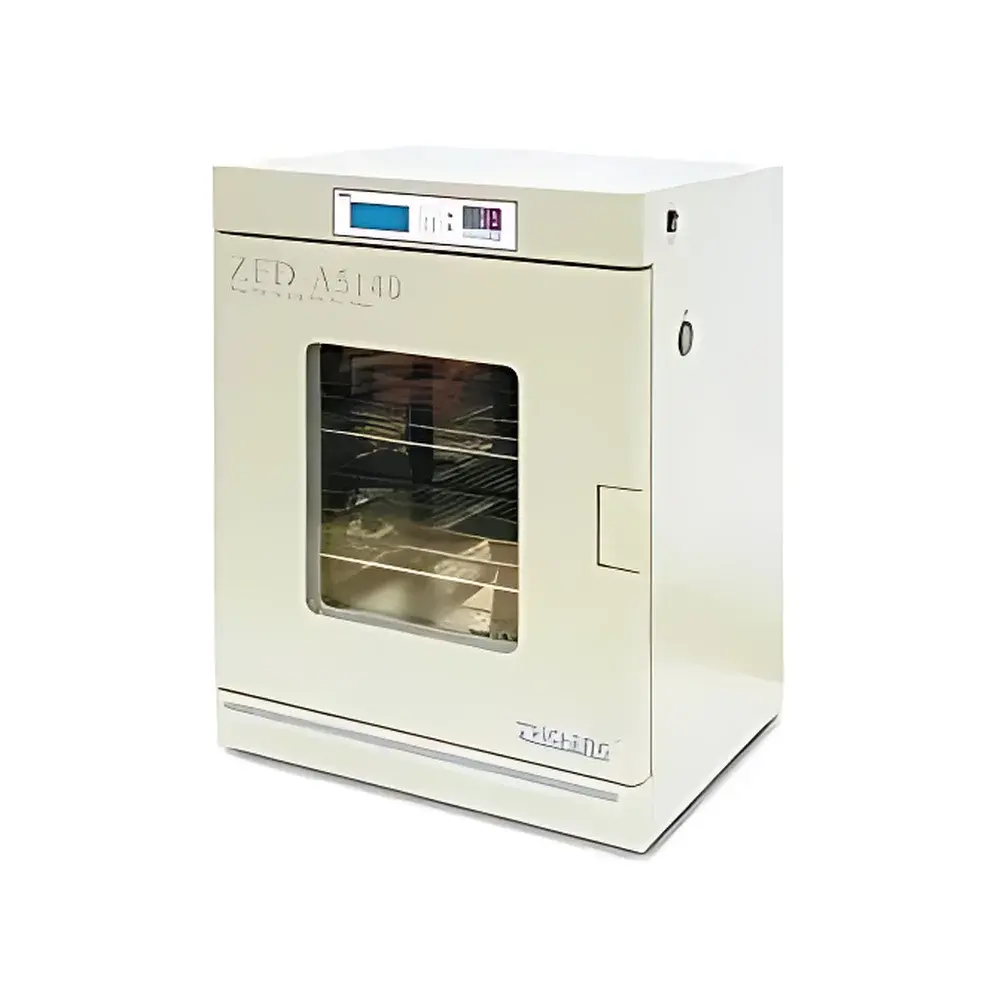
Zhicheng ZXFD-A5090 Ten-Stage Programmable Forced-Air Dry Oven with Bottom Heating
| Brand | Zhicheng |
|---|---|
| Origin | Shanghai, China |
| Manufacturer Type | Direct Manufacturer |
| Country of Origin | China |
| Model | ZXFD-A5090 |
| Pricing | Upon Request |
| Capacity | 90 L |
| Temperature Range | Ambient +5°C to 200°C |
| Temperature Resolution | 0.1°C |
| Temperature Uniformity | ≤ ±2.5% (at max operating temperature) |
| Temperature Fluctuation | ≤ ±1°C |
| Programmability | 10 segments / 18 steps |
| Segment Duration | 1–999 minutes per step |
| Control Method | Fuzzy Logic Control |
| Display | LCD |
| Airflow Direction | Vertical upward forced convection from bottom heater |
| Internal Chamber Dimensions (W×D×H) | 400 × 445 × 485 mm |
| External Dimensions (W×D×H) | 590 × 575 × 865 mm |
| Net Weight | 55 kg |
| Power Supply | AC 220 V, 50/60 Hz |
| Rated Power | 1100 W |
| Shelving | 2 standard stainless steel electropolished shelves (expandable to 4) |
| Safety Features | Independent overtemperature cut-off (adjustable 30–80°C), independent overheat prevention device, leakage current protection, overcurrent trip, power failure alarm, sensor fault detection, upper/lower limit temperature alarms |
| Data Interface | RS-232 port |
| Optional Output | Embedded thermal microprinter |
| Insulation | Double-wall insulated chamber with outer door glass compliant with EN 61000-3-2 and EN 61000-6-3 safety standards |
| Interior Material | Mirror-finish stainless steel |
| Door | Tempered double-glazed inner door |
Overview
The Zhicheng ZXFD-A5090 is a precision-engineered, ten-stage programmable forced-air dry oven designed for laboratory-grade thermal processing in life science, pharmaceutical, and materials research environments. Unlike conventional static ovens, it employs bottom-mounted vertical airflow convection—optimized to ensure uniform heat distribution across the entire 90 L working chamber. Its core operational principle relies on dry-heat sterilization (DHS), leveraging sustained elevated temperatures (up to 200°C) to induce irreversible microbial inactivation through protein denaturation, oxidative damage, and electrolyte imbalance. This mechanism complies with established dry-heat validation protocols referenced in ISO 14937, USP , and EU Annex 1 for depyrogenation and sterility assurance of heat-stable labware, glassware, and instrumentation components.
Key Features
- Fuzzy logic temperature control system delivering high reproducibility and adaptive response to load-induced thermal inertia
- 10-segment programmable cycle architecture supporting up to 18 discrete steps—including pre-set “zero” segment for delayed start and conditional transitions between temperature ramps, holds, and cooling phases
- Bottom-heating configuration with engineered vertical airflow path minimizes thermal stratification and enhances chamber uniformity (≤ ±2.5% at 200°C)
- Triple-layer safety architecture: independently wired overtemperature cut-off (30–80°C adjustable), dedicated overheat prevention device, and electromagnetic circuit breaker for leakage/overcurrent protection
- Real-time self-diagnostic monitoring including sensor fault detection, power interruption logging, and upper/lower temperature limit violation alerts
- LCD interface with clock display, parameter password lock, temperature calibration offset adjustment, and automatic power-resume functionality after grid recovery
- Mirror-finish 304 stainless steel interior with electropolished shelving and tempered double-glazed inner door—designed for easy decontamination and long-term corrosion resistance
- RS-232 serial interface enables integration into centralized lab management systems; optional embedded thermal printer supports GLP-compliant hardcopy record generation
Sample Compatibility & Compliance
The ZXFD-A5090 accommodates a broad range of heat-tolerant materials including borosilicate glassware, stainless steel instruments, ceramic substrates, polymer-based carriers, and inert sample containers. Its chamber geometry and airflow design prevent turbulence-induced sample displacement while maintaining laminar thermal exposure—critical for consistent depyrogenation outcomes. The unit meets essential electrical safety requirements under IEC 61010-1 and electromagnetic compatibility (EMC) standards EN 61326-1 and EN 61000-6-3. For regulated environments, its programmable logic, audit-trail-capable event logging (via RS-232), and parameter password protection support alignment with FDA 21 CFR Part 11 data integrity expectations when paired with validated software platforms.
Software & Data Management
While the ZXFD-A5090 operates as a standalone instrument with embedded firmware, its RS-232 interface permits bidirectional communication with external PCs or LIMS using ASCII-based command protocols. Users may export time-stamped temperature profiles, alarm logs, and program execution records for retrospective analysis. When deployed in GxP settings, the combination of parameter memory retention, power-failure recovery, and printable thermal output satisfies minimum documentation requirements for equipment qualification (IQ/OQ) and routine operational verification. No proprietary software installation is required—standard terminal emulators or custom Python/Node.js scripts can parse and archive transmitted data streams.
Applications
- Dry-heat sterilization and depyrogenation of glass vials, pipettes, Petri dishes, and surgical instruments per ISO 17665-1
- Moisture removal from hygroscopic reagents, excipients, and reference standards prior to gravimetric analysis
- Thermal denaturation studies of purified proteins and nucleic acid samples under controlled ramp-and-hold conditions
- Pre-conditioning of building materials, electronic components, and composite resins for accelerated aging tests
- Baking and curing of thin-film coatings, solder pastes, and ceramic precursors in materials R&D labs
- Residual solvent evaporation from chromatography columns, TLC plates, and HPLC sample vials
- Environmental stress testing of packaging integrity under elevated temperature and low-humidity conditions
FAQ
What is the maximum validated sterilization temperature for dry-heat applications?
The ZXFD-A5090 achieves stable operation up to 200°C, which aligns with standard dry-heat sterilization cycles requiring ≥160°C for 120 minutes or ≥170°C for 60 minutes per ISO 14937 Annex C.
Can the oven maintain temperature uniformity with multiple loaded shelves?
Yes—the vertical bottom-up airflow and symmetrical chamber geometry ensure ≤±2.5% uniformity even with four electropolished stainless steel shelves installed and fully loaded.
Is the RS-232 interface compatible with modern Windows/macOS systems?
Yes—using a USB-to-RS-232 adapter and standard terminal software (e.g., Tera Term, CoolTerm), users can establish reliable serial communication without driver conflicts.
Does the unit support GLP-compliant electronic record keeping?
It provides foundational capabilities—parameter password protection, non-volatile program storage, timestamped alarm logs, and optional printed output—but full 21 CFR Part 11 compliance requires integration with validated third-party data acquisition software.
How does the fuzzy logic controller improve thermal stability compared to PID-only systems?
Fuzzy logic dynamically adjusts heating power based on real-time deviation magnitude, rate-of-change, and historical error trends—reducing overshoot during ramp phases and minimizing steady-state fluctuation (<±1°C) under variable load conditions.