
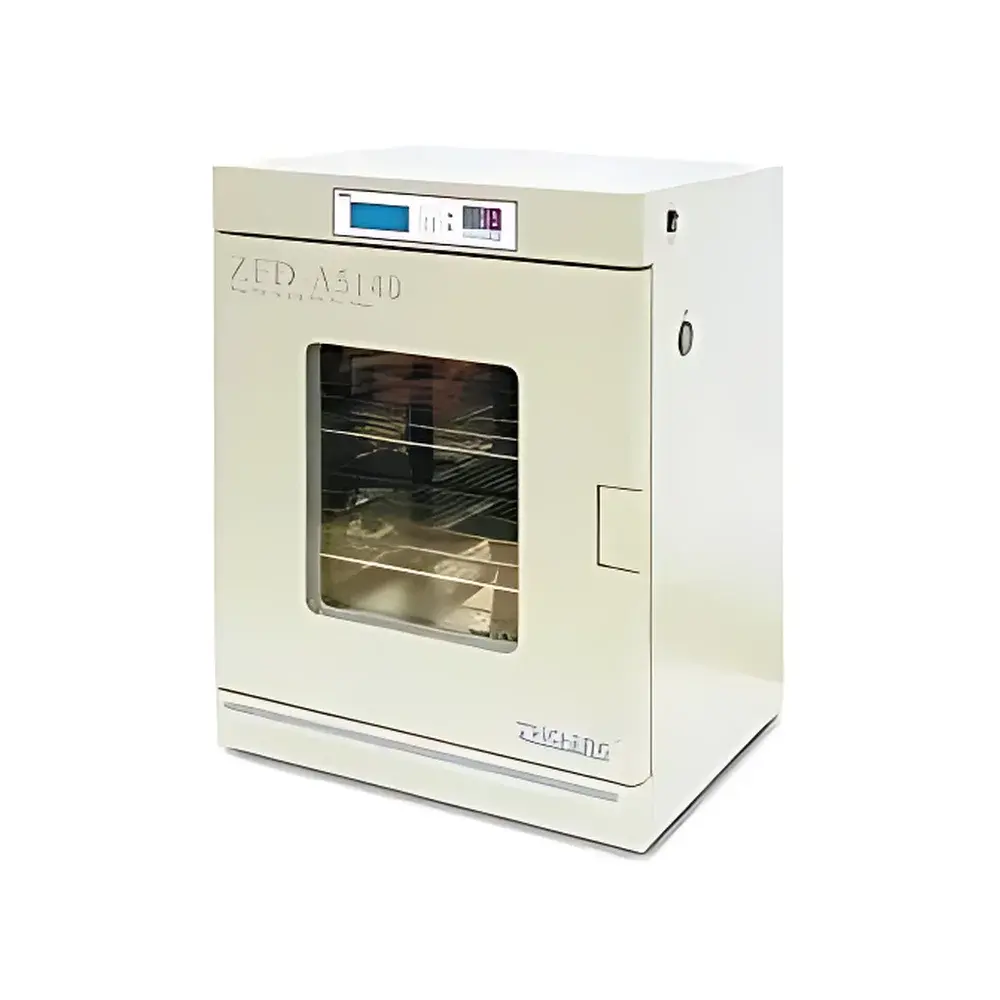
ZhiCheng ZXFD-A5430 Ten-Stage Programmable Forced-Air Dry Oven with Bottom-Mounted Heating
| Brand | ZhiCheng |
|---|---|
| Origin | Shanghai, China |
| Manufacturer Type | Direct Manufacturer |
| Region of Origin | Domestic (China) |
| Model | ZXFD-A5430 |
| Pricing | Upon Request |
| Capacity | 430 L |
| Temperature Range | Ambient +5°C to 200°C |
| Temperature Resolution | 0.1°C |
| Temperature Uniformity | ≤±2.5% (at max operating temperature) |
| Temperature Fluctuation | ≤±1°C |
| Control Method | Fuzzy Logic Control |
| Display | LCD |
| Airflow Direction | Vertical upward convection from bottom-mounted blower |
| Programming | 10 segments / 18 steps (Segment 0 = pre-set timing |
| Step Duration | 1–999 minutes per step |
| Internal Dimensions (W×D×H) | 700 × 650 × 950 mm |
| External Dimensions (W×D×H) | 890 × 780 × 1420 mm |
| Net Weight | 170 kg |
| Power Supply | AC 220 V, 50/60 Hz |
| Rated Power | 3100 W |
| Shelving | 2 standard stainless steel electropolished shelves (expandable to 4) |
| Safety Features | Independent overtemperature cut-off (adjustable 30–80°C), independent overheat prevention device, leakage current protection, overcurrent circuit breaker, power failure alarm, sensor fault detection, upper/lower limit temperature alarms, self-diagnostic system |
| Interface | RS-232 serial port |
| Optional Output | Embedded thermal microprinter |
| Insulation | High-efficiency ceramic fiber + double-wall construction |
| Interior Material | Mirror-finish 304 stainless steel |
| Door | Double-glazed tempered glass with outer layer compliant with EN 61000-3-2 safety standards |
| Heating System | Full-perimeter, bottom-mounted heating elements with 360° radiant and convective heat distribution |
Overview
The ZhiCheng ZXFD-A5430 is a precision-engineered, ten-stage programmable forced-air dry oven designed for laboratory-grade thermal processing in life science, pharmaceutical, clinical, and materials research environments. Unlike conventional static ovens, the ZXFD-A5430 employs bottom-mounted vertical airflow convection—optimized via a low-turbulence, micro-adjustable blower system—to ensure uniform thermal distribution across its 430 L chamber. Its core operational principle relies on dry-heat sterilization (DHS), leveraging sustained elevated temperatures (up to 200°C) to induce irreversible microbial inactivation through protein denaturation, oxidative damage to cellular membranes, and intracellular electrolyte imbalance. This mechanism complies with internationally recognized dry-heat validation protocols referenced in ISO 14937, USP , and EU GMP Annex 1 for depyrogenation and sterile equipment conditioning.
Key Features
- Fuzzy logic temperature control algorithm delivering high reproducibility and minimal overshoot during multi-step thermal transitions
- 10-segment programmable sequence (18 total steps), supporting complex thermal profiles including ramp-hold-cool cycles, time-dependent gradient heating, and conditional segment triggering
- Bottom-mounted heating architecture combined with full-perimeter radiant elements and laminar air guidance ensures ≤±2.5% temperature uniformity at maximum operating temperature (200°C), verified per ASTM E2234
- Dual-safety architecture: independent adjustable overtemperature limiter (30–80°C range) and hardwired overheat cut-off device, both electrically isolated from the main controller
- Comprehensive self-diagnostic suite—including sensor fault detection, power interruption logging, upper/lower limit violation alerts, and real-time thermal drift monitoring—enabling GLP-compliant audit trails
- Mirror-finish 304 stainless steel interior with electropolished shelving and seamless corner welds to minimize particle retention and support cleaning validation per ISO 14644-1 Class 5 requirements
- Double-glazed tempered glass door with certified low-surface-temperature outer pane (EN 61000-3-2 compliant), ensuring operator safety without compromising visibility
- Embedded RS-232 interface supports bidirectional communication with LIMS or SCADA systems; optional thermal microprinter provides timestamped, tamper-evident hardcopy output of setpoints, actual temperatures, and alarm events
Sample Compatibility & Compliance
The ZXFD-A5430 accommodates a broad spectrum of heat-stable sample types—including borosilicate glassware, metal instruments, polymer substrates, ceramic components, and inert particulate matrices—without risk of condensation-induced contamination. Its dry-heat environment eliminates moisture-related degradation pathways, making it suitable for depyrogenation of glass vials (≥250°C for ≥30 min equivalent kinetics at 200°C per USP ), pre-sterilization drying of surgical tools, residual solvent removal from chromatography columns, and thermal aging studies of electronic encapsulants. The unit meets CE marking requirements under the EU Machinery Directive 2006/42/EC and Electromagnetic Compatibility Directive 2014/30/EU. All electrical safety design conforms to IEC 61010-1:2010 for laboratory equipment. Firmware supports configurable password-protected parameter access and automatic timestamped event logging aligned with FDA 21 CFR Part 11 data integrity expectations.
Software & Data Management
While the ZXFD-A5430 operates via an embedded microcontroller with local LCD interface, its RS-232 port enables integration into centralized lab automation ecosystems. Supported ASCII-based command protocols allow remote initiation/termination of programs, real-time temperature polling (±0.1°C resolution), and retrieval of historical cycle logs—including start/stop timestamps, segment-wise dwell times, deviation alerts, and diagnostic flags. Data export formats include CSV and fixed-width text, compatible with Microsoft Excel, LabArchives ELN, and custom Python-based analysis pipelines. All parameter changes are recorded with user ID (if authenticated via external system), timestamp, and pre-/post-value—fulfilling ALCOA+ principles for raw data attribution and traceability. Optional firmware updates maintain alignment with evolving ISO/IEC 17025 documentation requirements.
Applications
- Depyrogenation and dry-heat sterilization of glassware, pipettes, and stainless-steel components in QC/QA labs
- Moisture content reduction in pharmaceutical excipients prior to tablet compression or lyophilization
- Thermal curing of epoxy resins, silicone coatings, and printed circuit board laminates
- Baking and annealing of geological samples, catalyst supports, and battery electrode materials
- Accelerated stability testing per ICH Q1A(R2) guidelines under controlled dry-heat stress conditions
- Pre-heating and conditioning of environmental monitoring sensors and calibration standards
- Drying of botanical extracts, soil samples, and agricultural specimens without oxidation artifacts
- Validation of thermal kill kinetics for Bacillus atrophaeus spores (ATCC 9372) as biological indicators
FAQ
What is the difference between ZXFD and ZXRD series ovens?
The ZXFD series features bottom-mounted vertical airflow for optimal uniformity in tall, narrow loads (e.g., stacked glassware), while the ZXRD series uses rear-mounted horizontal convection optimized for shallow, wide-format trays.
Can the ZXFD-A5430 be validated for GMP use?
Yes—the unit supports IQ/OQ documentation packages, includes hardware-level redundancy in safety circuits, and provides auditable digital logs required for FDA 21 CFR Part 11 and EU Annex 11 compliance.
Is the temperature uniformity specification verified at all setpoints?
Uniformity is tested and certified at 100°C, 150°C, and 200°C per ASTM E2234; interpolation is permitted for intermediate temperatures within the operating range.
Does the oven support Ethernet or USB connectivity?
No—only RS-232 serial interface is provided; however, third-party USB-to-serial adapters with signed drivers are widely deployed in regulated labs without impact on validation status.
What maintenance is required for long-term calibration stability?
Annual verification using NIST-traceable PT100 probes is recommended; door gasket integrity and blower motor performance should be inspected quarterly per preventive maintenance SOPs.




