
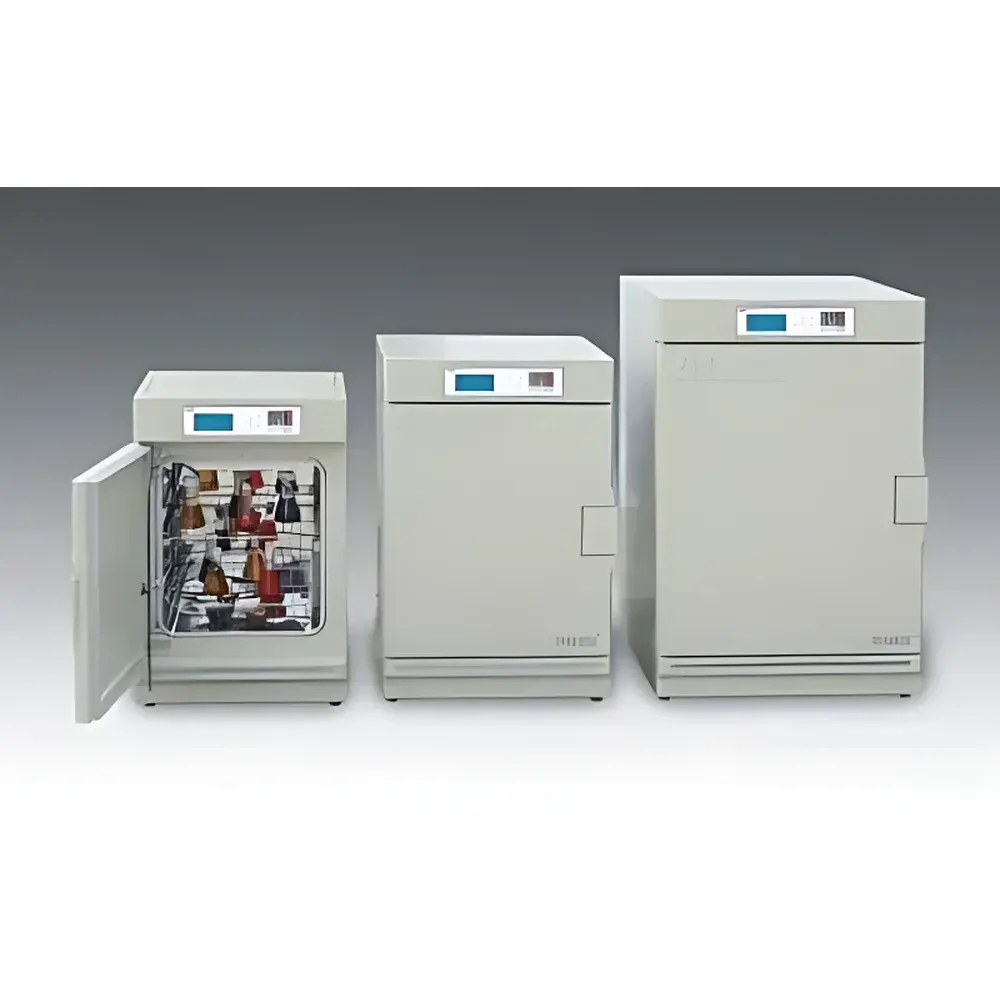
Zhicheng ZXGP-A2270 Water-Jacketed Programmable Incubator with 10-Stage Temperature Curve Control
| Brand | Zhicheng |
|---|---|
| Origin | Shanghai, China |
| Manufacturer Type | Direct Manufacturer |
| Region Classification | Domestic (China) |
| Model | ZXGP-A2270 |
| Quotation | Upon Request |
| Heating Method | Water-jacketed |
| Temperature Range | Ambient +5°C to 60°C |
| Temperature Resolution | 0.1°C |
| Temperature Uniformity | ≤±1.0°C at 37°C |
| Temperature Fluctuation | ≤±0.5°C |
| Programming Capacity | 10 segments / 18 steps |
| Time per Step | 1–999 minutes |
| Display | LCD |
| Air Circulation | Top-mounted micro-airflow system |
| Chamber Volume | 270 L |
| Interior Dimensions (W×D×H) | 600×600×750 mm |
| External Dimensions (W×D×H) | 760×725×1120 mm |
| Net Weight | 115 kg |
| Power Supply | AC 220 V, 50/60 Hz |
| Rated Power | 1800 W |
| Safety Features | Independent overtemperature cutoff (adjustable 30–80°C), independent overheat prevention device, leakage current protection, overcurrent trip, power-failure alarm, sensor fault detection, upper/lower limit temperature alarms |
| Interface | RS-232 serial port |
| Optional Output | Embedded thermal printer |
| Shelving | 2 standard stainless steel electropolished shelves (max. 4) |
| Interior Material | Mirror-finish stainless steel |
| Door Configuration | Dual-door design with inner tempered glass observation window |
| Control Algorithm | Fuzzy logic control |
| Operating Ambient | 5–35°C |
Overview
The Zhicheng ZXGP-A2270 is a water-jacketed programmable incubator engineered for precise, stable, and reproducible temperature control in life science laboratories. Unlike forced-air convection units, its water-jacketed thermal architecture provides superior thermal inertia and insulation—minimizing internal temperature fluctuations during ambient variations or door openings. The system employs fuzzy logic control algorithms to dynamically adjust heating output based on real-time feedback from high-response platinum resistance temperature sensors (PT100-class equivalent), ensuring rapid stabilization and long-term drift compensation. Designed for GLP-compliant environments, the incubator maintains uniform chamber conditions across its 270 L working volume, with validated uniformity of ≤±1.0°C at 37°C—a critical benchmark for mammalian cell culture, microbial growth, and enzyme activity assays. Its dual-door configuration (outer insulated door + inner tempered glass observation door) reduces thermal loss while enabling non-invasive monitoring, supporting uninterrupted experimental integrity.
Key Features
- 10-segment, 18-step programmable temperature profile capability—enabling complex thermal protocols such as stepwise ramping, hold-and-soak cycles, and timed transitions for developmental biology or circadian rhythm studies.
- Fuzzy logic temperature regulation with 0.1°C resolution and ≤±0.5°C fluctuation, delivering tighter control than conventional PID-based systems under dynamic load conditions.
- Dual independent safety layers: an adjustable overtemperature prevention device (30–80°C range) and a hardwired overheat cutoff—both certified to IEC 61000-4-5 surge immunity and EN 61010-1 safety standards.
- Comprehensive self-diagnostic suite: power-failure logging, sensor continuity verification, upper/lower limit violation alerts, and automatic recovery upon mains restoration (with parameter memory retention).
- Mirror-finish stainless steel interior and electropolished stainless steel shelving resist corrosion and facilitate ISO 14644-1 Class 5-compatible cleaning protocols; seamless welded corners eliminate microbial harborage points.
- Top-mounted micro-airflow circulation system ensures laminar, low-velocity air movement—critical for minimizing shear stress on sensitive adherent cultures and preventing condensation on Petri dishes.
Sample Compatibility & Compliance
The ZXGP-A2270 accommodates standard laboratory vessels—including stacked T-flasks (up to 175 cm²), multiwell plates (6–96-well), roller bottles, and serum vials—within its 600 × 600 × 750 mm chamber. Its water-jacketed construction eliminates hot/cold spots common in air-jacketed units, making it suitable for applications requiring strict thermal consistency per ASTM E1249 (Standard Practice for Performance Testing of Laboratory Incubators). The unit complies with GB/T 23797–2009 (Chinese national standard for incubators) and incorporates electrical safety features aligned with IEC 61010-1:2010. While not FDA 21 CFR Part 11–certified out-of-the-box, its RS-232 interface supports integration with validated third-party data acquisition systems for audit-trail generation in GMP-regulated bioprocessing workflows.
Software & Data Management
The embedded microcontroller provides local operation via intuitive LCD interface with multilingual menu navigation (English default). All program parameters—including segment start times, target temperatures, dwell durations, and ramp rates—are stored in non-volatile memory with password-protected access (user-defined 4-digit code). Real-time temperature logging is available through the RS-232 port using standard Modbus RTU protocol, enabling direct connection to LabVIEW, MATLAB, or LIMS platforms. Optional embedded thermal printer outputs time-stamped temperature traces and alarm events—serving as primary records for internal QA audits. Data export supports CSV formatting for traceability and trend analysis in accordance with ISO/IEC 17025 clause 7.7.
Applications
This incubator serves core functions across academic, clinical, and industrial life science settings: bacterial and fungal culture (e.g., E. coli, S. cerevisiae), hybridoma expansion, stem cell maintenance, tissue explant incubation, BOD testing, pharmaceutical stability studies (ICH Q1A), and storage of temperature-sensitive reagents (e.g., sera, growth factors, restriction enzymes). Its programmable curve functionality supports specialized protocols such as thermal shock induction in Drosophila genetics, synchronized sporulation in Bacillus species, and controlled denaturation/renaturation assays. Environmental research labs utilize its stability for soil microcosm incubations and aquatic toxicity testing under regulated thermal regimes.
FAQ
What is the difference between water-jacketed and air-jacketed incubators?
Water-jacketed incubators use a surrounding layer of heated water to maintain chamber temperature, offering higher thermal mass and reduced sensitivity to ambient fluctuations—ideal for long-duration, unattended experiments.
Can the ZXGP-A2270 be validated for GMP use?
Yes—its consistent uniformity, documented safety interlocks, and RS-232 data logging support IQ/OQ/PQ execution per ASTM E2500; final qualification requires site-specific mapping and alarm response testing.
Is the thermal printer optional or built-in?
The thermal printer is factory-integrated and cannot be retrofitted; it operates independently of external software and prints alarm logs and real-time temperature snapshots.
How does the “10-segment, 18-step” programming work?
Each segment may contain up to two steps (e.g., ramp + hold), allowing flexible sequencing—for example: segment 1 = ramp from 25°C to 37°C over 30 min; segment 2 = hold at 37°C for 72 h; segment 3 = cool to 4°C and hold—totaling 10 segments maximum.
Does the unit support remote monitoring via Ethernet or Wi-Fi?
No—only RS-232 serial communication is provided; network connectivity requires external serial-to-Ethernet converters compliant with RFC 2217.




