
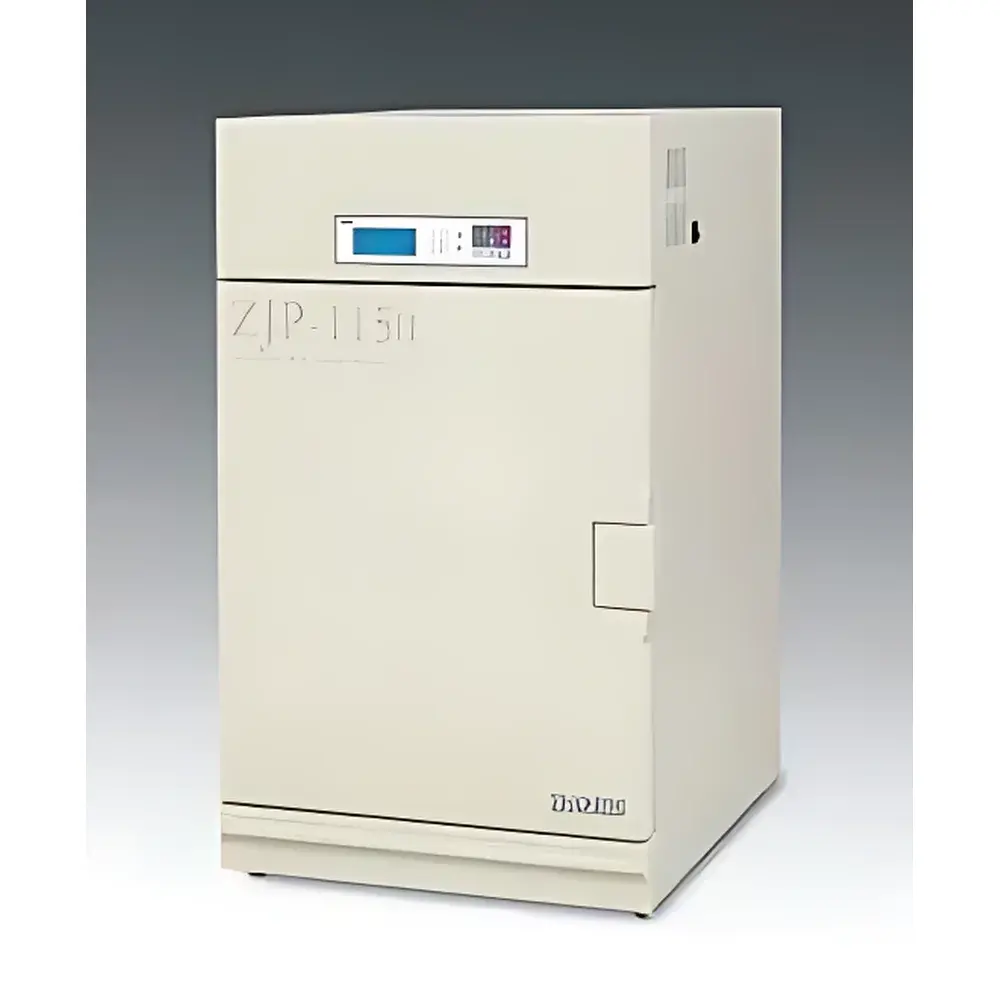
Zhicheng ZXJP-A1230 Ten-Stage Programmable Mold Incubator
| Brand | Zhicheng |
|---|---|
| Origin | Shanghai, China |
| Manufacturer Type | Direct Manufacturer |
| Region of Origin | Domestic (China) |
| Model | ZXJP-A1230 |
| Pricing | Upon Request |
| Capacity | 230 L |
| Temperature Range | 0–65 °C |
| Temp. Resolution | 0.1 °C |
| Temp. Uniformity | ≤ ±1 °C (at 37 °C) |
| Temp. Fluctuation | ≤ ±0.5 °C |
| Humidity Range | 40–95 %RH |
| Humidity Resolution | 0.1 %RH |
| Humidity Fluctuation | ≤ ±2 %RH |
| Humidity Uniformity | ≤ ±6 %RH |
| Control Logic | Fuzzy Logic |
| Display | LCD |
| Air Circulation | Forced convection with turbine fan |
| Door Design | Double-layer door with internal tempered glass window |
| Power Supply | AC 220 V, 50/60 Hz |
| Power Consumption | 1000 W |
| Net Weight | 130 kg |
| Internal Dimensions (W×D×H) | 600 × 550 × 700 mm |
| External Dimensions (W×D×H) | 740 × 790 × 1400 mm |
| Shelving | 2 standard stainless steel electropolished shelves (expandable to 4) |
| Safety Systems | Independent overtemperature cut-off (adjustable 30–80 °C), leakage current protection, overcurrent trip, compressor overload protection, low-water-level alarm, sensor fault detection, power-failure recovery, parameter password lock |
Overview
The Zhicheng ZXJP-A1230 Ten-Stage Programmable Mold Incubator is an engineered environmental chamber designed for precise, reproducible control of temperature and relative humidity across extended experimental timelines. It operates on a dual-parameter fuzzy logic control architecture—integrating high-response capacitive humidity sensors and platinum resistance temperature detectors (PT100)—to maintain stable microclimates essential for fungal growth, microbial culture preservation, spore germination studies, and long-term stability testing of biological samples. Unlike conventional static incubators, the ZXJP-A1230 implements a stepwise, multi-segment programming protocol capable of executing up to ten distinct environmental profiles, each comprising up to eighteen sequential steps. This enables researchers to simulate dynamic natural conditions—such as diurnal humidity cycling or gradual thermal ramping—critical for mycological research, pharmaceutical stability protocols (ICH Q1A–Q1E), and environmental stress response assays.
Key Features
- Ten-stage, eighteen-step programmable controller supporting time-dependent transitions between user-defined temperature/humidity setpoints (step duration: 1–999 minutes)
- Intelligent frost-free refrigeration system using R134a refrigerant with variable-speed compressor modulation for energy-efficient, condensation-free operation
- Secondary water reservoir design with automatic replenishment—eliminates manual refilling during extended unattended runs
- High-efficiency forced-air circulation via forward-curved turbine blower; optimized airflow path ensures uniform distribution (≤ ±1 °C at 37 °C; ≤ ±6 %RH spatial variance)
- Double-wall insulated chamber with inner tempered glass door and mirror-finish electropolished stainless-steel interior (304 grade), facilitating cleaning validation and minimizing contamination risk
- Comprehensive safety architecture: independent adjustable overtemperature limiter (30–80 °C), dual-stage thermal cutoffs, earth-leakage circuit breaker, and real-time self-diagnostic alerts (low water, sensor failure, power interruption)
- LCD interface with clock display, parameter password protection, calibration offset adjustment, and power-loss recovery functionality
Sample Compatibility & Compliance
The ZXJP-A1230 accommodates standard microbiological formats—including Petri dishes (up to 150 mm), multi-well plates, slant tubes, and Erlenmeyer flasks—within its 230 L working volume. Its geometry-optimized cavity minimizes dead zones and supports ISO 14644-1 Class 7 cleanroom-compatible handling when used in conjunction with laminar flow hoods. The unit meets general laboratory safety requirements per IEC 61010-1 and conforms to electromagnetic compatibility standards EN 61326-1. While not certified for GLP/GMP production environments out-of-the-box, its audit-ready features—including parameter memory logging, timestamped event records, and RS-232 serial output—support integration into validated workflows compliant with FDA 21 CFR Part 11 when paired with appropriate data acquisition software.
Software & Data Management
Equipped with an industry-standard RS-232 communication port, the ZXJP-A1230 enables bidirectional data exchange with external PCs or SCADA systems. Optional embedded thermal printer provides hard-copy traceability of operational parameters, alarms, and runtime logs—facilitating documentation for ISO/IEC 17025-accredited labs. All configuration changes, setpoint modifications, and alarm events are timestamped and stored in non-volatile memory. Firmware supports firmware-upgradable logic modules for future protocol expansion. No proprietary software installation is required for basic monitoring; ASCII-based command sets allow integration into custom LabVIEW, Python, or MATLAB automation scripts.
Applications
- Mycological cultivation of Aspergillus, Penicillium, Cladosporium, and other filamentous fungi under controlled hygrothermal regimes
- BOD5 and microbial respiration assays requiring stable 20–25 °C / 60–80 %RH conditions per APHA Standard Methods
- Seed germination and plant tissue culture studies involving alternating humidity cycles
- Stability testing of diagnostic reagents, vaccines, and lyophilized biologics per ICH guidelines
- Environmental simulation for corrosion testing of medical device packaging materials
- Long-term storage of bacterial and yeast cultures where moisture-sensitive viability must be preserved
FAQ
What is the maximum number of programmable segments supported?
The ZXJP-A1230 supports up to ten independent segments, each containing up to eighteen sequential steps for temperature and humidity profile definition.
Can the incubator operate continuously during power interruptions?
Yes—it features automatic restart and parameter restoration after power recovery, retaining all active program states and setpoints.
Is remote monitoring possible without optional hardware?
Basic status readout (current temp/RH, setpoint, alarm status) is accessible via RS-232 using terminal emulation; full telemetry requires integration with third-party data loggers or custom software.
What maintenance intervals are recommended for optimal sensor accuracy?
Capacitive RH sensors should be verified annually against NIST-traceable hygrometers; PT100 probes require calibration every 6 months if used in GxP-regulated applications.
Does the unit comply with UL or CE safety certification?
The ZXJP-A1230 carries CCC (China Compulsory Certification); CE marking is available upon request for EU-bound units with supplementary EMC and LVD testing reports.




