
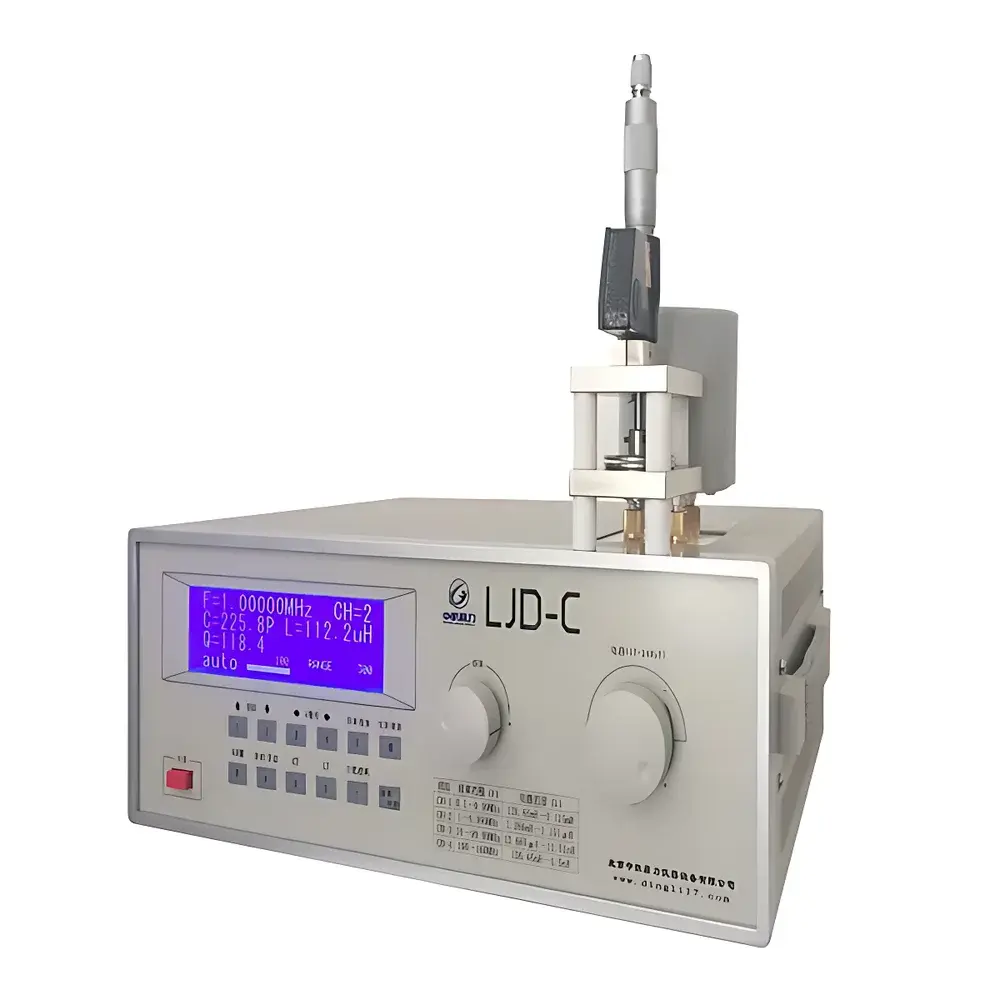
Zhonghang Dingli LJD-C High-Frequency Dielectric Constant and Loss Tangent Analyzer
| Brand | Zhonghang Dingli |
|---|---|
| Origin | Beijing, China |
| Manufacturer Type | Authorized Distributor |
| Product Origin | Domestic (China) |
| Model | LJD-C |
| Price | USD 3,950 (FOB Beijing) |
Overview
The Zhonghang Dingli LJD-C High-Frequency Dielectric Constant and Loss Tangent Analyzer is a precision impedance measurement instrument engineered for quantitative characterization of dielectric properties in the RF and microwave frequency range. It operates on the principle of series resonance, where the quality factor (Q) is derived from the voltage magnification ratio across a tuned LC circuit at resonance — defined as Q = XR/R, where XR is reactance and R is effective series resistance. By precisely measuring resonant frequency (fr), distributed capacitance (C), inductance (L), and Q, the instrument enables direct calculation of complex permittivity (ε* = ε′ − jε″), dielectric loss tangent (tan δ = ε″/ε′), and high-frequency material loss mechanisms. Designed for laboratory-grade reproducibility, it supports full-parameter extraction without external calibration standards under controlled ambient conditions (20 ± 2 °C, RH < 50 %). Its architecture integrates a DDS-based signal source (0.1 MHz to 160 MHz, 6-digit resolution), microprocessor-controlled stepper-motor-driven main capacitor (18–220 pF), and auto-stabilized excitation amplitude, ensuring traceable, low-drift measurements compliant with fundamental metrological practices for RF dielectrics.
Key Features
- Wide frequency coverage: Four selectable bands — CH1 (0.1–0.999999 MHz), CH2 (1–9.99999 MHz), CH3 (10–99.9999 MHz), CH4 (100–160 MHz)
- High-resolution Q measurement: Range 2–1023, with manual or automatic range switching across five scales (30, 100, 300, 1000)
- Digital main capacitance control: Stepper-motor actuated tuning (18–220 pF), ±1.5 pF accuracy below 150 pF; ±1% above
- Automated resonance search: Dual-mode sweep — frequency-sweep (FSWEEP) and capacitance-sweep (CSWEEP) — for rapid identification of fr and Cr
- Integrated Q pass/fail comparator: Programmable threshold (5–1000); visual “OK”/“NO” indication and audible alert on compliance
- On-board ATmega128 microcontroller: Real-time data acquisition, parameter interpolation, and display management via 4-line LCD
- Low-residual test fixture: Optimized layout minimizes stray inductance (<7 nH residual L0) and parasitic capacitance for accurate small-component measurement
Sample Compatibility & Compliance
The LJD-C analyzer accommodates discrete passive components including wound inductors (4.5 nH–7.9 mH), ceramic/mica capacitors (1–205 pF), and bulk dielectric specimens via custom electrode fixtures. It supports evaluation of PCB substrates (FR-4, Rogers), polymer films, ferrite cores, and RF ceramics under controlled temperature and humidity. While not certified to ISO/IEC 17025, its measurement methodology aligns with ASTM D150 (Standard Test Methods for Dielectric and Resistivity Properties of Solid Electrical Insulating Materials) and IEC 60250 (Methods of Test for Determination of the Permittivity and Dielectric Dissipation Factor of Electrical Insulating Materials). For GMP/GLP environments, raw Q, C, fr, and L values are digitally logged without modification; audit trails require external software integration. The instrument meets CE electromagnetic compatibility requirements per EN 61326-1 and safety standards per EN 61010-1.
Software & Data Management
The LJD-C operates as a stand-alone hardware platform with no embedded PC or proprietary software dependency. All measurement parameters — frequency, main capacitance, Q, calculated L/C, and comparator status — are displayed in real time on the integrated LCD. Data export is achieved via manual transcription or optional RS-232 interface (not standard; requires factory-configured add-on module). When interfaced, ASCII-formatted output includes timestamped records of fr, Cr, Q, and computed tan δ. No firmware-based data encryption, user role management, or FDA 21 CFR Part 11 electronic signature capability is implemented; therefore, for regulated workflows, third-party SCADA or LIMS systems must handle data integrity, version control, and audit logging. Calibration constants (e.g., residual L0, C0) are stored in non-volatile memory and may be updated using manufacturer-provided procedures.
Applications
This analyzer serves core functions in materials science R&D, RF component QA, and academic electromagnetics laboratories. Typical use cases include: quantifying frequency-dependent permittivity dispersion in piezoelectric ceramics; validating low-loss tangent specifications for 5G antenna substrates; screening batch-to-batch consistency of high-Q RF inductors used in power amplifiers; measuring distributed capacitance and self-resonant frequency of SMD chip inductors; characterizing moisture-induced dielectric degradation in epoxy encapsulants; and verifying compliance of microwave absorber materials per MIL-DTL-83528. Its ability to resolve Q-values >150 at 100+ MHz makes it suitable for evaluating thin-film dielectrics in MEMS resonators and LTCC multilayer structures. Educational applications include hands-on instruction in resonant circuit theory, impedance matching, and RF loss mechanisms.
FAQ
What is the maximum measurable dielectric loss tangent (tan δ)?
The instrument does not directly display tan δ but calculates it from Q and measured parameters: tan δ ≈ 1/Q for series-equivalent models. With Q ranging from 2 to 1023, tan δ resolution spans ~0.001 to 0.5. Accuracy depends on residual parameter correction and operator technique.
Can the LJD-C measure bulk solid samples (e.g., polymer slabs)?
Yes — when paired with parallel-plate electrodes (sold separately), it determines complex permittivity using the formula ε′ = Cmeas·d/(ε0·A), where d is thickness and A is electrode area. Requires user-supplied dimensional metrology and surface flatness <1 µm RMS.
Is firmware upgrade support available?
Firmware updates are provided free-of-charge by Zhonghang Dingli upon request for critical bug fixes. No field-upgradable bootloader is implemented; updates require return-to-factory service or authorized technician intervention.
Does the unit comply with ISO 17025 for accredited testing labs?
No — it lacks documented uncertainty budgets, internal reference standards, and automated calibration reporting. It may serve as a Class II working standard when verified against NIST-traceable references per ISO/IEC 17025 Clause 6.5.
What accessories are required for SMD component testing?
A dedicated SMD test fixture (e.g., QBG-3D-compatible clamp) is mandatory. Fixture parasitics must be subtracted manually; typical residual inductance is 7 nH. Contact Zhonghang Dingli for mechanical drawings and mounting specifications.



