
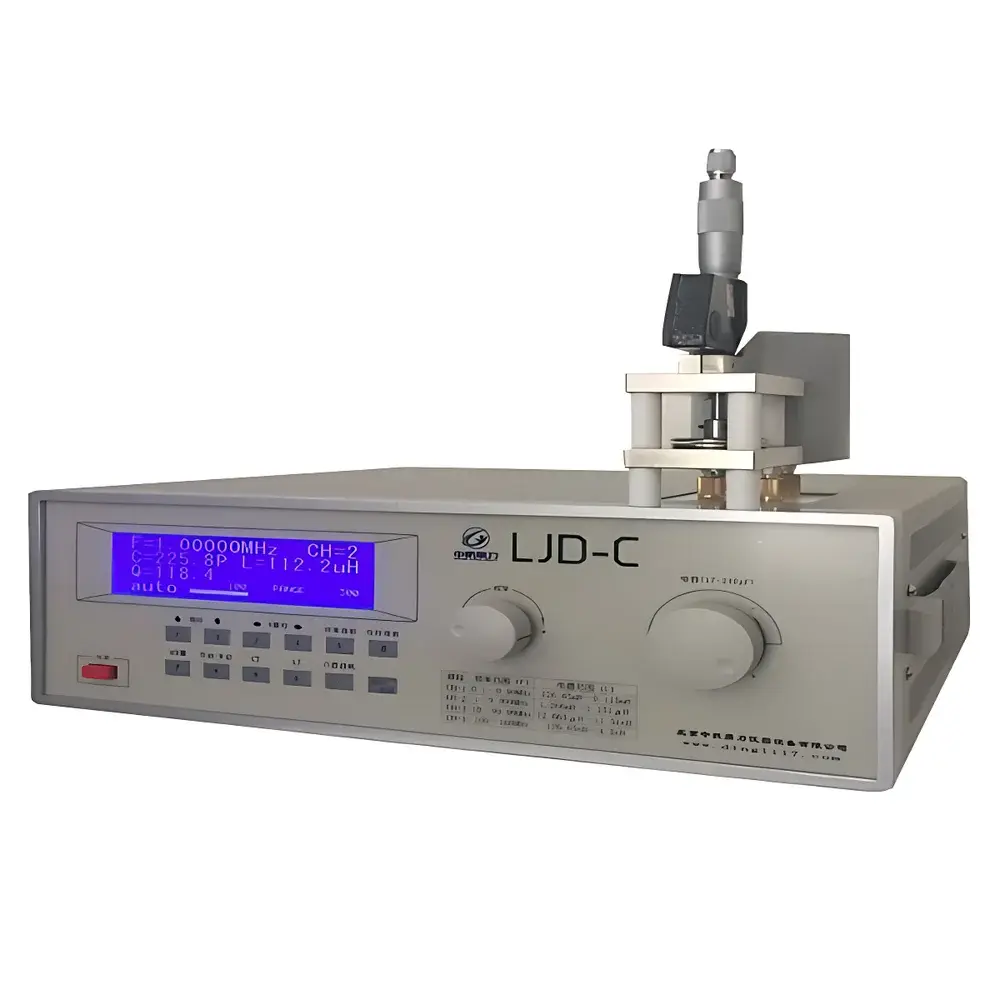
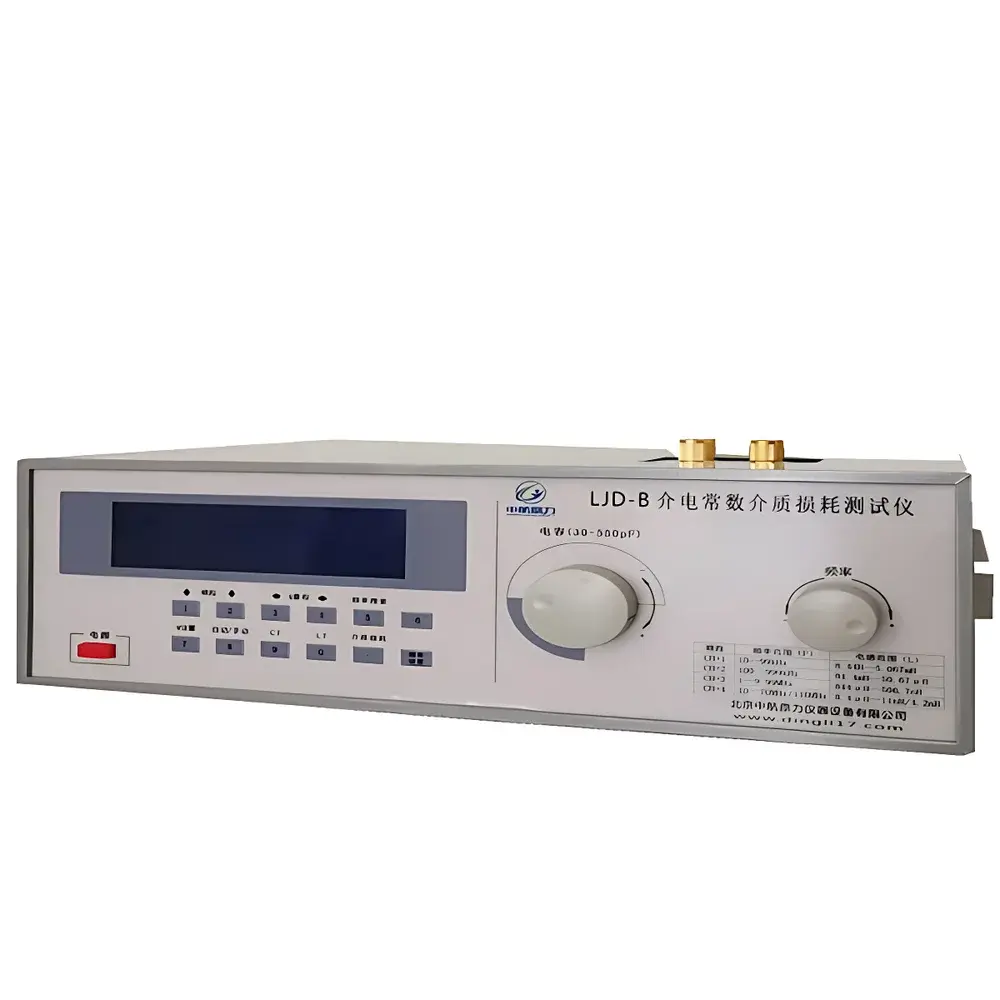
Zhonghang Dingli LJD-C Series High-Frequency Dielectric Constant and Dissipation Factor Analyzer
| Brand | Zhonghang Dingli |
|---|---|
| Origin | Beijing, China |
| Manufacturer Type | Authorized Distributor |
| Product Origin | Domestic (China) |
| Model | LJD-C High-Frequency Dielectric Constant Analyzer |
| Price | USD 3,500 (FOB Beijing) |
Overview
The Zhonghang Dingli LJD-C Series High-Frequency Dielectric Constant and Dissipation Factor Analyzer is a precision Q-meter-based measurement system engineered for the quantitative characterization of dielectric properties of insulating materials under high-frequency alternating electric fields. It operates on the principle of series resonance, where the test specimen—configured as the dielectric of a parallel-plate capacitor—is integrated into a resonant LC circuit with a high-Q inductor. By measuring the quality factor (Q), resonant frequency (fr), and distributed capacitance, the instrument determines both the complex permittivity ε* = ε′ − jε″ and the loss tangent tanδ = ε″/ε′ across a continuous frequency range from 100 kHz to 160 MHz. This method conforms rigorously to standardized test protocols including GB/T 1409–2006 (China), ASTM D150–18 (USA), and IEC 60250 (International), ensuring metrological traceability and interlaboratory comparability for materials used in RF substrates, capacitor dielectrics, aerospace composites, and high-speed PCB laminates.
Key Features
- Direct digital synthesis (DDS) signal source with frequency resolution of 1 × 10⁻⁶ and output stability < ±0.01% over 8-hour operation
- Full digital readout of Q (2–1023), inductance (4.5 nH–140 mH), capacitance (18–240 pF), and frequency (100 kHz–160 MHz)
- Integrated AS916 precision test fixture featuring dual-diameter parallel-plate electrodes (Φ38 mm / Φ50 mm), motorized micrometer with 1 µm resolution, and automatic zeroing function
- Frequency-swept resonance search algorithm enabling rapid identification of fr without manual tuning; supports both auto and manual Q-range switching (30/100/300/1000)
- LKI-1 inductor set (9 units, 50 nH–10 mH) optimized for impedance matching across the full operating band; each inductor characterized for Q ≥ 90–200 at specified fr
- Embedded microprocessor-controlled data acquisition module for automated tanδ and ε′ calculation, eliminating manual interpolation and reducing operator-induced variance
- Compliance-ready architecture: all measurements support GLP audit trails when paired with optional PC-based software (AS2853A-compatible interface)
Sample Compatibility & Compliance
The LJD-C system accommodates solid dielectric specimens in disk form (diameter: 38.4–40 mm or 50.4–52 mm; thickness: 1–5 mm), with optimal performance achieved for planar, void-free samples exhibiting surface flatness ≤ 5 µm. Thin-film or low-permittivity (< ε′ = 3) materials may require stacking per Annex III of GB/T 1409–2006. The AS916 fixture’s calibrated electrode gap (adjustable up to ≥15 mm) and sub-pF parasitic capacitance (<4 × 10⁻⁴ at 1 MHz) ensure minimal boundary-field distortion. All hardware and firmware comply with electromagnetic compatibility (EMC) requirements per GB/T 18268.21 and safety standards per GB 4793.1. Test reports generated via the optional software module include timestamped metadata, operator ID, environmental conditions (T, RH), and instrument calibration status—fully aligned with FDA 21 CFR Part 11 electronic record requirements when validated.
Software & Data Management
The LJD-C integrates seamlessly with the AS2853A-compatible data acquisition and tanδ calculation module, enabling real-time digitization of Q, fr, C, and D (sample thickness). Raw data streams via RS-232 or USB-C to Windows-based analysis software, which applies matrix-corrected algorithms per ASTM D150 Annex A2 to compute ε′, ε″, and tanδ while compensating for residual inductance (Lt) and stray capacitance (Ct). Export formats include CSV, XML, and PDF with embedded uncertainty budgets (k=2, coverage probability 95%). Audit logs record every parameter change, measurement initiation, and calibration event—supporting ISO/IEC 17025 laboratory accreditation workflows.
Applications
This analyzer serves critical R&D and QC functions across multiple sectors: evaluation of ceramic capacitor dielectrics (e.g., BaTiO3-based MLCCs) at 1–100 MHz; screening of polyimide and liquid crystal polymer (LCP) films for 5G antenna substrates; verification of epoxy-glass laminate (FR-4) dispersion behavior up to Ka-band frequencies; qualification of aerospace-grade phenolic resins per MIL-STD-202; and comparative assessment of nanocomposite fillers (e.g., BN, AlN) in thermoset matrices. Its ability to resolve tanδ down to 10−4 makes it suitable for low-loss material certification required by IEEE Std 288 and IPC-4101D.
FAQ
What standards does the LJD-C system validate against?
It fully implements GB/T 1409–2006, ASTM D150–18, and IEC 60250 for measurement of ε′ and tanδ using the series-resonance Q-meter method.
Can the system measure thin films below 1 mm thickness?
Yes—via the stacked-sample protocol detailed in GB/T 1409 Annex C, with thickness correction applied during post-processing.
Is firmware upgradable in the field?
Yes—via USB interface using signed binary packages; version history and cryptographic checksums are logged in non-volatile memory.
Does the AS916 fixture support liquid-phase measurements?
Yes—the optional three-electrode oil-immersion kit (included) enables tanδ testing of transformer oils per IEC 60247 and ASTM D924.
What calibration documentation is supplied?
Each unit ships with NIST-traceable calibration certificate (covering frequency, Q, C, and D axes), uncertainty budget, and as-found/as-left data per ISO/IEC 17025 clause 6.5.



