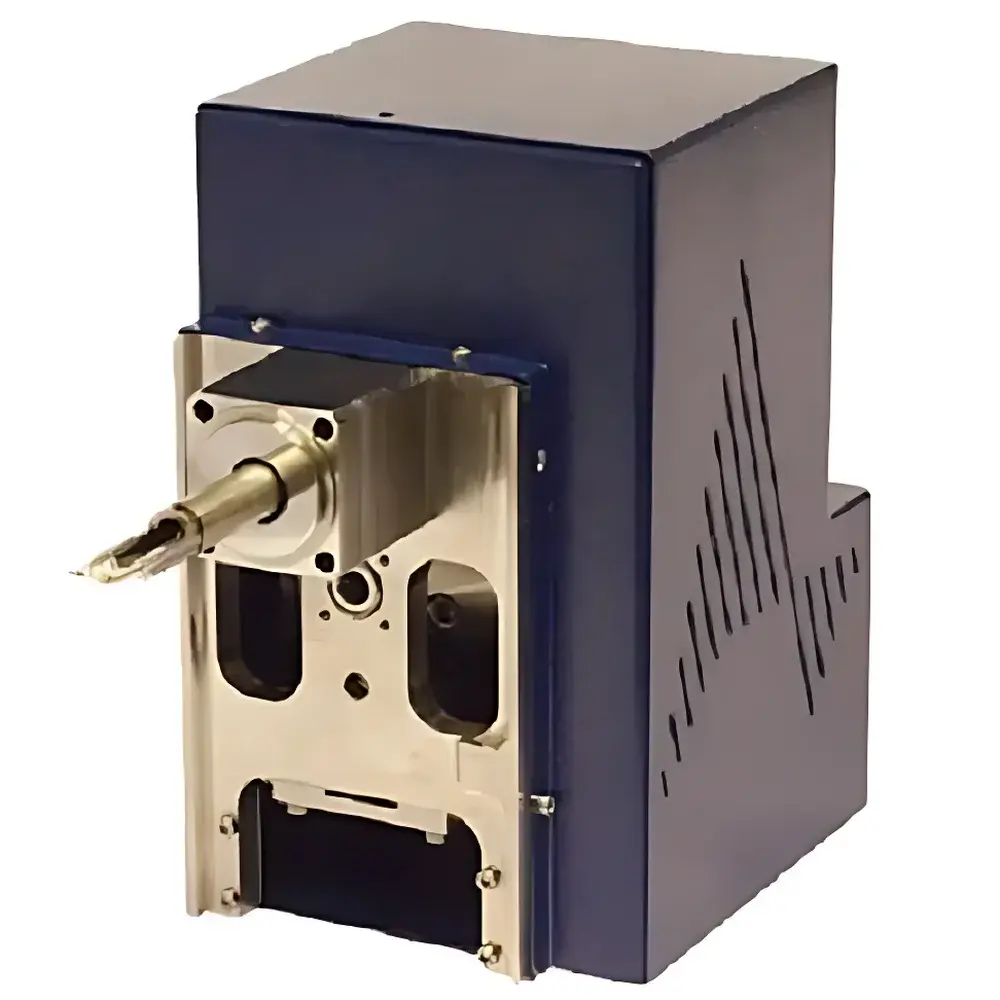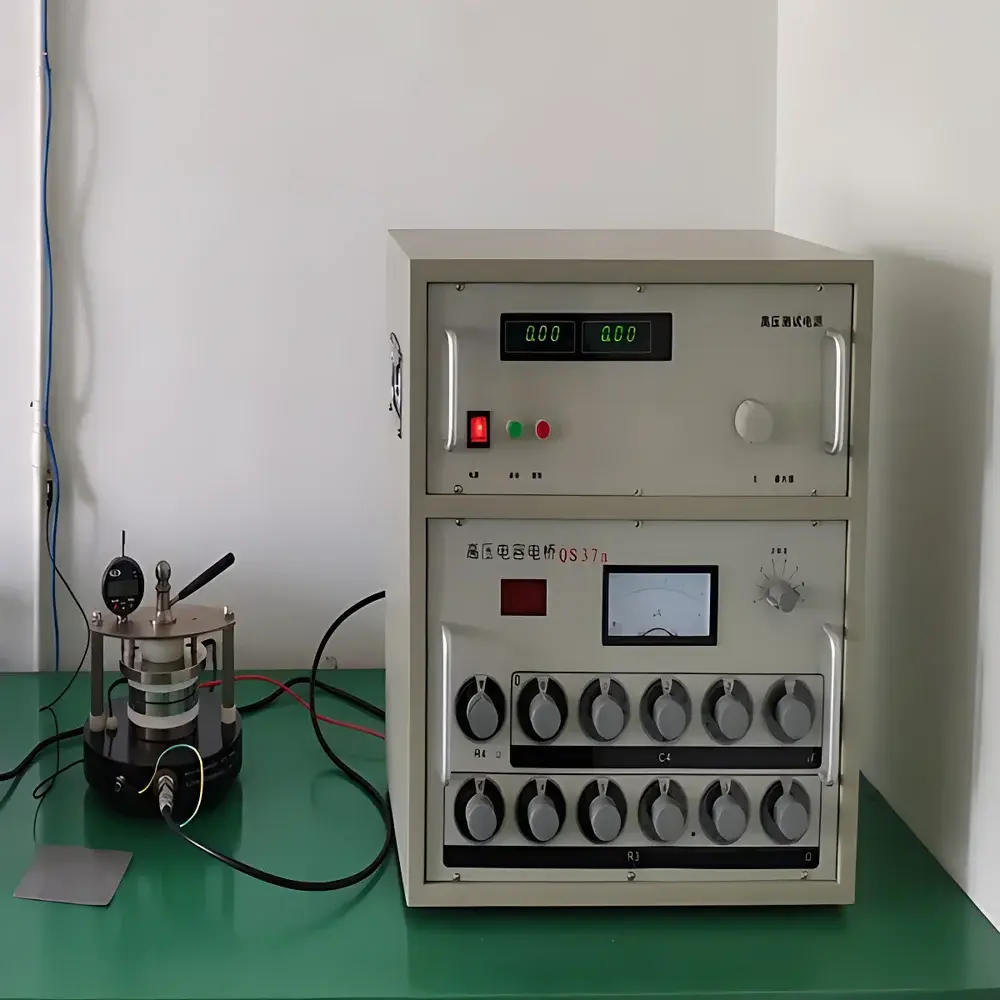
Zhonghang Dingli QS37a High-Voltage Schering Bridge for Power-Frequency Dielectric Constant and Dissipation Factor Measurement
| Brand | Zhonghang Dingli |
|---|---|
| Origin | Beijing, China |
| Model | QS37a |
| High-Voltage Source | 0–2500 V (50 Hz), 0–20 mA |
| Built-in Standard Capacitor | 100 pF (tanδ < 5×10⁻⁵) |
| Measurement Principle | Schering Bridge (Classical Westinghouse/Schering configuration, “direct connection” method for ground-insulated specimens) |
| Capacitance Range (Cₙ = 100 pF, R₄ = 3183.2 Ω) | 40 pF – 20,000 pF ±(0.5% Cₓ + 2 pF) |
| Dissipation Factor Range (tanδ) | 0–1 ±(1.5% tanδₓ + 1×10⁻⁴) |
| Alternate Range (R₄ = 318.3 Ω) | Cₓ = 4–2000 pF |
| Electrode System | Three-terminal guarded electrode per GB/T 1409—2006 (IEC 60250), measuring electrode Ø50 mm (19.6 cm²), guard gap adjustable 0–5 mm, null tanδ ≤ 3×10⁻⁵ at 2000 V |
| Operating Ambient | 20 ± 5 °C, RH 65 ± 5% |
| Dimensions | Ø210 × H180 mm |
| Weight | 6 kg |
Overview
The Zhonghang Dingli QS37a High-Voltage Schering Bridge is a precision AC impedance measurement instrument engineered for standardized power-frequency (50 Hz) dielectric characterization of insulating materials and components under high-voltage conditions. It implements the classical Schering bridge topology—a four-arm AC bridge circuit optimized for accurate determination of complex capacitance (Cx) and dissipation factor (tan δ), where tan δ serves as the primary indicator of dielectric loss in solid and liquid insulation systems. The bridge operates using the “direct connection” (positive connection) method, enabling stable, low-noise measurements on ground-insulated test objects such as power transformers, high-voltage bushings, current/voltage transformers, and insulating oils. Its integrated 2.5 kV/50 Hz high-voltage source and factory-calibrated 100 pF reference capacitor (with intrinsic tan δ < 5×10⁻⁵) eliminate external HV supply dependencies and reduce systematic calibration drift. Designed to comply with fundamental requirements of IEC 60250, IEC 60270, and GB/T 1409—2006, the QS37a delivers traceable, reproducible results suitable for quality control laboratories, transformer manufacturing QA departments, and high-voltage equipment certification testing.
Key Features
- Integrated 0–2500 V, 50 Hz high-voltage source with current limiting up to 20 mA—enabling direct excitation of test specimens without auxiliary HV transformers or coupling capacitors.
- Built-in 100 pF high-stability standard capacitor with verified loss angle < 5×10⁻⁵, minimizing reference uncertainty and supporting absolute Cx and tan δ calculations per Schering bridge equations: Cx = R4·Cn/R3; tan δ = ω·R4·C4.
- Dual-range bridge configuration: selectable R4 values (3183.2 Ω and 318.3 Ω) allow optimized sensitivity for wide capacitance spans—from 4 pF (e.g., small ceramic samples) to 20,000 pF (e.g., large oil-impregnated paper capacitors).
- Onboard potential tracker and vibration-damped galvanometer provide real-time null detection with minimal operator intervention and reduced susceptibility to electromagnetic interference.
- Three-terminal guarded electrode system (conforming to GB/T 1409) suppresses surface leakage currents and ensures uniform electric field distribution across the active measuring area (Ø50 mm, 19.6 cm²), critical for valid εr derivation from Cx.
- Minimal external cabling requirement—only HV lead, ground, and signal interconnects needed—reducing stray capacitance and improving measurement repeatability in industrial lab environments.
Sample Compatibility & Compliance
The QS37a supports standardized dielectric testing of both liquid and solid insulation media. For liquids—including mineral insulating oils, silicone fluids, and ester-based dielectrics—the bridge interfaces with ASTM D924-compliant test cells or IEC 60156-style electrodes. For solids, it pairs exclusively with the supplied three-electrode system (measuring, guard, and high-voltage electrodes), which satisfies the geometric and shielding requirements of GB/T 1409—2006 (equivalent to IEC 60250) for relative permittivity (εr) and tan δ determination at power frequency. The electrode’s 0–5 mm adjustable spacing accommodates thickness variations in laminates, films, and molded parts while maintaining field uniformity. All measurements are performed under controlled ambient conditions (20 ± 5 °C, 65 ± 5 % RH) to meet ISO/IEC 17025 preconditions for accredited testing. The instrument’s electrical safety design conforms to IEC 61010-1:2010 (Measurement Category CAT II, Pollution Degree 2), ensuring operator protection during routine HV operation.
Software & Data Management
While the QS37a is an analog/manual null-balance instrument, its measurement protocol is fully compatible with GLP/GMP-aligned documentation workflows. Each test record must include: applied voltage magnitude and waveform fidelity verification (via external oscilloscope or RMS meter), ambient temperature and humidity logs, electrode geometry and spacing, specimen identification, and raw bridge balance readings (R3, C4, R4). These data points enable full traceability and uncertainty budgeting per GUM (JCGM 100:2008). When integrated into automated test stations, optional analog-to-digital interface modules support IEEE-488 (GPIB) or RS-232 output of balance parameters for import into LIMS or statistical process control (SPC) platforms. All calibration certificates—including annual verification of the internal standard capacitor and HV source linearity—are retained for audit readiness under FDA 21 CFR Part 11 and ISO/IEC 17025 clause 6.6.
Applications
- Quality assurance of transformer insulating oils per IEC 60296 and ASTM D877/D1816.
- Determination of εr and tan δ in epoxy resin castings, polyimide films, and silicone rubber housings used in HV switchgear.
- Acceptance testing of bushing capacitive cores and grading layers prior to field installation.
- Research-grade evaluation of aging effects in cellulose-paper-oil systems under accelerated thermal stress.
- Validation of dielectric performance in new biodegradable insulating fluids (e.g., natural esters) against legacy mineral oil baselines.
- Production-line screening of ceramic capacitor dielectrics and polymer film capacitors for batch consistency.
FAQ
What standards does the QS37a support for dielectric testing?
The instrument is designed to implement measurement procedures defined in GB/T 1409—2006 (identical to IEC 60250), IEC 60270 (partial discharge correlation), and ASTM D924 (liquid dielectrics). Its bridge topology and electrode geometry meet the physical and electrical constraints specified in these documents.
Can the QS37a measure samples at frequencies other than 50 Hz?
No. The built-in high-voltage source is fixed at 50 Hz sinusoidal output. For 60 Hz applications (e.g., North American utility testing), external 60 Hz HV sources must be used with appropriate impedance matching and safety interlocks—though this configuration voids factory calibration validity.
Is the 100 pF internal standard capacitor user-replaceable?
No. The capacitor is hermetically sealed, temperature-compensated, and factory-traceable to national metrology institutes. Replacement requires full recalibration by authorized service centers and issuance of updated uncertainty statements.
What is the maximum recommended test voltage for solid samples using the supplied electrode?
The three-terminal electrode is rated for continuous operation up to 2000 V RMS at 50 Hz. Exceeding this voltage risks flashover across the guard gap or irreversible damage to the electrode’s PTFE insulation.
How is measurement uncertainty quantified for tan δ results?
Total expanded uncertainty (k=2) is derived from contributions including bridge null resolution (±1×10⁻⁴), standard capacitor stability (±0.25% over 12 months), voltage waveform distortion (<0.5% THD), and environmental parameter drift. Typical combined uncertainty for tan δ < 0.01 is ±(2.5% tan δ + 1.5×10⁻⁴).
Related Products