
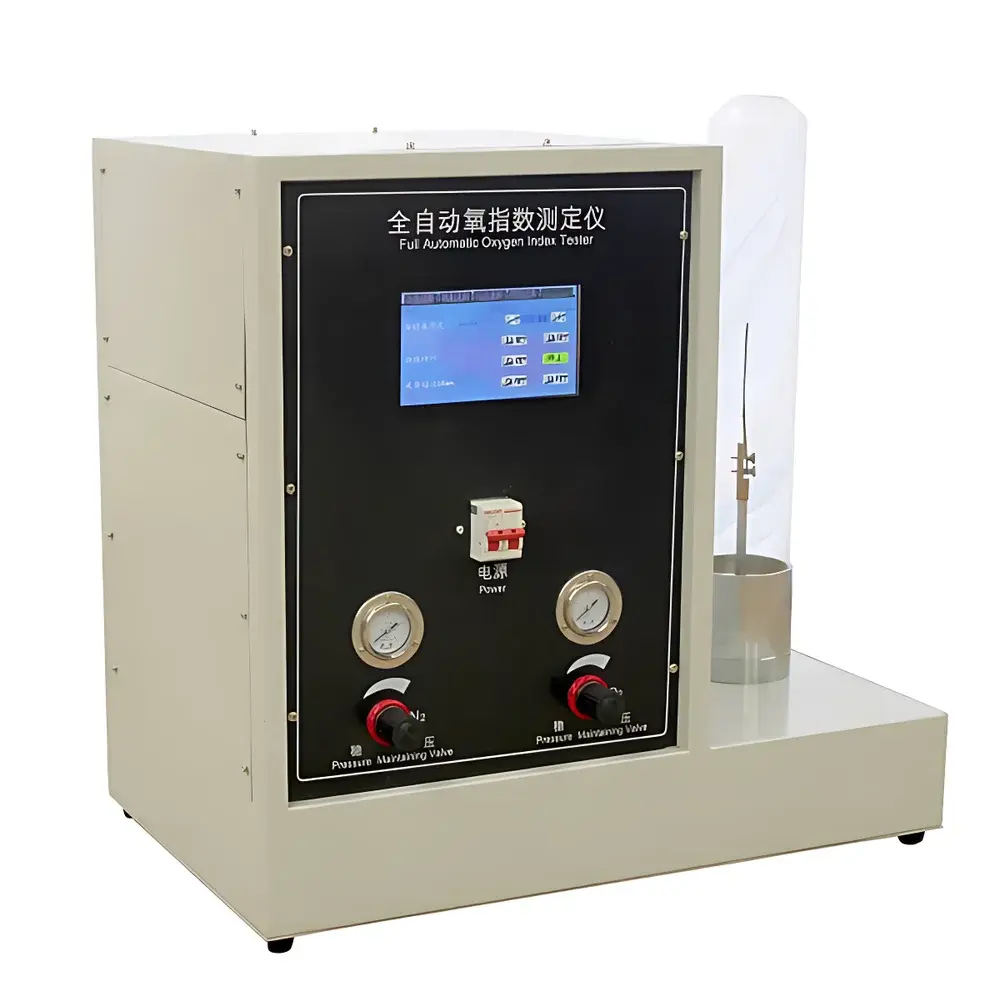
Zhonghangshidai JF-5 Fully Automated Oxygen Index Tester
| Brand | Zhonghangshidai |
|---|---|
| Origin | Beijing, China |
| Manufacturer Type | Direct Manufacturer |
| Origin Category | Domestic (China) |
| Model | JF-5 |
| Price Range | USD 850 – 4,250 (FOB) |
| Sample State | Solid only |
Overview
The Zhonghangshidai JF-5 Fully Automated Oxygen Index Tester is an advanced benchtop instrument engineered for precise determination of the Limiting Oxygen Index (LOI) — defined as the minimum volume percent of oxygen in a nitrogen–oxygen mixture required to support candle-like combustion of a material under specified test conditions. Based on the principle of controlled upward flame propagation in a vertical specimen column within a laminar-flow combustion chamber, the JF-5 complies strictly with GB/T 2406.2–2009, which aligns methodologically with ISO 4589–2 and ASTM D2863. Its core architecture integrates closed-loop gas concentration control, high-stability flow regulation, and real-time digital monitoring to eliminate manual intervention during testing — thereby ensuring repeatability across laboratories and compliance with GLP-aligned quality assurance protocols.
Key Features
- Fully integrated 7-inch full-color TFT touch interface enabling intuitive parameter input, automated oxygen concentration ramping, and real-time status feedback including audible alerts upon target O₂ stabilization
- High-precision imported electrochemical oxygen sensor with 0–100% vol measurement range, ±0.1% digital resolution, and Class 0.1 accuracy per IEC 60751
- Stepper-driven proportional control valve with closed-loop feedback ensures dynamic correction of O₂ concentration drift during active combustion — a critical enhancement over open-loop legacy systems
- Dual-standard combustion tube selection: interchangeable quartz glass tubes with internal diameters of ≥75 mm or ≥85 mm, both conforming to GB/T 2406.2 geometric requirements
- Regulated gas flow system delivering 0–20 L/min (0–1200 L/h) with linear velocity maintained at 40 ± 2 mm/s inside the combustion column
- Intelligent diagnostics suite: automatic detection and visual/audible warnings for gas source misconnection (O₂/N₂ swap), sensor aging, pressure anomalies, ignition failure, and cylinder depletion
- Integrated timing module with programmable 50-mm burn length option, adjustable flame height (5–60 mm), and standardized 16 ± 4 mm propane pilot flame via bendable Φ2 ± 1 mm stainless steel nozzle
- Comprehensive data handling: onboard storage for ≥1000 test records, searchable history log, timestamped export-ready reports, and one-touch calibration/re-calibration sequence
Sample Compatibility & Compliance
The JF-5 accommodates rigid and semi-rigid solid specimens including thermoplastics, thermosets, elastomers, fiber-reinforced composites, building insulation materials (e.g., EPS, XPS, mineral wool boards), coated wood products, and fire-rated door cores. Optional non-self-supporting specimen holders enable standardized testing of textiles, foams, and thin films per Clause 7.3 of GB/T 2406.2–2009. All mechanical fixtures — including axial self-supporting clamps and dual-edge textile frames — are constructed from corrosion-resistant stainless steel and calibrated to maintain specimen centerline alignment within ±0.5 mm tolerance. The system meets structural and operational requirements for ISO/IEC 17025-accredited testing laboratories when operated under documented SOPs and routine verification per manufacturer’s maintenance schedule.
Software & Data Management
While the JF-5 operates autonomously via embedded firmware, its internal database supports CSV export via USB interface for traceable post-processing in Excel or LIMS environments. Each stored record includes: test ID, date/time stamp, ambient temperature/humidity, initial/final O₂ concentration, burn duration, specimen dimensions, pass/fail flag, and operator ID (if enabled). Audit trail functionality logs all configuration changes, calibration events, and diagnostic triggers — satisfying basic FDA 21 CFR Part 11 data integrity expectations for non-GxP environments. Firmware updates are delivered via secure offline package to preserve regulatory boundary integrity.
Applications
This instrument serves quality control labs in polymer manufacturing, construction material certification bodies, fire safety R&D departments, and third-party testing organizations performing comparative flammability screening. Typical use cases include LOI benchmarking of halogen-free flame-retardant compounds, validation of intumescent coating efficacy, classification of cable jacketing materials per IEC 60332–1, and pre-compliance assessment of automotive interior trim against FMVSS 302. Its precision and automation reduce inter-operator variability — a key factor in multi-site correlation studies and supplier qualification programs.
FAQ
What gas purity is required for valid LOI testing?
Industrial-grade oxygen (≥99.2% pure) and nitrogen (≥99.5% pure) are mandatory; impurities such as argon or moisture affect buoyancy-driven flame dynamics and invalidate results per GB/T 2406.2–2009 Annex A.
Can the JF-5 be used for UL 94 V-0/V-1/V-2 classification?
No — the JF-5 measures LOI only. UL 94 vertical burning tests require separate apparatus meeting specific flame application geometry, specimen mounting, and pass/fail criteria not implemented in this platform.
Is external PC connectivity supported?
No Ethernet or Bluetooth interface is provided; data retrieval is limited to USB mass-storage mode to ensure electromagnetic compatibility and prevent unauthorized remote access.
How often must the oxygen sensor be recalibrated?
Annual zero/span verification using certified 21% O₂ in N₂ and 100% N₂ reference gases is recommended; field calibration is performed via built-in one-button procedure using ambient air (20.9% O₂) as zero reference.
Does the system comply with ASTM D2863?
While hardware specifications meet ASTM D2863 dimensional and flow requirements, formal conformance requires user-established SOPs referencing that standard — the instrument itself is certified to GB/T 2406.2–2009, its Chinese national equivalent.



