
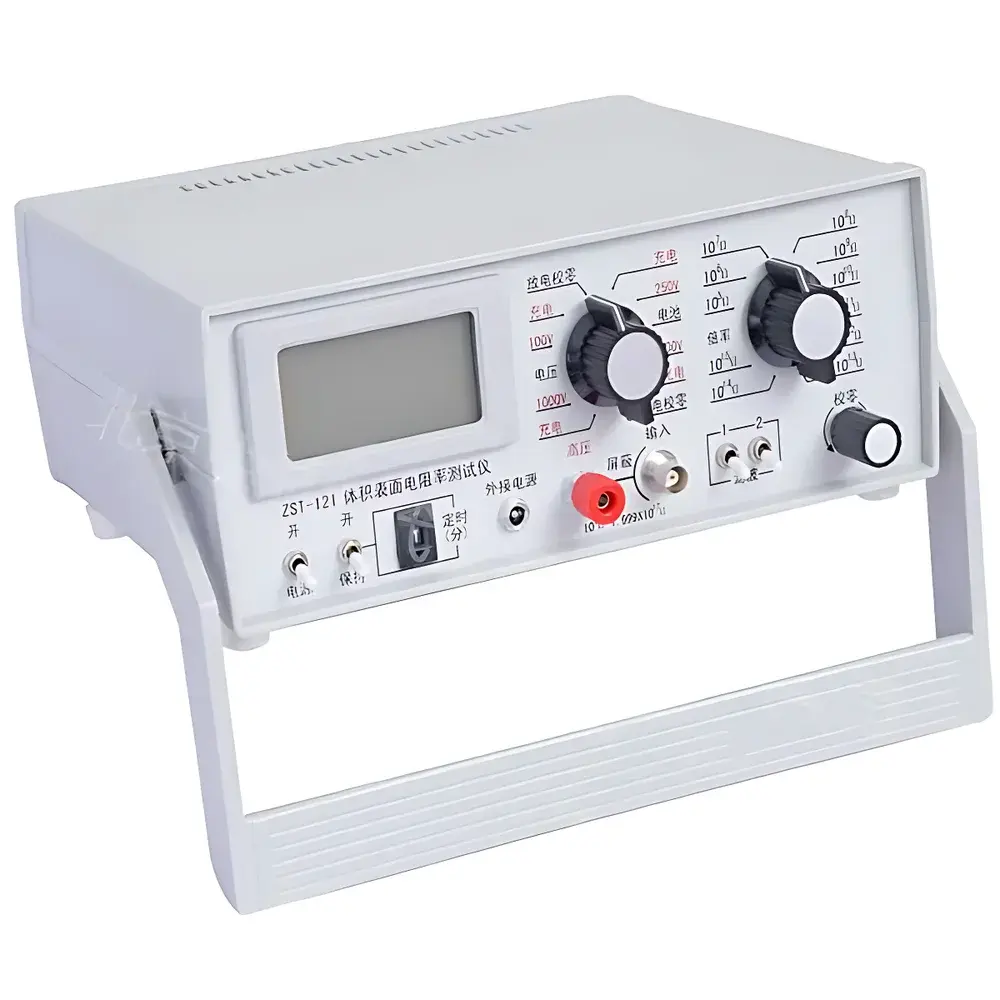
Zhonghangshidai ZST-121 GB/T 31838 Volume & Surface Resistivity Tester
| Brand | Zhonghangshidai |
|---|---|
| Model | ZST-121 |
| Standard Compliance | GB/T 31838.2–2019, GB/T 31838.3–2019 |
| Resistance Range | 1×10⁴ Ω to 1×10¹⁸ Ω |
| Current Range | 2×10⁻⁴ A to 1×10⁻¹⁶ A |
| Test Voltages | 10 V / 50 V / 100 V / 250 V / 500 V / 1000 V (selectable) |
| Accuracy | ±2% |
| Display | Digital LCD |
| Dimensions | 285 mm × 245 mm × 120 mm |
| Weight | ~5 kg |
| Power Supply | AC 220 V, 50 Hz, ~5 W |
Overview
The Zhonghangshidai ZST-121 GB/T 31838 Volume & Surface Resistivity Tester is a precision DC-based high-resistance and ultra-low-current measurement instrument engineered for compliance with China’s national standard GB/T 31838.2–2019 (Volume Resistivity) and GB/T 31838.3–2019 (Surface Resistivity). It operates on the fundamental principle of Ohm’s Law (R = V/I), but implements a dual-sensing architecture that simultaneously measures applied voltage across the sample and resulting current through it—enabling direct digital computation of resistance without analog scaling or manual coefficient correction. Unlike conventional electrometer-based high-resistance meters with non-linear analog scales and voltage-dependent calibration drift, the ZST-121 employs large-scale integrated circuits (LSI) to perform real-time V/I division and high-resolution A/D conversion. This architecture ensures stable, linear, and repeatable readings across its full measurement span—from 1×10⁴ Ω to 1×10¹⁸ Ω—with minimal dependence on source voltage fluctuations, environmental drift, or operator interpretation.
Key Features
- Simultaneous digital display of resistance value (Ω) and current (A) on a high-contrast LCD screen
- Programmable DC test voltages: 10 V, 50 V, 100 V, 250 V, 500 V, and 1000 V—each selectable via front-panel switch for standardized testing per material class and application requirement
- Extended resistance measurement range: 0.01×10⁴ Ω to 1×10¹⁸ Ω (10⁴–10¹⁸ Ω), covering insulators, antistatic polymers, conductive composites, and semiconductor-grade dielectrics
- Ultra-low current detection capability: 2×10⁻⁴ A down to 1×10⁻¹⁶ A, supporting dark current characterization of photodiodes and leakage analysis in high-voltage insulation systems
- Integrated guard terminal and shielded input architecture to minimize surface leakage and stray capacitance effects during surface resistivity measurements
- Compact benchtop form factor (285 × 245 × 120 mm), lightweight (~5 kg), and low power consumption (~5 W), suitable for QC labs, R&D environments, and production floor deployment
- No external multipliers or range-dependent correction factors required—resistance values are displayed directly in ohms at any voltage or range setting
Sample Compatibility & Compliance
The ZST-121 supports standardized volume and surface resistivity determination for solid, semi-solid, and liquid samples per GB/T 31838.2 and GB/T 31838.3. Compatible geometries include flat plates, films, molded plaques, elastomeric sheets, powders (in compression cells), and viscous pastes. For surface resistivity, the instrument interfaces with concentric-ring electrode fixtures (e.g., ASTM D257-compliant guarded electrodes); for volume resistivity, parallel-plate or two-terminal configurations are used. The system meets essential metrological requirements for ISO/IEC 17025-accredited laboratories, including traceable calibration paths, documented uncertainty budgets, and stability monitoring protocols. While not inherently 21 CFR Part 11 compliant, its fixed test parameters, non-editable raw data output, and timestamped measurement logs support GLP/GMP-aligned documentation when integrated into validated lab workflows.
Software & Data Management
The ZST-121 operates as a standalone hardware instrument with no embedded firmware-based data logging or USB/RS-232 connectivity. All measurements are presented in real time on the front-panel LCD; users record results manually or integrate with external DAQ systems via analog voltage outputs (if equipped on optional variants). To ensure auditability, test conditions—including selected voltage, range multiplier, elapsed stabilization time (per standard 60 s dwell per GB/T 31838), and ambient temperature/humidity—are documented externally in laboratory notebooks or LIMS entries. For regulated environments, this design aligns with “instrument-as-tool” validation paradigms where configuration control, operator training, and procedural SOPs—not software features—define data integrity. Calibration certificates per JJG 696–2015 (Chinese metrological verification regulation for high-resistance meters) are provided with each unit.
Applications
- Quality control of polymer insulators, EPDM rubber, silicone elastomers, and fluorinated coatings used in aerospace, automotive, and medical device housings
- Development and qualification of antistatic packaging films, conductive carbon-black-filled TPEs, and ESD-safe flooring materials
- Characterization of dielectric strength and charge decay behavior in cleanroom garments, gloves, and work surfaces
- Research on charge transport mechanisms in novel 2D materials, perovskite thin films, and organic semiconductors
- Verification of grounding continuity and system resistance in raised access floors and static-dissipative footwear per IEC 61340-4-1 and ANSI/ESD S20.20
- Baseline leakage current assessment in photodetectors, CCD sensors, and high-voltage capacitor dielectrics
FAQ
Does the ZST-121 comply with international standards such as ASTM D257 or IEC 62631?
The instrument is explicitly designed and verified against GB/T 31838.2–2019 and GB/T 31838.3–2019. While its electrical architecture and measurement methodology are functionally equivalent to those required by ASTM D257 and IEC 62631-3-1, formal conformance claims require third-party verification under those specific standards’ procedural and reporting requirements.
Can it measure grounded or earth-referenced samples?
No—the ZST-121 uses a floating, isolated high-voltage source and requires both terminals to be electrically isolated from ground. Measurement of one-terminal-grounded samples is not supported and may compromise safety and accuracy.
What environmental conditions are required for valid measurements?
Per GB/T 31838, testing must occur at 23 ± 2 °C and 50 ± 5% RH unless otherwise specified. The instrument itself operates within 0–40 °C and <80% RH (non-condensing), but sample conditioning per standard takes precedence over instrument operating limits.
Is calibration traceable to national standards?
Yes—each unit ships with a factory calibration certificate traceable to China’s National Institute of Metrology (NIM) via certified reference resistors and calibrated current sources, satisfying JJG 696–2015 verification requirements.
How is surface resistivity distinguished from volume resistivity during setup?
Surface resistivity requires a three-terminal guarded electrode configuration (central electrode + concentric guard ring + back electrode), while volume resistivity uses two parallel electrodes contacting opposite faces. The ZST-121’s front-panel labeling (“Rs” and “Rv”) and dedicated binding posts guide correct wiring per GB/T 31838 Annexes A and B.






