
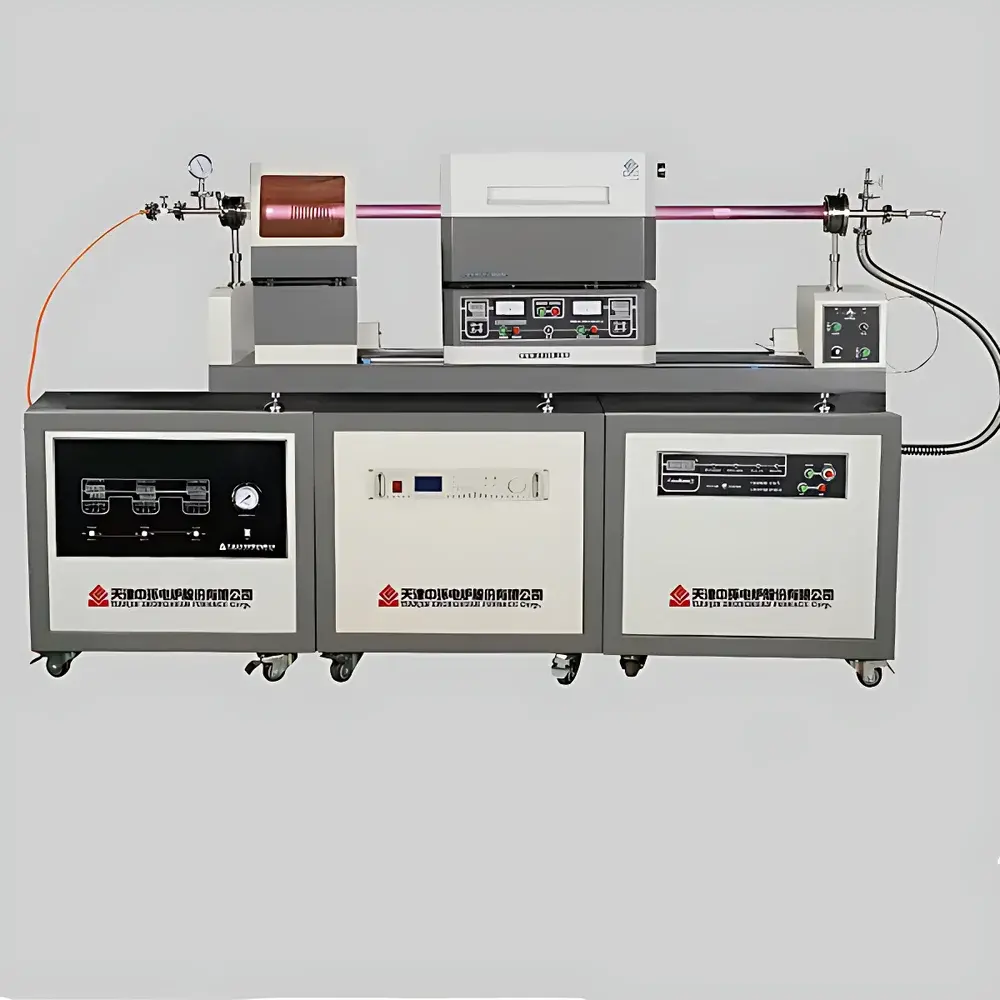
ZHONGHUAN FURNACE 1200°C Preheating Sliding Dual-Zone Plasma-Enhanced Chemical Vapor Deposition (PECVD) System
| Brand | ZHONGHUAN FURNACE |
|---|---|
| Origin | Tianjin, China |
| Model | 1200°C Preheating Sliding Dual-Zone PECVD System |
| Instrument Type | Tube Furnace |
| Max Temperature | 1200°C |
| Temperature Control Accuracy | ±1°C |
| Max Power | 1.2 kW |
| Heating Method | 50-Stage Programmable Temperature Controller |
| Internal Chamber Dimensions | 340 × 580 × 555 mm |
| Vacuum Compatibility | Medium- or High-Vacuum Configurable |
| RF Power Supply | Integrated Plasma RF Generator |
| Gas Delivery | Multi-Channel Mass Flow Controlled System |
| Preheat Zone | Independent Opening-Type Tube Furnace |
| Main Reaction Zone | Dual-Zone Sliding Tube Furnace with In-Tube Thermocouple Monitoring |
| Drive Options | Manual or Motorized Linear Sliding Mechanism |
Overview
The ZHONGHUAN FURNACE 1200°C Preheating Sliding Dual-Zone PECVD System is a purpose-engineered platform for low-temperature, high-fidelity thin-film synthesis via plasma-enhanced chemical vapor deposition. Unlike conventional thermal CVD, this system leverages radio-frequency (RF) induced plasma to dissociate precursor gases—such as silane (SiH₄), ammonia (NH₃), or tetraethyl orthosilicate (TEOS)—into highly reactive radicals and ions at substrate temperatures significantly below their thermal decomposition thresholds. This enables conformal, stoichiometrically controlled deposition of dielectric, semiconductor, and passivation layers—including silicon nitride (SiNₓ), silicon dioxide (SiO₂), amorphous silicon (a-Si), and hydrogenated carbon films—on temperature-sensitive substrates such as flexible polymers, pre-fabricated devices, or low-melting-point alloys. The dual-zone architecture—comprising an independently controlled preheating zone and a main plasma reaction zone—ensures precise thermal conditioning of precursors prior to plasma exposure, minimizing gas-phase nucleation and enhancing film uniformity across wafers up to 6 inches in diameter.
Key Features
- Dual independent temperature zones: A front preheating furnace (opening-type, max 1200°C) and a rear sliding dual-zone tube furnace, both equipped with 50-segment programmable controllers and ±1°C thermal stability.
- Integrated RF plasma source: 13.56 MHz matching network with adjustable forward/reflected power monitoring, optimized for stable glow discharge under medium-vacuum conditions (10⁻²–10⁻¹ mbar).
- Sliding mechanism: Motorized or manual linear translation system enabling precise axial positioning of substrates relative to plasma ignition region and thermal gradient profile—critical for graded film composition or multi-layer stack fabrication.
- In-tube real-time temperature monitoring: Dual K-type thermocouples embedded within the quartz reaction tube provide localized feedback at both preheat and plasma zones, supporting closed-loop process validation.
- Multi-channel gas delivery: Three independent mass flow controllers (MFCs) with digital setpoint interface support simultaneous introduction of reactive, carrier, and purge gases with repeatability better than ±0.5% full scale.
- Vacuum flexibility: Compatible with two-tier vacuum configurations—rotary vane pump + cold trap (medium vacuum, ≤1×10⁻² mbar) or turbomolecular pump + backing pump (high vacuum, ≤5×10⁻⁵ mbar)—to accommodate varying plasma impedance and film purity requirements.
Sample Compatibility & Compliance
The system accommodates standard quartz or alumina tube configurations (OD 60–100 mm, length up to 1200 mm) and accepts flat substrates (up to 150 mm × 150 mm), wafers (≤6″), and powder samples mounted on ceramic boats. All wetted components—including gas lines, MFCs, and vacuum seals—are constructed from electropolished stainless steel or VCR-compatible fittings to ensure compatibility with corrosive precursors (e.g., NF₃, BCl₃). The control architecture supports audit-ready operation per GLP and GMP guidelines: event logging with timestamped parameter records, user access levels, and password-protected recipe storage. While not certified to IEC 61000-6-3 or UL 61010-1 out-of-box, the system meets essential safety provisions for laboratory-scale RF plasma equipment when installed with proper grounding, interlocked shielding, and local exhaust ventilation per ANSI Z9.11.
Software & Data Management
Temperature profiles, RF power parameters, gas flows, and vacuum pressure are coordinated through a Windows-based HMI interface with native OPC UA support. All operational data—including ramp rates, dwell times, plasma ignition events, and thermocouple traces—are logged in CSV and SQLite formats for traceability. The software includes built-in compliance tools: electronic signature capability, configurable alarm thresholds with email/SNMP alerts, and exportable audit trails compliant with FDA 21 CFR Part 11 requirements when deployed on validated IT infrastructure. Remote monitoring via Ethernet is supported; no cloud connectivity is enabled by default.
Applications
- Deposition of SiNₓ anti-reflective and passivation layers for photovoltaic cell manufacturing (ASTM E2847-21).
- Growth of low-k SiOC:H films for microelectronics interlayer dielectrics (IEEE Std 1620.1-2015).
- Synthesis of DLC (diamond-like carbon) coatings on biomedical implants requiring nanoscale adhesion control.
- Functionalization of 2D materials (e.g., graphene, MoS₂) via plasma-assisted surface grafting without lattice damage.
- R&D of solid-state electrolyte thin films (e.g., LiPON) for all-solid-state battery prototypes.
- Process development for roll-to-roll compatible PECVD on PET and polyimide substrates (ISO 15197:2013 reference method adaptation).
FAQ
What vacuum level is required for stable plasma ignition in this PECVD system?
Stable capacitive-coupled RF plasma ignition typically initiates between 1×10⁻² mbar and 5×10⁻¹ mbar, depending on gas composition and electrode geometry. The system supports both medium- and high-vacuum configurations to accommodate process optimization.
Can the sliding mechanism be synchronized with temperature ramping?
Yes—the motorized slide option supports trigger-based movement via digital I/O signals from the temperature controller, enabling automated substrate translation during thermal profiling.
Is the RF generator compatible with pulsed plasma operation?
The integrated 13.56 MHz RF supply supports duty-cycle modulation (1–100%); pulse parameters must be configured externally via TTL input or SCPI command set.
What is the maximum recommended quartz tube wall thickness for RF coupling efficiency?
For optimal electromagnetic field penetration and minimal standing-wave distortion, quartz tubes with wall thickness ≤5 mm and OD ≤100 mm are recommended.
Does the system include calibration certificates for thermocouples and MFCs?
Factory calibration reports are provided for all primary sensors; NIST-traceable recalibration services are available upon request.



