
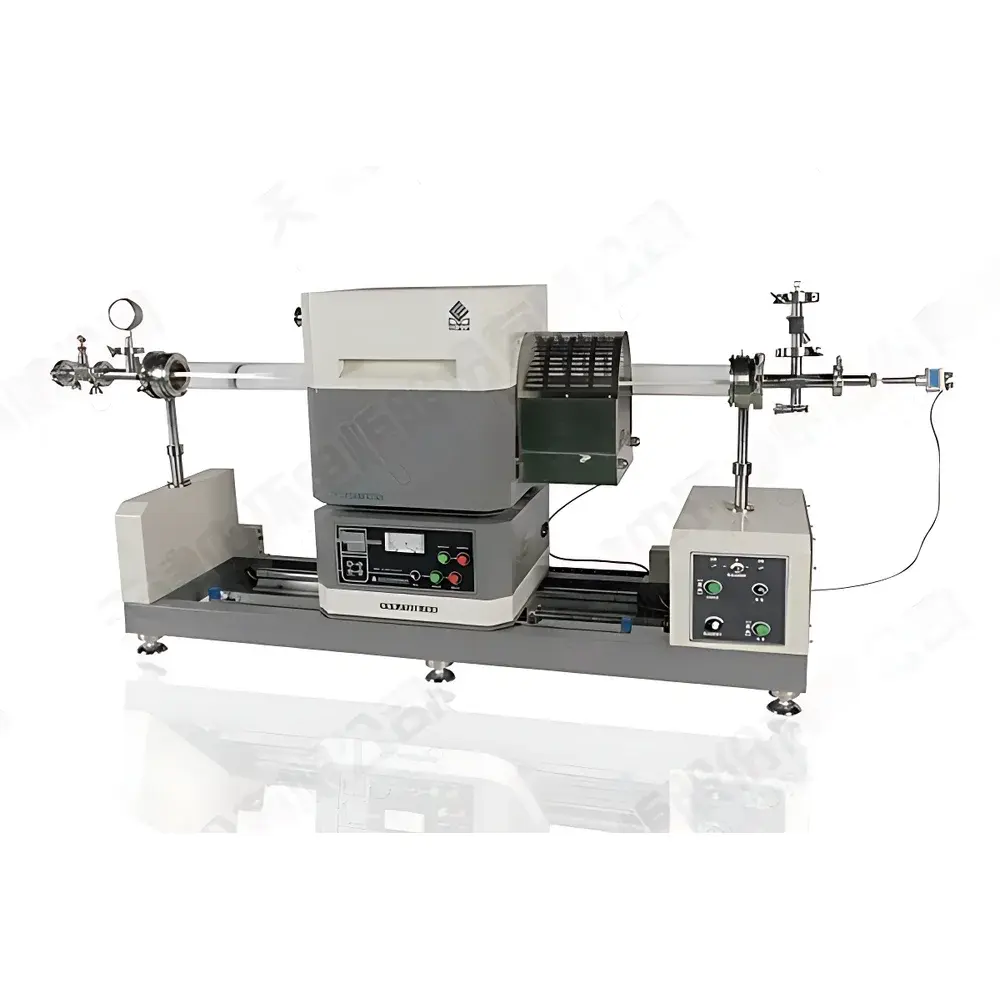
ZHONGHUAN FURNACE RTP-G06123K-H Sliding-Rail Rapid Thermal Processing Furnace
| Brand | ZHONGHUAN FURNACE |
|---|---|
| Origin | Tianjin, China |
| Instrument Type | Tube Furnace |
| Max Temperature | 1000 °C |
| Temperature Control Accuracy | ±1 °C |
| Max Power | 9 kW |
| Max Ramp Rate | 50 °C/s |
| Cooling Rate (900 → 200 °C) | 15 min |
| Heating Method | Infrared Lamp Array |
| Chamber Dimensions (L×W×H) | 360 × 385 × 595 mm |
| Heating Zone Length | 250 mm |
| Uniform Temperature Zone Length | 200 mm |
| Quartz Tube Options | Φ60 / Φ80 / Φ100 mm |
| Sliding Stroke | 300 mm |
| Gas Flow Range | 60–600 mL/min (Float Meter) |
| Net Weight | 85 kg |
Overview
The ZHONGHUAN FURNACE RTP-G06123K-H is a precision-engineered sliding-rail rapid thermal processing (RTP) furnace designed for controlled, high-speed thermal treatments in research and development environments. Unlike conventional resistance-heated tube furnaces, this system employs high-intensity infrared lamp arrays to deliver exceptional thermal ramp rates—up to 50 °C per second—enabling precise transient thermal profiles essential for semiconductor annealing, 2D material synthesis (e.g., graphene CVD), nanomaterial crystallization, and carbon fiber stabilization. Its defining mechanical feature is a motorized, linearly actuated furnace body that slides along precision-ground rails to rapidly insert or withdraw the heating zone relative to a stationary quartz process tube. This architecture decouples thermal mass from the sample zone, minimizing thermal inertia and facilitating both ultra-fast heating and forced-air-assisted cooling (achieving 900 → 200 °C in ≤15 minutes). The system operates up to 1000 °C with ±1 °C stability over a 200 mm uniform temperature zone, supporting repeatable, time-resolved thermal protocols under inert, reducing, or vacuum atmospheres.
Key Features
- Sliding-rail mechanism with programmable positional control: furnace body moves automatically based on temperature program stage, ensuring reproducible thermal exposure timing and spatial alignment.
- Dual safety architecture: independent over-temperature cutoff (hardware-based thermocouple limit) and earth-leakage circuit protection conforming to IEC 61000-4-5 surge immunity and low-voltage directive requirements.
- Modular gas handling interface: proprietary quick-connect flange design minimizes assembly time and eliminates misalignment-induced stress on quartz tubing; includes integrated vacuum gauge and pressure-rated sealing.
- Optimized thermal management: forced-air cooling ducts mounted directly adjacent to the quartz tube support rapid quenching without condensation or thermal shock-induced fracture.
- 50-segment programmable temperature controller with real-time ramp/soak logic, event-triggered slide commands, and USB data logging (CSV export compatible with MATLAB and Python analysis workflows).
- Robust mechanical construction: anodized aluminum rail frame (360 × 1300 × 265 mm footprint), reinforced ceramic insulation, and vibration-damped mounting feet for stable operation in shared lab spaces.
Sample Compatibility & Compliance
The RTP-G06123K-H accommodates standard high-purity fused silica tubes (Φ60, Φ80, or Φ100 mm ID) with optional custom lengths up to 1200 mm. Its compact internal chamber (360 × 385 × 595 mm) supports wafer-level substrates (up to 6″ diameter), powder beds in crucibles, and fiber spools. Process compatibility extends across ambient, N2, Ar, H2/N2, forming gas, and vacuum conditions (base pressure <10−2 mbar with optional pump). The system meets CE marking requirements for electromagnetic compatibility (EN 61326-1) and safety (EN 61010-1). While not certified to ISO/IEC 17025, its ±1 °C control accuracy and traceable calibration path support GLP-compliant documentation when paired with external NIST-traceable reference thermocouples and audit-ready log files.
Software & Data Management
The embedded controller runs a deterministic real-time OS with non-volatile memory for program retention during power loss. All temperature profiles, slide positions, and gas flow setpoints are timestamped and stored internally (≥10,000 records) and exportable via USB to CSV. No proprietary software installation is required—data files open natively in Excel or can be parsed using Python’s pandas library for statistical process control (SPC) analysis. Audit trail functionality includes operator ID tagging (via optional RFID badge reader integration), change logs for parameter edits, and tamper-evident file hashing—supporting FDA 21 CFR Part 11 readiness when deployed with institutional IT validation protocols.
Applications
- Semiconductor processing: dopant activation annealing (e.g., Si, GaAs), silicide formation, and oxide densification requiring sub-second thermal budgets.
- 2D material synthesis: controlled CVD growth of graphene, MoS2, and h-BN on catalytic metal foils or insulating substrates.
- Nanoparticle engineering: rapid thermal decomposition of precursors for quantum dot nucleation and metal oxide nanoparticle crystallinity tuning.
- Advanced composites: oxidative stabilization of PAN-based carbon fiber precursors and graphitization ramp profiling.
- Materials qualification: thermal shock testing of thin-film adhesion, interfacial diffusion studies, and phase transformation kinetics under non-isothermal conditions.
FAQ
What quartz tube sizes are supported, and can custom diameters be accommodated?
Standard configurations include Φ60, Φ80, and Φ100 mm OD fused silica tubes. Custom diameters up to Φ120 mm are available upon request, subject to mechanical clearance verification and thermal uniformity mapping.
Is vacuum capability built-in, or does it require external pumping equipment?
The furnace includes a vacuum-rated flange and analog pressure gauge but requires connection to an external two-stage rotary vane pump (not supplied) to achieve base pressures below 10−2 mbar.
How is temperature uniformity validated across the 200 mm hot zone?
Uniformity is verified per ASTM E220 using three calibrated R-type thermocouples placed axially at 0, 100, and 200 mm positions; typical deviation is ≤±1.5 °C at 950 °C.
Can the sliding motion be manually overridden during operation?
Yes—the controller provides emergency manual jog mode via front-panel buttons, with hardware end-stop limits preventing overtravel or collision.
What maintenance intervals are recommended for the infrared lamps and rail system?
Infrared lamps are rated for ≥2000 hours at 90% max power; visual inspection every 500 hours is advised. Linear rails require dry lubrication with fluorinated grease every 6 months or 200 cycles, whichever occurs first.



