
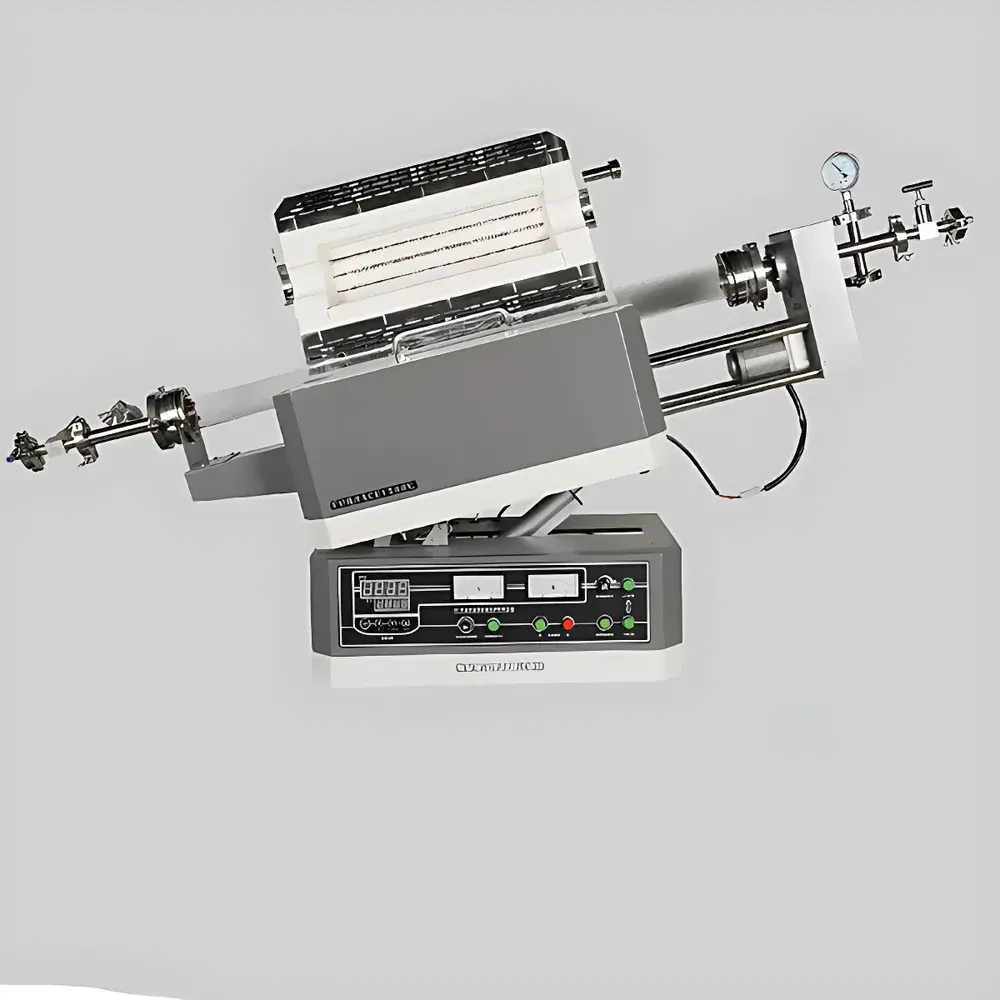
ZHONGHUAN FURNACE SK-G06123K-R Rotating Vacuum & Atmosphere Tube Furnace
| Brand | ZHONGHUAN FURNACE |
|---|---|
| Origin | Tianjin, China |
| Model | SK-G06123K-R |
| Max Temperature | 1200 °C |
| Temperature Control Accuracy | ±1 °C |
| Rated Power | 3 kW |
| Heating Element | OCr27Al7Mo2 High-Resistance Alloy Wire |
| Internal Chamber Dimensions | 340 × 580 × 555 mm |
| Heating Zone Length | 420 mm |
| Constant-Temperature Zone Length | 210 mm |
| Quartz Tube Dimensions | Φ60 × 1000 mm or Φ90 × 200 mm |
| Rotation Speed | 0–20 rpm |
| Tilt Angle | 40° |
| Empty-Chamber Ramp Time to Max Temp | <15 min |
| Weight | 75 kg |
Overview
The ZHONGHUAN FURNACE SK-G06123K-R is a precision-engineered rotating vacuum and controlled-atmosphere tube furnace designed for advanced thermal processing in materials science, catalysis, powder metallurgy, and solid-state chemistry laboratories. It operates on resistive heating principles using high-stability OCr27Al7Mo2 alloy wire elements embedded within a multi-crystalline mullite fiber insulation chamber—enabling uniform radial and axial temperature distribution across its 420 mm heating zone (210 mm constant-temperature region). The furnace supports both vacuum and reactive/protective gas environments (e.g., N₂, Ar, H₂, NH₃, CO, forming gas), with dual-stage sealing via double-ring flange technology and fine-tuned gas flow control through calibrated inlet/outlet ports. Its rotating capability (0–20 rpm) ensures homogeneous heat exposure and particle mixing during sintering, calcination, or reduction processes—critical for reproducible phase formation and grain growth studies.
Key Features
- Rotational operation with adjustable speed (0–20 rpm) and mechanical tilt (40°) for enhanced sample homogenization and controlled gravity-assisted material handling.
- Quick-connect flange system enables tool-free gas line attachment/detachment using a single stainless-steel clamp—eliminating torque-sensitive bolted assemblies and reducing quartz tube stress and breakage risk.
- Bifurcated furnace body design: upper chamber pivots rearward up to 110° for unobstructed access to the hot zone, facilitating rapid loading/unloading and real-time visual monitoring of reaction progress.
- Dual-loop safety architecture includes automatic power cutoff upon door opening, independent over-temperature cutoff (with audible alarm), and ground-fault circuit interruption (GFCI) compliant with IEC 61000-4-5 surge immunity standards.
- Intelligent temperature control system featuring PID + fuzzy logic algorithms, auto-tuning capability, and programmable ramp-soak profiles—supporting up to 50 segments in the standard Chinese-made controller (optional Eurotherm or Watlow equivalents available).
- Active surface-cooling system integrates thermal-sensing feedback: when external casing temperature exceeds 50 °C, integrated axial fans activate automatically to maintain operator-safe surface temperatures per EN 60519-2 requirements.
Sample Compatibility & Compliance
The SK-G06123K-R accommodates cylindrical quartz tubes (Φ60 × 1000 mm or Φ90 × 200 mm) rated for continuous operation up to 1100 °C and intermittent use at 1200 °C. Its modular gas interface supports integration with mass flow controllers (MFCs), vacuum pumps (down to 10⁻³ mbar), and pressure regulators—enabling compliance with ASTM C1211 (high-temperature flexural strength), ISO 11571 (thermal stability of ceramics), and USP (residue on ignition testing). All electrical components meet CE marking directives (2014/35/EU Low Voltage Directive and 2014/30/EU EMC Directive); firmware logging meets ALCOA+ data integrity principles for GLP/GMP-aligned labs requiring audit-ready records.
Software & Data Management
Equipped with RS-485 communication interface (Modbus RTU protocol), the furnace interfaces seamlessly with optional PC-based software for centralized supervision of up to 200 units. The platform provides real-time temperature trajectory visualization, configurable alarm thresholds, timestamped event logging (door open/close, power fault, over-temp), and exportable CSV/PDF reports compliant with FDA 21 CFR Part 11 requirements—including electronic signatures, audit trails, and user-level access control. Optional color touchscreen upgrade delivers intuitive navigation across live trend graphs, historical curve overlays, alarm status dashboards, and parameter configuration screens—all in English-language UI.
Applications
- Controlled-atmosphere synthesis of transition metal oxides (e.g., LiCoO₂, Ni-rich NMC cathodes) under inert or reducing conditions.
- Rotational annealing of ceramic powders to suppress agglomeration and improve densification kinetics.
- Thermal decomposition studies of MOFs and coordination polymers with in situ gas evolution analysis.
- Carbothermal reduction of metal precursors (e.g., Fe₂O₃ → Fe) with simultaneous rotation to prevent localized overheating.
- Preparation of core-shell nanoparticles via sequential gas-phase reactions enabled by precise multi-segment thermal programming.
- Calibration and validation of thermocouples and infrared pyrometers under traceable vacuum/argon conditions.
FAQ
What vacuum level can this furnace achieve when paired with a standard two-stage rotary vane pump?
With an appropriately sized pump (≥4 m³/h) and leak-tight quartz tube installation, the system typically reaches 1–5 × 10⁻² mbar; higher vacuum levels require optional diffusion or turbomolecular pumping stages.
Is the quartz tube included with the base configuration?
Yes—the standard package includes one fused silica tube (Φ60 × 1000 mm), two quartz end caps, a ceramic sample boat, high-temperature gloves, and a complete gas manifold assembly with analog vacuum gauge.
Can the rotation function operate while the furnace is at 1200 °C?
Rotation is fully functional across the entire temperature range, including at maximum setpoint; the drive mechanism employs ceramic-insulated bearings and air-cooled shaft seals to ensure long-term reliability under thermal cycling.
Does the controller support hold steps with gas flow modulation during soak periods?
Yes—each program segment allows independent definition of temperature, dwell time, ramp rate, and digital I/O triggers for external MFCs or valve actuators via optional 0–10 V analog output modules.
What maintenance intervals are recommended for optimal thermal performance?
Inspect fiber insulation integrity and flange gasket condition every 200 operational hours; recalibrate thermocouple input annually or after 500 thermal cycles above 1000 °C; clean gas pathways quarterly if used with reactive or particulate-laden atmospheres.



