
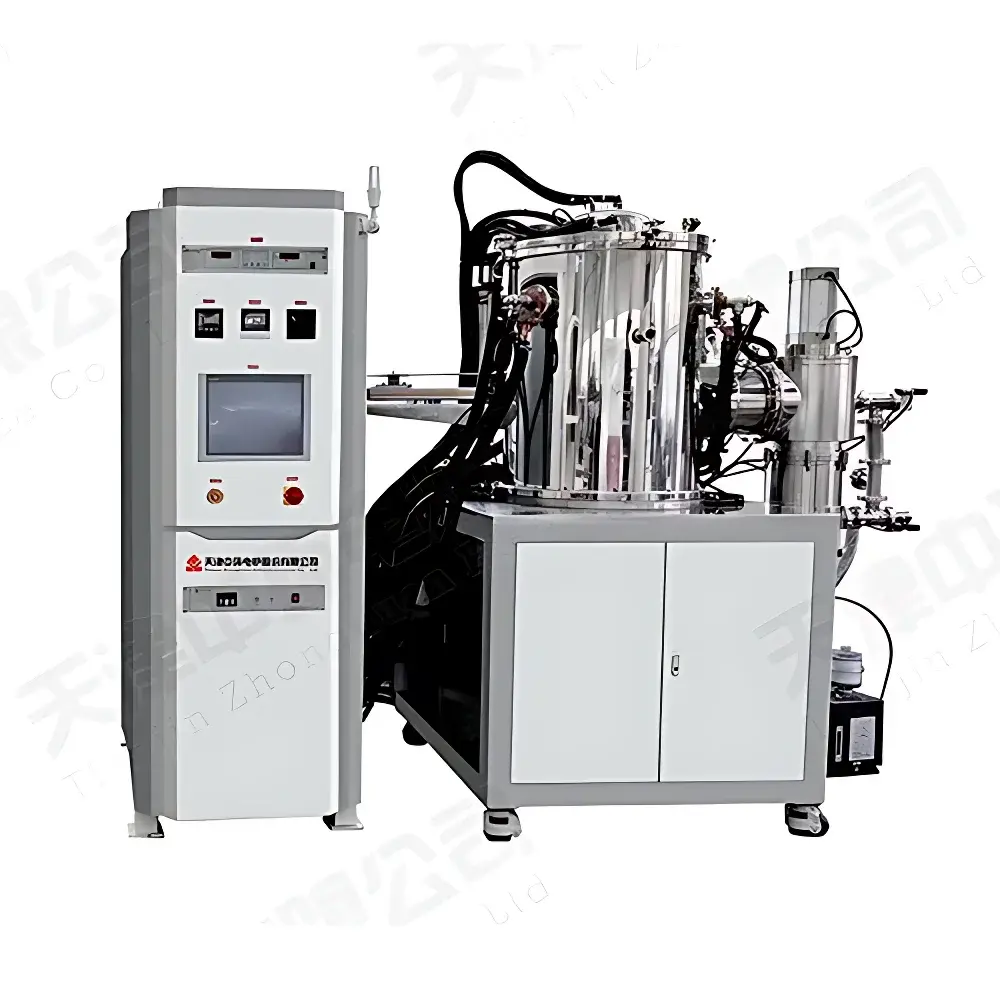
Zhonghuan Furnace ZHM-0316S Ultra-Clean Vacuum & Controlled Atmosphere Sintering Furnace
| Brand | Zhonghuan Furnace |
|---|---|
| Origin | Tianjin, China |
| Model | ZHM-0316S |
| Max Temperature | 2200 °C |
| Temperature Control Accuracy | ±5 °C |
| Construction | Dual-layer SUS304 water-cooled chamber |
| Heating Elements | Molybdenum or Tungsten (configurable) |
| Operation Modes | High vacuum (≤5×10⁻⁴ Pa) or controlled atmosphere (N₂, Ar, H₂, forming gas) |
| Control System | Touchscreen PLC with manual/auto mode switching |
| Cooling | Standard forced convection cooling |
Overview
The Zhonghuan Furnace ZHM-0316S is an ultra-clean, high-temperature vacuum and controlled atmosphere sintering furnace engineered for precision thermal processing in advanced materials research and development. It operates on the principle of resistive heating within a hermetically sealed, water-cooled dual-chamber structure, enabling stable thermal profiles under vacuum (down to 5×10⁻⁴ Pa) or precisely regulated gaseous environments—including inert (Ar, N₂), reducing (H₂, forming gas), or reactive atmospheres. Designed for reproducible high-temperature processing up to 2200 °C, the furnace supports critical unit operations such as vacuum brazing, diffusion bonding, ceramic-metal co-firing, and hermetic encapsulation of optoelectronic components (e.g., sapphire-to-metal, glass-to-metal seals). Its architecture prioritizes thermal uniformity (±3 °C across 100 mm hot zone), minimal particle generation, and long-term operational stability—key requirements for R&D labs working with aerospace alloys, biomedical implants, semiconductor packaging substrates, and functional ceramics.
Key Features
- Dual-layer SUS304 stainless steel vacuum chamber with integrated deionized water cooling circuit—ensures structural integrity, minimizes external surface temperature rise (<45 °C at 2200 °C operation), and prevents oil contamination from external pumps.
- Multi-zone insulation system comprising high-purity alumina fiber modules and reflective molybdenum foil layers—reduces heat loss by >40% versus conventional designs while maintaining radial and axial temperature uniformity within ±3 °C over a 100 mm × 100 mm usable hot zone.
- Configurable high-temperature heating elements: molybdenum (Mo) for applications up to 1800 °C in vacuum or inert gas; tungsten (W) for extended service up to 2200 °C, with optimized power distribution and low thermal mass design for rapid ramp rates (up to 20 °C/min).
- Full-featured touchscreen PLC controller with embedded recipe management, real-time data logging (1 Hz sampling), programmable multi-step profiles (up to 32 segments), and seamless manual override capability—supporting both development-mode flexibility and production-grade repeatability.
- Standard fast pump-down sequence achieving ≤5×10⁻⁴ Pa in <45 minutes (with turbomolecular + dry scroll pumping configuration); optional residual gas analyzer (RGA) integration for process gas purity verification and leak detection per ASTM E1078.
- Rapid quench system (optional): pressurized inert gas (N₂ or Ar) injection with flow-controlled nozzles and internal baffle design—enables controlled cooling from 2200 °C to <200 °C in under 15 minutes without thermal shock or microstructural degradation.
Sample Compatibility & Compliance
The ZHM-0316S accommodates diverse sample geometries and material systems—including metallic alloys (stainless steels, Ti-6Al-4V, Inconel® 718, Kovar®, CuCrZr), refractory ceramics (Al₂O₃, Si₃N₄, ZrO₂), optical substrates (sapphire, fused silica), and multilayer composites. Its ultra-clean internal surface finish (Ra ≤ 0.8 µm electropolished SUS304), absence of organic binders in insulation, and low-outgassing construction meet ISO 14644-1 Class 5 cleanroom compatibility standards when installed in controlled environments. The furnace complies with IEC 61000-6-2/6-4 (EMC), UL 61010-1 (electrical safety), and supports GLP/GMP documentation workflows via optional audit-trail-enabled software modules aligned with FDA 21 CFR Part 11 requirements.
Software & Data Management
Equipped with Zhonghuan’s FurnaceLink™ control suite (v3.2+), the ZHM-0316S provides secure, time-stamped acquisition of temperature, pressure, gas flow, and power consumption data—exportable in CSV, Excel, or XML formats. The software includes configurable alarm thresholds, automated calibration logging, and digital signature support for electronic records. Optional Ethernet/IP or Modbus TCP interfaces enable integration into centralized lab automation platforms (e.g., LabVantage, Thermo Fisher SampleManager) and MES systems. All firmware updates are delivered via encrypted USB key with version-controlled release notes and traceable validation reports.
Applications
- Vacuum brazing of turbine blades, heat exchangers, and medical device components using Ag-, Cu-, or Ni-based filler metals.
- Diffusion bonding of dissimilar metals (e.g., Al-to-Ti, Cu-to-Steel) for microfluidic and power electronics packaging.
- Sintering of nanostructured WC-Co hardmetals and UHTC (ultra-high-temperature ceramic) composites for cutting tools and hypersonic leading edges.
- Hermetic sealing of MEMS sensors, laser diode packages, and optical windows using matched-expansion alloys and active metal brazing techniques.
- High-temperature annealing of single-crystal substrates (e.g., GaN-on-sapphire) and solid-state electrolyte densification for solid oxide fuel cells (SOFCs).
FAQ
What vacuum level can the ZHM-0316S achieve, and what pumping configuration is recommended?
The furnace achieves ≤5×10⁻⁴ Pa using a standard combination of a dry scroll backing pump and a 1200 L/s turbomolecular pump. For ultra-high-purity processes (e.g., optical crystal growth), a cryo-trap and secondary ion pump may be integrated.
Is the furnace suitable for hydrogen atmosphere processing?
Yes—when configured with H₂-compatible valves, pressure transducers, and leak-tested gas lines per ISO 10156, the system supports continuous operation at up to 1 bar H₂ partial pressure with integrated safety interlocks.
Can the temperature uniformity be verified and certified?
Yes—Zhonghuan provides optional NIST-traceable 9-point thermocouple mapping per AMS 2750E, including as-built uniformity report and annual recalibration services.
What maintenance intervals are recommended for long-term reliability?
Water-cooling system filtration every 3 months; hot-zone inspection and element resistance check every 200 operating hours; full vacuum seal and insulation integrity assessment annually or after 1000 thermal cycles.
Does the furnace support remote monitoring and troubleshooting?
Yes—via optional secure VPN-enabled remote access module, allowing authorized engineers to review live parameters, diagnose alarms, and update control logic without on-site presence.



