
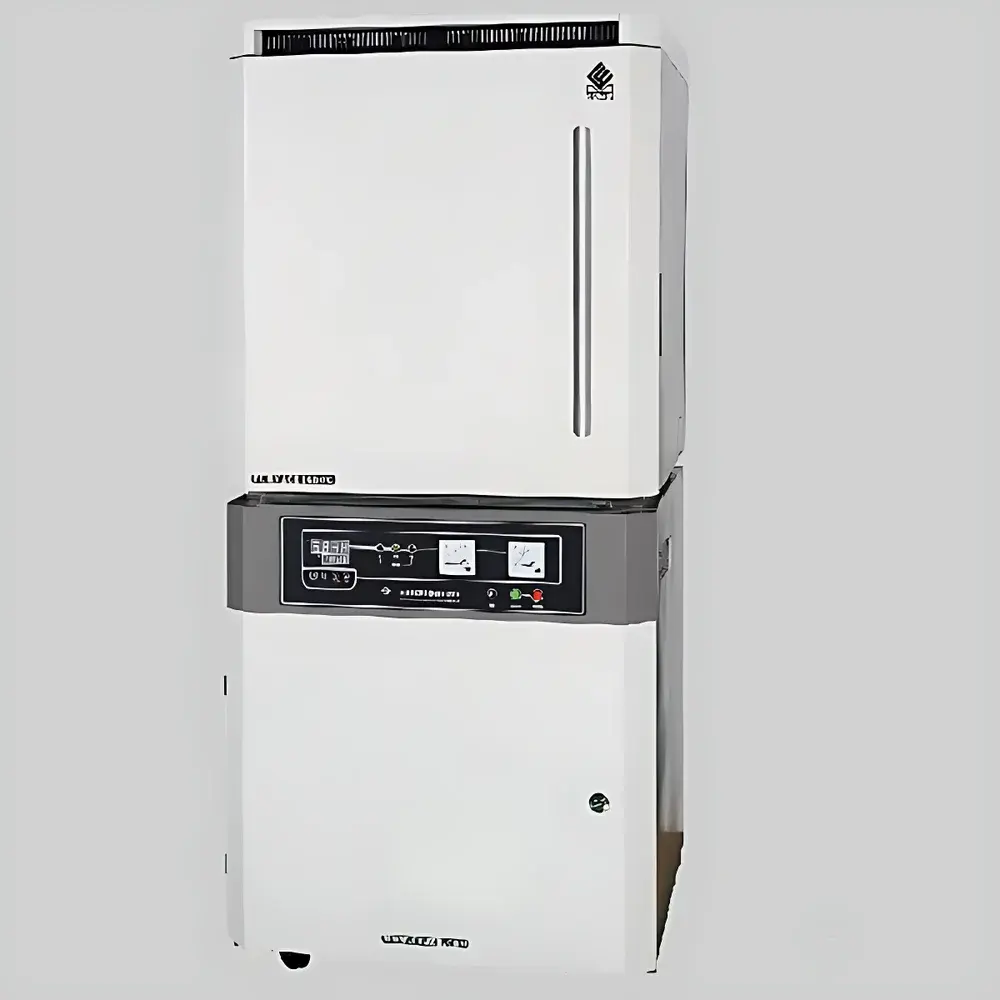
ZHONGHUAN FURNACE ZHX-13163 Vertical High-Temperature Muffle Furnace (1600 °C)
| Brand | ZHONGHUAN FURNACE |
|---|---|
| Origin | Tianjin, China |
| Model | ZHX-13163 |
| Instrument Type | Box-Type Muffle Furnace |
| Max Temperature | 1600 °C |
| Temperature Control Accuracy | ±1 °C |
| Max Power | 12 kW |
| Heating Time to Max Temp | 40 min |
| Heating Elements | Silicon Carbide Rods & Molybdenum Disilicide (MoSi₂) Rods |
| Internal Chamber Dimensions | 840 × 715 × 1690 mm |
Overview
The ZHONGHUAN FURNACE ZHX-13163 is a vertically oriented, high-temperature box-type muffle furnace engineered for precision thermal processing in research laboratories, materials science departments, and industrial quality control environments. Operating at a maximum temperature of 1600 °C, it employs dual heating element technology—silicon carbide (SiC) rods rated to 1500 °C and molybdenum disilicide (MoSi₂) rods rated to 1700 °C—to ensure stable, uniform heating across extended operational cycles. The furnace chamber is constructed from vacuum-formed polycrystalline mullite fiber insulation, offering superior thermal retention and reducing energy consumption by approximately 50% compared to conventional refractory brick linings. Its vertical architecture optimizes floor space utilization while enabling ergonomic loading/unloading of crucibles, sintering boats, and ceramic substrates. Designed for continuous-duty operation under controlled atmospheric conditions (air, inert gas, or low-vacuum with optional sealing), the ZHX-13163 complies with fundamental safety and performance expectations aligned with IEC 61000-6-3 (EMC emissions) and IEC 61000-6-2 (immunity), and supports integration into GLP-compliant workflows through audit-trail-capable temperature logging.
Key Features
- Intelligent current-limiting and soft-start circuitry protects MoSi₂ heating elements from thermal shock and extends service life; mitigates inrush current stress on user-supplied 380 V three-phase power infrastructure.
- Automatic power cutoff upon furnace door opening—mechanically interlocked via microswitch—ensures operator safety during sample handling.
- Dual-stage overtemperature protection: primary PID-based controller shutdown + independent mechanical limit switch activation at preset threshold (configurable up to 1620 °C).
- Ground-fault detection circuit interrupts power within <30 ms upon leakage current exceeding 30 mA, meeting IEC 61000-4-5 surge immunity benchmarks.
- Active surface-cooling system: integrated thermal sensor triggers axial exhaust fans when external casing temperature exceeds 50 °C, maintaining safe touch-surface temperatures (<60 °C) per EN 60519-1.
- Modular control architecture supports three firmware tiers: basic digital setpoint controller (non-programmable), domestic 30-segment programmable controller, or imported 40-segment controller with ramp/soak profiling and hold-to-stabilize logic.
Sample Compatibility & Compliance
The ZHX-13163 accommodates standard ceramic crucibles (Al₂O₃, ZrO₂), graphite boats, platinum ware (up to 1400 °C), and metal oxide substrates. Its uniform radial and axial temperature distribution—±3 °C at 1600 °C across the effective working zone (400 × 300 × 300 mm)—enables reproducible calcination, ashing, sintering, and heat-treatment protocols required for ASTM C1171 (refractory testing), ISO 5660-1 (fire calorimetry), and USP heavy metals residue analysis. All electrical components conform to IP20 enclosure rating; wiring meets UL 746C flammability standards. Optional argon/nitrogen purge ports support oxygen-sensitive processes without requiring full vacuum systems.
Software & Data Management
Equipped with RS-485 Modbus RTU interface (standard), the furnace integrates seamlessly with SCADA platforms and centralized lab management systems. A dedicated Windows-based software suite enables remote monitoring and control of up to 200 units simultaneously—supporting real-time temperature graphing, event-triggered data capture (e.g., door open/close, alarm activation), timestamped CSV export, and PDF report generation with configurable headers (lab ID, operator, SOP reference). Audit trail functionality records all parameter changes, including setpoint modifications, program uploads, and manual overrides—with user login authentication and time/date stamping compliant with FDA 21 CFR Part 11 requirements when deployed with validated electronic signature modules.
Applications
- High-temperature ashing of biological, pharmaceutical, and environmental samples per EPA Method 3050B and ISO 11885.
- Sintering of advanced ceramics (SiC, AlN, YSZ), ferrites, and battery cathode precursors (LiCoO₂, NMC).
- Thermal gravimetric analysis (TGA) pre-conditioning and residual solvent removal in polymer composites.
- Calibration of thermocouples (Types B, R, S) and radiation pyrometers against fixed-point cells (e.g., Cu, Ag, Au).
- Pre-oxidation of MoSi₂ heating elements and conditioning of mullite fiber linings prior to first use.
FAQ
What heating elements are installed in the ZHX-13163, and how are they protected?
The furnace uses dual-element configuration: silicon carbide (SiC) rods for lower-temperature stability and molybdenum disilicide (MoSi₂) rods for sustained operation at 1600 °C. Current-limiting circuitry and zero-crossing soft-start prevent thermal stress-induced fracture.
Does the furnace support inert atmosphere processing?
Yes—optional gas inlet/outlet ports allow continuous purging with Ar, N₂, or forming gas (5% H₂/95% N₂); recommended for oxidation-sensitive materials. Sealing gasket kits and pressure-relief valves are available as accessories.
Can temperature profiles be exported for regulatory documentation?
Yes—the RS-485 interface and配套 software generate timestamped, digitally signed CSV and PDF reports traceable to operator ID and instrument serial number, supporting ISO/IEC 17025 and GMP documentation requirements.
Is the control system compatible with LabVIEW or Python-based automation?
Yes—Modbus RTU protocol implementation allows native integration with LabVIEW’s Modbus I/O libraries and Python’s pymodbus or minimalmodbus packages for custom script-driven thermal cycling.
What maintenance intervals are recommended for long-term reliability?
Inspect heating element resistance quarterly; replace SiC rods if resistance increases >20% from baseline. Clean fiber insulation surfaces annually using dry air; avoid solvents. Verify door seal integrity and microswitch actuation every 200 operating hours.
Related Products



