
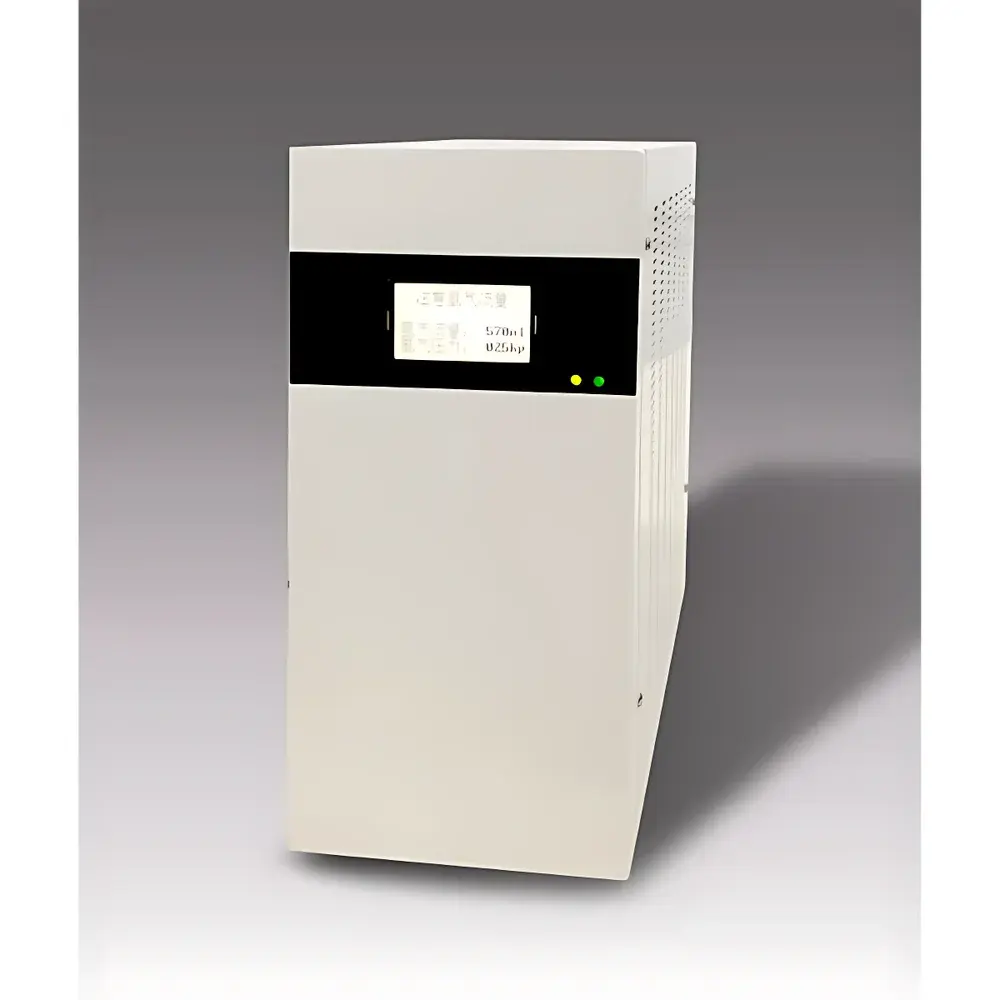
Zhonghui Pu ATH-1000 Automated Pure-Water Electrolysis Hydrogen Generator
| Brand | Zhonghui Pu |
|---|---|
| Origin | Beijing, China |
| Manufacturer Type | Direct Manufacturer |
| Country of Origin | China |
| Model | ATH-1000 |
| Pricing | Upon Request |
| Hydrogen Generation Principle | Pure-Water Electrolysis |
| Output Flow Rate | 0–1000 mL/min |
| Output Pressure | 0–0.4 MPa |
| Hydrogen Purity | ≥99.9995% |
| Power Consumption | 1 kW |
Overview
The Zhonghui Pu ATH-1000 is a laboratory-grade, automated hydrogen generator engineered for continuous, high-purity H₂ supply in analytical and research applications requiring stable, on-demand gas delivery. It employs proton exchange membrane (PEM) electrolysis—specifically solid polymer electrolyte (SPE) technology—to split deionized water into high-purity hydrogen and oxygen without caustic electrolytes. This eliminates alkali carryover, corrosion risks, and maintenance associated with traditional KOH-based systems. The generator operates under precise pressure and flow control, delivering hydrogen at up to 1000 mL/min and 0.4 MPa (4 bar), with real-time stabilization maintained within ±0.001 MPa. Its design conforms to core safety and operational expectations for Class II gas generation equipment used in GC carrier gas, fuel cell testing, catalytic reaction studies, and inert atmosphere purging.
Key Features
- SPE-based pure-water electrolysis system using imported Nafion® membrane stacks, ensuring long-term electrochemical stability and zero alkaline contamination.
- Integrated intelligent microcontroller with automated water level monitoring and closed-loop replenishment—eliminates manual top-up and prevents dry-electrolysis failure.
- Two-stage purification architecture: first-stage pressure-swing adsorption (PSA) drying achieves ≤−55 °C dew point; second-stage integrated oxygen scavenger removes residual O₂ to ≤3 ppm without requiring activation or periodic replacement.
- Dynamic flow regulation via digital pressure feedback loop—reduces power draw during low-demand operation while maintaining setpoint accuracy.
- Comprehensive safety suite including over-pressure cutoff, hydrogen leak detection with automatic shutdown, and thermal overload protection compliant with IEC 61000-6-2/6-4 EMC standards.
- Rear-panel RS-232 serial interface enables bidirectional communication with laboratory information management systems (LIMS) or GC controllers for remote status polling, alarm logging, and scheduled operation.
Sample Compatibility & Compliance
The ATH-1000 is designed exclusively for use with Type I ultrapure water (resistivity ≥18.2 MΩ·cm, TOC <5 ppb) as the sole feedstock—no additives, catalysts, or secondary reagents are required. It meets functional equivalence to ASTM D7512–19 (Standard Guide for Gas Purity in Gas Chromatography) for hydrogen carrier gas applications. While not certified to ISO 8573-1:2010 Class 1 for compressed air, its output satisfies ISO 8573-1 Class 2 (solid particles ≤0.1 µm, dew point ≤−55 °C, oil content non-detectable) when operated within specified ambient conditions (1–40 °C, RH <85%). The unit’s firmware architecture supports audit-ready event logging suitable for GLP environments, though full 21 CFR Part 11 compliance requires integration with validated third-party data acquisition software.
Software & Data Management
The embedded controller stores operational history—including cumulative runtime, total H₂ volume generated, pressure deviation events, and fault codes—for up to 30 days. Raw telemetry (flow, pressure, temperature, water level) is accessible via ASCII protocol over RS-232 at 9600 baud. No proprietary software is bundled; however, ASCII-formatted output is compatible with common SCADA platforms (e.g., LabVIEW, Ignition, WinCC) and custom Python/Node-RED scripts. All configuration changes—including max pressure setpoint, alarm thresholds, and auto-refill trigger levels—are password-protected and logged with timestamp and operator ID (if externally authenticated). Data export is limited to CSV via terminal emulation; no cloud connectivity or internal storage expansion is supported.
Applications
- Carrier gas source for capillary gas chromatography (GC), particularly in flame ionization (FID) and thermal conductivity (TCD) detectors where baseline stability and low oxygen content are critical.
- Fuel cell research—providing controlled H₂ feed for PEMFC and SOFC stack characterization under variable load conditions.
- Catalysis laboratories—supplying ultra-high-purity hydrogen for hydrogenation, hydrodeoxygenation (HDO), and ammonia synthesis screening reactors.
- Materials science labs—enabling reducing atmospheres during sintering, annealing, or thin-film deposition processes requiring O₂-free environments.
- Calibration gas blending systems—serving as primary H₂ source in dynamic dilution manifolds for certified reference gas production (ISO 6142).
FAQ
What type of water must be used with the ATH-1000?
Deionized water meeting ASTM D1193 Type I specifications (resistivity ≥18.2 MΩ·cm at 25 °C, silica <10 ppb, TOC <5 ppb) is mandatory. Tap water, distilled water, or RO-only water will cause rapid membrane fouling and irreversible performance loss.
Is routine filter replacement required?
No. The integrated oxygen removal cartridge and dual-stage desiccant system are designed for ≥12 months of continuous operation under nominal load (≤700 mL/min average flow) and proper water quality. Replacement intervals scale inversely with inlet water purity and daily duty cycle.
Can the ATH-1000 be integrated into an automated GC startup sequence?
Yes—via RS-232 handshake commands, the generator can receive “start,” “stop,” and “set flow” instructions from GC system controllers, and return status codes (e.g., “READY,” “LOW_WATER,” “OVER_PRESSURE”) to enable conditional sequencing.
Does the unit require ventilation or external exhaust?
No dedicated venting is needed during normal operation, as oxygen byproduct is safely diluted and exhausted through the rear passive vent grille. However, installation in a well-ventilated lab space per NFPA 55 guidelines for hydrogen-using equipment is strongly recommended.
What is the expected service life of the electrolysis stack?
Under continuous operation with compliant feed water and ambient conditions, the SPE stack maintains ≥95% of initial efficiency for ≥8,000 hours (≈11 months, 24/7), based on accelerated life-cycle testing per IEC 62282-1 Annex B protocols.



