
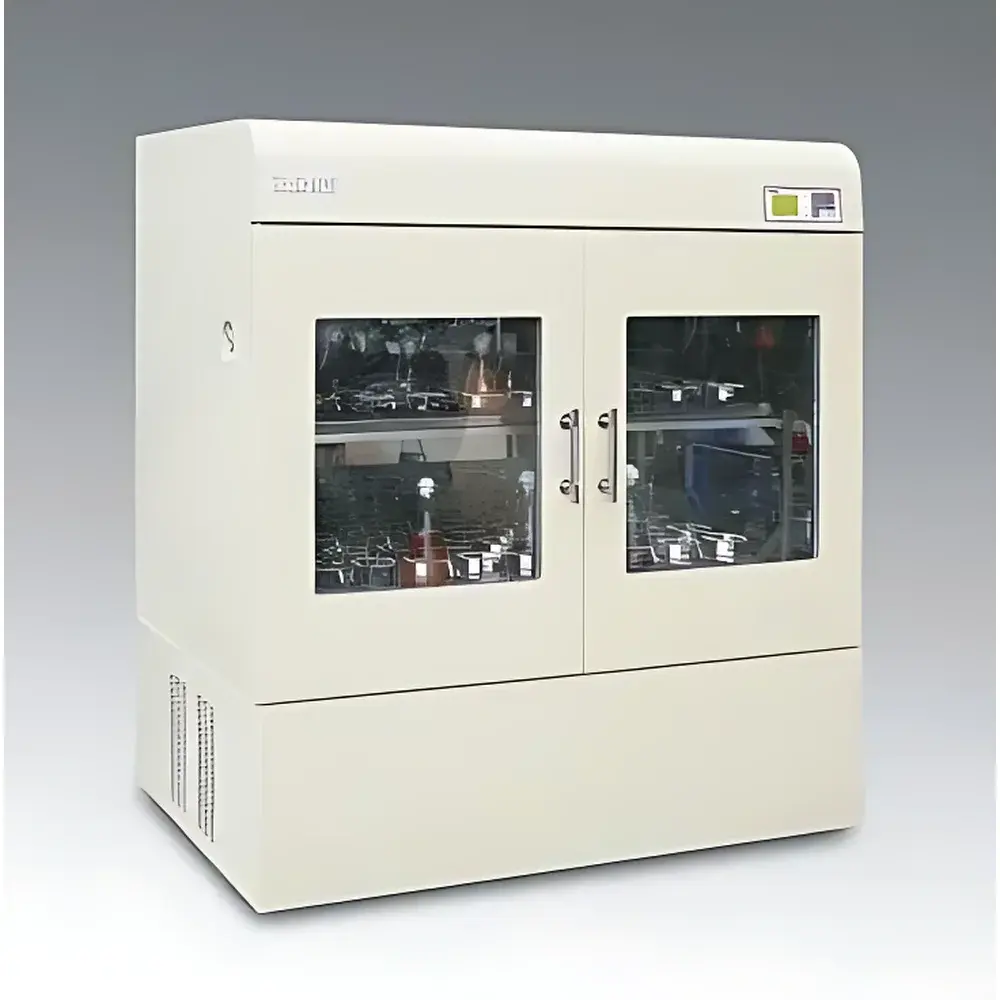
Zhonghui ZWY-A2102 Dual-Layer Programmable Temperature-Controlled Orbital Shaker
| Origin | Shanghai, China |
|---|---|
| Manufacturer Type | Authorized Distributor |
| Regional Origin | Domestic (PRC) |
| Model | ZWY-A2102 |
| Pricing | Upon Request |
| Temperature Range | 4–60 °C |
| Temperature Uniformity | ≤±1 °C (at 37 °C) |
| Temperature Stability | ≤±0.1 °C (at 37 °C) |
| Temperature Resolution | ±0.1 °C |
| Orbital Speed Range | 30–300 rpm |
| Speed Accuracy | ±1 rpm |
| Orbit Diameter | Φ26 mm |
| Timer Range | 0–500 h |
| Chamber Volume | 332 L |
| Dual Shaking Platforms | 2 × 734 × 458 mm |
| Internal Dimensions | 845 × 515 × 765 mm |
| External Dimensions | 950 × 710 × 1370 mm |
| Net Weight | 235 kg |
| Power Supply | AC 220 V, 50/60 Hz |
| Rated Power | 1200 W |
| Cooling Method | Air-cooled, R134a refrigerant, frost-free operation |
| Control Algorithm | PID with environmental scanning microprocessor |
| Display | Backlit LCD with real-time parameter monitoring |
| Programming Capacity | 6 segments / 12 steps, up to 100 h per segment |
| Data Output | Embedded thermal printer (integrated, miniature) |
| Safety Protections | Independent over-temperature cutoff (adjustable), door-open shutdown, leakage current protection, motor overload protection, compressor over-load protection, power failure alarm, sensor fault detection, upper/lower limit temperature & speed deviation alarms |
| Auxiliary Functions | Auto-restart after power recovery, parameter memory & encryption, speed calibration, clock display, water-level auto-detection with audible/visual alert and auto-refill |
Overview
The Zhonghui ZWY-A2102 Dual-Layer Programmable Temperature-Controlled Orbital Shaker is an engineered platform for precise, reproducible, and scalable incubation of biological and biochemical samples under controlled thermal and mechanical agitation conditions. Designed around a robust orbital shaking principle—where platform motion follows a circular trajectory at a defined diameter (Φ26 mm)—the system ensures uniform suspension and oxygen transfer across culture vessels without vortexing or splashing. Its dual-layer configuration enables independent or synchronized operation of two large-format shaking platforms (734 × 458 mm each), supporting high-throughput workflows in microbial cultivation, recombinant protein expression, cell line expansion, and enzymatic assay development. Temperature control employs a PID-regulated air-cooling system with R134a refrigerant, enabling stable setpoint maintenance from 4 °C to 60 °C—even under continuous load—while minimizing condensation via frost-free operation. The unit operates within ambient conditions of 5–25 °C and complies with standard laboratory infrastructure requirements for Class II biosafety environments.
Key Features
- Dual independent shaking decks with identical motion profiles, configurable for synchronous or asynchronous operation
- PID-based microprocessor control with environmental scanning logic for adaptive thermal regulation and disturbance rejection
- 6-segment × 12-step programmable protocol engine supporting complex multi-phase experiments: temperature ramping, speed stepping, hold-and-shift cycles, and time-dependent oscillation profiles
- Integrated thermal printer for real-time logging of temperature, speed, elapsed time, and alarm events—no external software required
- Auto-refill water-level management system with optical level sensing, audible/visual low-water alerts, and fail-safe hydration protocol
- Comprehensive safety architecture: triple-redundant over-temperature protection (including adjustable independent cutoff), door-interlocked shutdown, ground-fault circuit interruption (GFCI), and compressor thermal overload monitoring
- Brushless AC induction motor with constant-torque output across full speed range (30–300 rpm), ensuring consistent shear delivery regardless of load distribution
- Gradual acceleration/deceleration algorithm prevents sample displacement during startup and stop transitions
- Electro-polished stainless-steel interior chamber and trays; static-dissipative powder-coated steel exterior; tempered glass dual-access viewing window
Sample Compatibility & Compliance
The ZWY-A2102 accommodates standard microbiological and molecular biology vessel formats—including Erlenmeyer flasks (up to 1000 mL × 24 per deck), test tubes, deep-well plates, and culture bottles—via interchangeable, tool-free clamping systems. Its internal volume (332 L) and platform dimensions support parallel processing of heterogeneous sample sets while maintaining ISO 13485-aligned thermal homogeneity (≤±1 °C at 37 °C). The device meets IEC 61010-1:2010 safety requirements for laboratory equipment and incorporates design elements aligned with GLP-compliant data integrity practices: parameter encryption, non-volatile memory retention, audit-ready event logging (via embedded printout), and tamper-resistant configuration locks. While not FDA 21 CFR Part 11–certified out-of-box, its RS-232 interface supports integration into validated LIMS or ELN ecosystems where electronic records are subject to regulatory review.
Software & Data Management
No proprietary PC software is required for basic operation—the built-in LCD interface provides complete local control and real-time visualization of all active parameters (setpoint vs. actual temperature/speed, remaining timer, segment progress, and alarm status). All user-defined programs, calibration offsets (e.g., temperature probe correction), and operational history are retained in non-volatile memory across power cycles. The embedded thermal printer generates timestamped hardcopy logs compliant with ALCOA+ principles (Attributable, Legible, Contemporaneous, Original, Accurate), suitable for batch record documentation in QC/QA labs. For advanced integration, the RS-232 port enables serial communication with external controllers or SCADA systems using ASCII command protocols—supporting remote start/stop, setpoint adjustment, and status polling without modifying internal firmware.
Applications
This shaker serves as a core platform in academic research laboratories, biopharmaceutical process development suites, and clinical diagnostics facilities. Typical use cases include aerobic bacterial culture (E. coli, Bacillus spp.), yeast fermentation (S. cerevisiae), mammalian suspension cell propagation (CHO, HEK293), phage amplification, enzyme kinetics assays under controlled shear, and solubility screening of biologics formulations. Its wide temperature span and precise speed resolution make it equally suitable for low-temperature metabolic studies (e.g., psychrophilic enzyme characterization at 4–15 °C) and high-temperature stress response modeling (e.g., heat shock protein induction at 42–45 °C). The dual-deck architecture reduces footprint-per-sample ratio by ~40% compared to stacked single-deck units—critical in space-constrained GMP cleanrooms or shared core facilities.
FAQ
Does the ZWY-A2102 support CO₂ or humidity control?
No—this model (ZWY-A2102) is configured exclusively for temperature and orbital agitation. CO₂ and humidity capabilities are available in the ZWY-C2102 and ZWY-D2102 variants.
Can the two decks operate at different temperatures or speeds?
No—the dual decks share a single thermal chamber and drive system; they maintain identical temperature and speed profiles at all times.
Is the embedded printer compatible with standard lab label stock?
The integrated thermal printer uses proprietary 57-mm-wide heat-sensitive paper rolls; custom labeling requires external printing solutions.
What is the maximum flask loading capacity per deck?
Each deck supports up to 24 × 1000 mL Erlenmeyer flasks, 30 × 750 mL flasks, or 44 × 500 mL flasks using standardized spring-loaded clamps.
How is calibration traceability maintained?
The unit includes user-accessible temperature and speed calibration offsets; certified NIST-traceable calibration services are available through authorized service centers upon request.




