
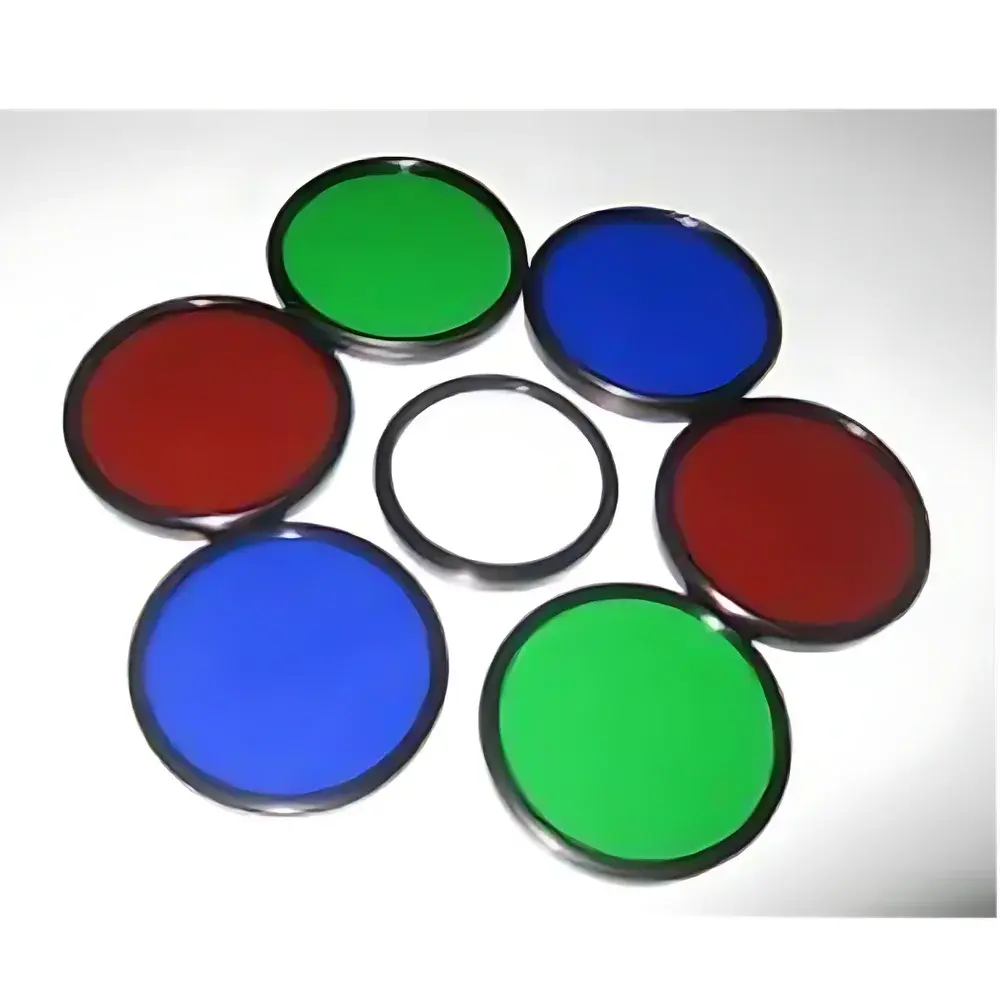
Zhongjiaojinyuan K9 Optical Bandpass Filter Glass
| Brand | Zhongjiaojinyuan |
|---|---|
| Origin | Beijing, China |
| Manufacturer Type | OEM/ODM Manufacturer |
| Region of Origin | Domestic (China) |
| Model | K9 Optical Bandpass Filter Glass |
| Pricing | Upon Request |
Overview
The Zhongjiaojinyuan K9 Optical Bandpass Filter Glass is a precision optical component engineered for selective spectral transmission in laboratory, industrial, and research-grade optical measurement systems. Fabricated from high-homogeneity, low-bubble K9 borosilicate crown glass (Schott BK7 equivalent), these filters operate on the principle of interference-enhanced spectral selectivity combined with intrinsic absorption edge characteristics of doped optical glass. Each filter exhibits a defined central transmission peak (λM), sharp short-wave and long-wave cut-on/cut-off transitions, and a narrow full-width-at-half-maximum (FWHM) bandwidth—typically specified in nanometers (nm). The optical performance is governed by composition-controlled absorption edges and optional thin-film interference coatings applied to substrate surfaces, enabling customization across UV, visible, and near-IR spectral regions (200–1100 nm). Designed for integration into spectrophotometers, fluorescence imaging systems, laser line isolation setups, and environmental monitoring sensors, this product meets fundamental requirements for spectral fidelity, thermal stability, and long-term irradiation resistance under controlled ambient conditions.
Key Features
- High-purity K9 optical glass substrate with refractive index nd ≈ 1.5168 and Abbe number νd ≈ 64.2, ensuring minimal chromatic aberration and excellent surface polishability
- Precisely controlled spectral parameters: peak transmittance (TM), center wavelength (λM), short-wave cutoff (λSW), long-wave cutoff (λLW), and FWHM—all verified via calibrated double-beam UV-Vis-NIR spectrophotometry (e.g., PerkinElmer Lambda 950 or Shimadzu UV-3600+)
- Multiple functional categories available: UV cutoff filters (e.g., ZJB series, λtj = 220–380 nm), visible bandpass filters (GRB series, λM = 420–1060 nm), UV bandpass filters (ZWB series, optimized for 254/280/313 nm mercury lines), and neutral density attenuation plates (AB series, OD 0.5–1.0)
- Standard thickness options: 2 mm and 3 mm; custom thicknesses (1–10 mm) available upon request to accommodate mechanical mounting constraints and étendue matching
- Surface quality compliant with MIL-PRF-13830B: 60-40 scratch-dig specification; parallelism ≤ 30 arcsec; wavefront distortion < λ/4 @ 633 nm
Sample Compatibility & Compliance
These filters are compatible with standard optical mounts (e.g., Thorlabs SM1-threaded lens tubes, Kinetic Systems kinematic stages) and integrate seamlessly into ISO/IEC 17025-accredited calibration workflows. Performance specifications align with relevant sections of ISO 9022-3 (optical instruments — environmental testing — spectral transmittance), ASTM E308-22 (computing instrumental color coordinates), and JIS R3102 (optical glass standards). While not inherently certified to FDA 21 CFR Part 11 or EU Annex 11, the filters support GxP-compliant instrument qualification when deployed within validated optical measurement platforms—particularly where spectral traceability to NIST-traceable reference materials (e.g., SRM 2036, 2068) is maintained. Documentation includes individual spectral transmittance curves, dimensional inspection reports, and material certificates of conformance per ISO 10477.
Software & Data Management
No embedded firmware or proprietary software is associated with passive optical filters. However, spectral data files (CSV, ASCII, or .SDF format) for each batch are supplied upon request and are fully compatible with industry-standard analysis environments including MATLAB (Optics Toolbox), Python (NumPy + SciPy + PyVista), and commercial optical design suites (Zemax OpticStudio, CODE V). Transmittance datasets include wavelength (nm) vs. %T columns, referenced to air and corrected for baseline drift using dual-beam normalization. For automated metrology integration, spectral profiles may be imported into LabVIEW-based QA/QC systems or LIMS platforms supporting ASTM E1317-compliant metadata tagging (e.g., filter ID, lot number, test date, operator ID).
Applications
- Laser-induced fluorescence (LIF) detection in combustion diagnostics and microfluidic cytometry, utilizing narrowband UV bandpass filters (e.g., ZWB1, λM = 254 nm, FWHM < 10 nm)
- UV-Vis spectrophotometric quantification of nucleic acids and proteins, where ZJB-series cutoff filters isolate excitation bands while rejecting stray visible light
- Machine vision lighting control in semiconductor wafer inspection, leveraging GRB-series visible bandpasses to enhance contrast at specific RGB channel wavelengths
- Environmental photometer calibration for solar UV index monitoring, using AB-series neutral density filters to attenuate broadband irradiance without spectral distortion
- Reference-grade optical alignment in interferometric metrology systems requiring stable, non-hygroscopic, low-fluorescence substrates
FAQ
What is the typical surface flatness tolerance for K9 bandpass filters?
Standard flatness is λ/4 @ 633 nm over the clear aperture; tighter tolerances (λ/10) are available under custom specification.
Can these filters be coated with anti-reflection (AR) layers?
Yes—single-layer MgF₂ or multi-layer broadband AR coatings (350–700 nm, R < 0.5% per surface) can be applied upon request.
Are ZWB-series UV bandpass filters suitable for high-intensity 254 nm mercury lamp exposure?
ZWB1 and ZWB2 grades exhibit >10⁴ hours of operational stability under continuous 254 nm irradiance at ≤10 mW/cm², provided ambient humidity remains <40% RH.
Do you provide NIST-traceable spectral certification?
Batch-level spectral validation is performed using NIST-traceable spectrophotometers; full traceability documentation (including uncertainty budgets per GUM) is available as an add-on service.
What is the maximum operating temperature range?
Continuous use up to +60 °C; short-term exposure (≤30 min) up to +120 °C is permissible, though thermal cycling should be limited to avoid stress birefringence.





