
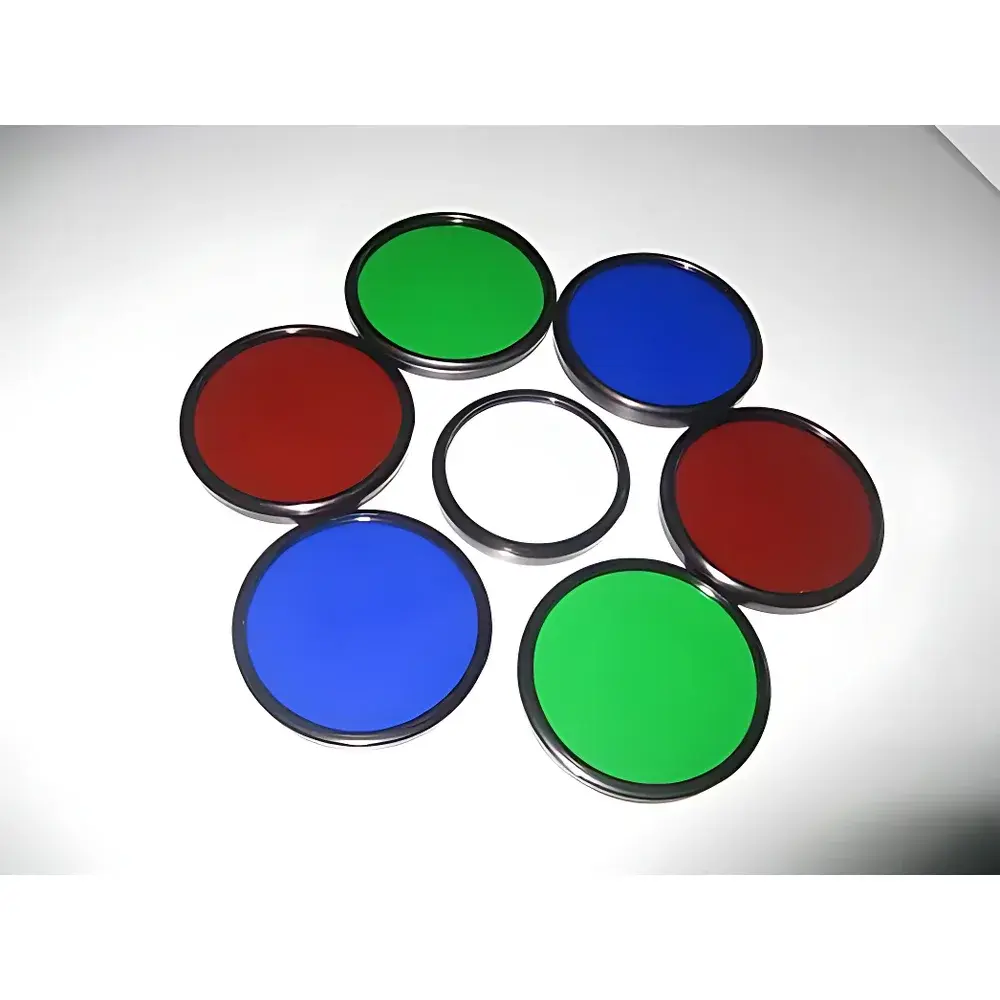

Zhongjiaojinyuan K9 Optical Bandpass Filter
| Brand | Zhongjiaojinyuan |
|---|---|
| Origin | Beijing, China |
| Manufacturer Type | OEM/ODM Manufacturer |
| Product Category | Optical Component |
| Model | K9 |
| Price Range | USD 7,000 – 14,000 (FOB China) |
| Material Substrate | Schott K9 Borosilicate Crown Glass (Equivalent to BK7) |
Overview
The Zhongjiaojinyuan K9 Optical Bandpass Filter is a precision-grade interference-based optical component engineered for selective spectral transmission in laboratory and industrial optical systems. Constructed from high-homogeneity K9 borosilicate crown glass—optically equivalent to Schott BK7—the filter utilizes multi-layer dielectric thin-film coatings deposited via ion-assisted electron-beam evaporation. Its spectral performance adheres to the fundamental principles of constructive and destructive interference in thin-film optics, enabling narrowband transmission with steep cut-on and cut-off edges. Designed for use in fluorescence microscopy, spectroscopic instrumentation, laser line separation, and UV-Vis-NIR analytical platforms, this bandpass filter delivers high peak transmittance (>85% typical), well-defined center wavelength (CWL) tolerance (±10 nm), and reproducible edge steepness across production batches. The substrate’s low thermal expansion coefficient (7.1 × 10⁻⁶ /K), excellent surface flatness (λ/4 @ 633 nm), and minimal wavefront distortion ensure compatibility with collimated and convergent beam paths in alignment-critical setups.
Key Features
- High-transmission dielectric coating optimized for specific CWLs ranging from 220 nm (UV) to 1060 nm (NIR), including standard bands at 254, 365, 405, 450, 532, 633, and 780 nm
- Narrow bandwidth options: Full Width at Half Maximum (FWHM) as low as 10 nm (e.g., ZWB series), with broader variants (e.g., GRB series) offering FWHM up to 70 nm for broadband applications
- Sharp spectral edges: Short-wavelength cutoff (λSW) and long-wavelength cutoff (λLW) defined at T = 0% or T ≤ 1% depending on spectral region; typical blocking OD ≥ 4.0 beyond passband
- K9 substrate compliance: Refractive index nd = 1.5163 @ 587.6 nm, Abbe number νd = 64.2, transmission >91% per surface (uncoated) from 350–2000 nm
- Robust environmental stability: Coating adhesion tested per MIL-C-48497A; humidity resistance verified under 95% RH / 40°C for 240 hrs; laser damage threshold ≥ 0.5 J/cm² @ 10 ns, 1064 nm (tested per ISO 21254-1)
Sample Compatibility & Compliance
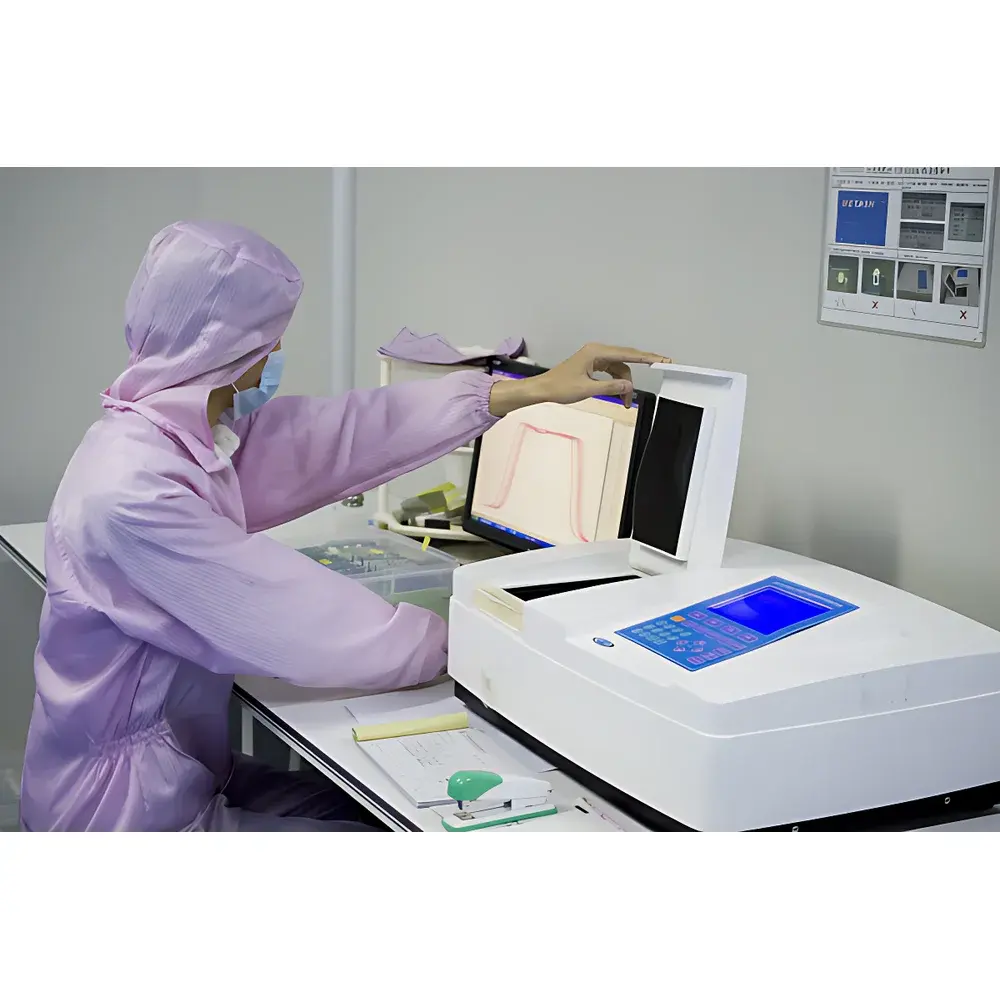
The K9 bandpass filters are supplied in standard thicknesses of 2 mm and 3 mm (custom thicknesses available upon request), with diameters ranging from Ø12.7 mm to Ø50.8 mm and rectangular formats up to 50 × 50 mm. All substrates undergo precision polishing to λ/4 surface flatness and 20–10 scratch-dig specification. Each batch is certified with spectral transmittance data measured using a calibrated double-monochromator spectrophotometer (e.g., PerkinElmer Lambda 1050+), traceable to NIST standards. Filters comply with ISO 10110-7 (optical element surface quality), ISO 9022-3 (environmental testing), and meet material requirements outlined in MIL-O-13830A for military-grade optical components. UV-grade variants (ZJB, ZWB series) conform to ASTM E275 for ultraviolet transmittance measurement methodology and support GLP-compliant documentation packages upon order.
Software & Data Management
While the K9 bandpass filter itself is a passive optical element, Zhongjiaojinyuan provides full spectral characterization reports in machine-readable CSV and XML formats compatible with common optical design software—including Zemax OpticStudio, CODE V, and FRED—enabling accurate system-level modeling of throughput, stray light, and signal-to-noise ratio. Customers receive spectral transmission curves with wavelength resolution ≤ 0.5 nm, annotated with CWL, FWHM, peak Tmax, blocking range, and edge steepness (Δλ/ΔT). For integration into automated QA workflows, spectral data can be exported to LIMS-compatible templates supporting 21 CFR Part 11 audit trails when paired with validated spectrophotometric validation protocols.
Applications
- Fluorescence excitation/emission isolation in confocal and widefield microscopes (e.g., DAPI/FITC/TRITC/Cy5 channel separation)
- Spectral calibration references in UV-Vis spectrophotometers and array-based hyperspectral sensors
- Laser safety and beam conditioning: harmonic separation (e.g., 532 nm fundamental vs. 266 nm fourth harmonic), pump-probe filtering
- Astronomical instrumentation: narrowband imaging for Hα, OIII, and SII emission line detection
- Environmental monitoring: gas-phase absorption spectroscopy (e.g., NO₂ at 400 nm, SO₂ at 313 nm)
- Biophotonics R&D: time-resolved fluorescence lifetime measurements requiring precise gating windows
FAQ
What is the typical surface quality and coating durability of the K9 bandpass filters?
All filters feature λ/4 surface flatness, 20–10 scratch-dig surface quality, and dielectric coatings qualified to MIL-C-48497A adhesion Class I. Humidity and thermal cycling tests confirm operational stability from −40°C to +80°C.
Can custom center wavelengths and bandwidths be manufactured?
Yes—Zhongjiaojinyuan supports custom CWL (200–1100 nm) and FWHM (5–100 nm) specifications with minimum order quantities starting at 25 units per configuration.
Are these filters suitable for high-power laser applications?
Standard versions are rated for CW powers up to 5 W/cm² at 532 nm; high-LDT variants (with enhanced coating architecture) are available for pulsed lasers (≥5 J/cm² @ 1064 nm, 10 ns) upon request.
Do you provide mounting solutions or optical housings?
Yes—standard SM1- and C-mount compatible anodized aluminum retention rings, kinematic mounts, and motorized filter wheels are offered as optional accessories with mechanical drawings and alignment tolerances specified per ISO 10110-1.
Is spectral certification included with each shipment?
Each filter lot includes a Certificate of Conformance with measured transmission curve, CWL deviation, FWHM, peak transmittance, and blocking OD values—traceable to internal metrology calibrated against NIST-traceable reference standards.




