
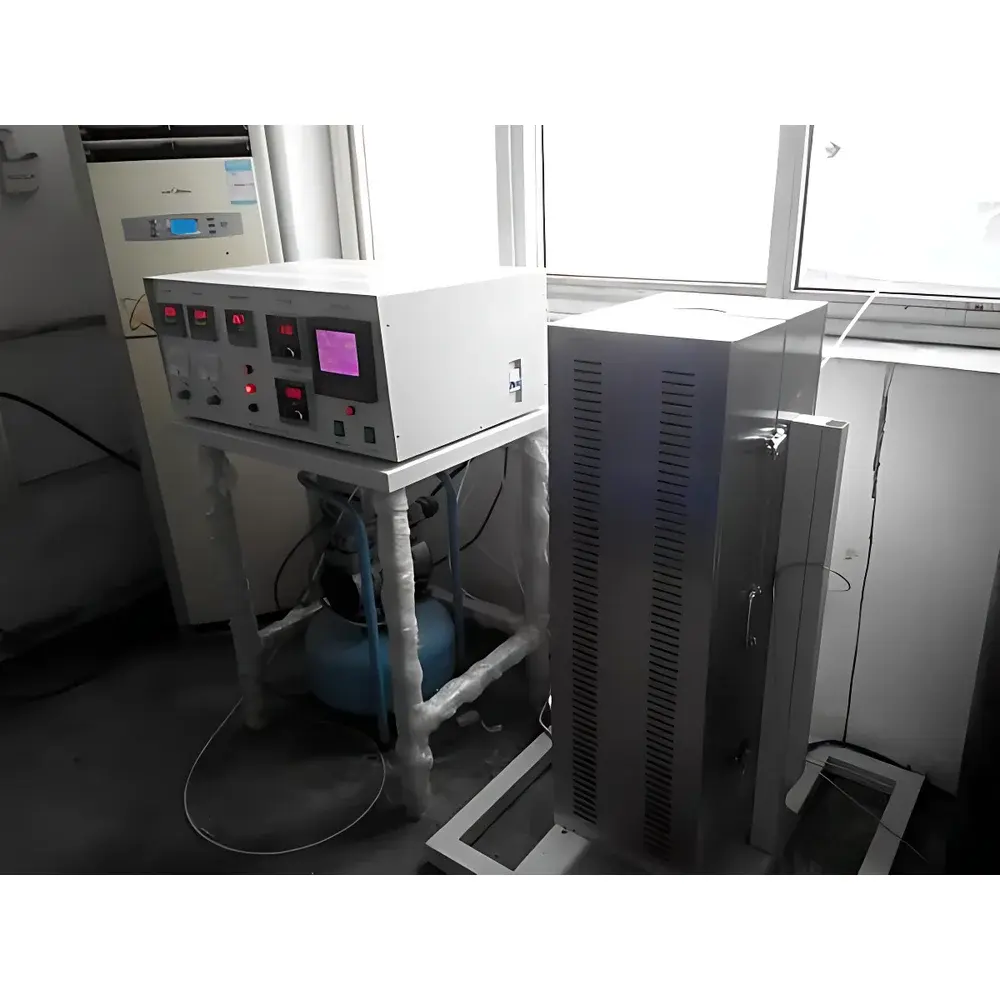
Zhongke Aobo Custom High-Temperature Fiber-Embedded Heating Furnace
No specifications available.
Overview
The Zhongke Aobo Custom High-Temperature Fiber-Embedded Heating Furnace is an engineered thermal solution designed for precision laboratory and industrial high-temperature applications requiring stable, rapid, and energy-efficient heating up to 1300 °C. Unlike conventional refractory or metal-sheathed resistance heaters, this furnace utilizes a proprietary fiber-embedded architecture: high-resistivity alloy wire (e.g., Kanthal A1 or similar Ni-Cr based alloys) is integrally embedded within low-density, high-purity ceramic fiber matrices—such as alumina-silica or polycrystalline mullite fiber—via controlled mechanical interlocking rather than adhesive bonding. This construction enables true volumetric heat generation with minimal thermal mass, supporting fast thermal ramp rates (typically ≤15 °C/min from ambient to 1200 °C), low thermal inertia, and exceptional thermal uniformity across the heated zone. The system operates on standard single-phase or three-phase AC supply (220–480 V, 50/60 Hz), with integrated thermocouple inputs (Type K or S) for closed-loop temperature control via external PID or programmable logic controllers.
Key Features
- Fiber-Embedded Resistive Architecture: Electrically insulated ceramic fiber substrate (density 200–600 kg/m³) mechanically anchors resistance wire in three configurations—fully embedded (buried 3–5 mm), semi-exposed (micro-protruding), or surface-coiled—enabling optimized surface power density (≤20 kW/m²) and reduced hot-spot risk.
- High-Temperature Capability: Continuous operation rated up to 1300 °C; short-term excursions permitted to 1350 °C per ISO 8501-1 and ASTM C871 thermal stability testing protocols.
- Thermal Efficiency & Responsiveness: Low volumetric heat capacity (<0.3 MJ/m³·K) and thermal conductivity (0.16 W/m·K at 1000 °C; 0.25 W/m·K at 1350 °C) yield >40% energy savings versus brick-lined furnaces under intermittent duty cycles.
- Mechanical Robustness: Exhibits excellent thermal shock resistance (tested per ASTM C1141), compressive strength ≥0.8 MPa (at 10% strain), and linear reheat shrinkage ≤2.0% after 1 h at 1500 °C.
- Custom Integration Flexibility: Available as flat panels, arc-shaped segments, tubular liners, crucible inserts, or fully bespoke geometries—dimensionally defined by customer-supplied CAD drawings or technical specifications.
Sample Compatibility & Compliance
This heating furnace is compatible with inert, oxidizing, and mildly reducing atmospheres (e.g., air, N₂, Ar, dilute H₂/N₂ mixtures). It is not suitable for strongly reducing, sulfidizing, or halogen-rich environments without protective cladding. All fiber substrates meet ISO 14405 geometric tolerancing standards for dimensional consistency, and raw materials comply with RoHS Directive 2011/65/EU and REACH Annex XVII restrictions. For GxP-regulated laboratories, the furnace supports integration with validated temperature mapping systems (per USP <1031> and ISO/IEC 17025) when paired with calibrated Class I thermocouples and audit-trail-capable controllers. Structural components conform to IEC 61000-6-2 (EMC immunity) and IEC 60529 IP20 enclosure rating.
Software & Data Management
The furnace itself is hardware-only and does not include embedded firmware or proprietary software. It is designed for seamless integration into existing lab automation ecosystems: analog 0–10 V or 4–20 mA setpoint/control interfaces enable compatibility with commercial PID controllers (e.g., Eurotherm, Watlow), PLC-based SCADA systems (Siemens S7, Rockwell Logix), or custom LabVIEW/Python-based DAQ platforms. When deployed in regulated environments, full electronic record integrity—including temperature profiles, ramp/soak sequences, and alarm logs—can be achieved using 21 CFR Part 11-compliant data acquisition software with user access controls, electronic signatures, and immutable audit trails.
Applications
- Research-grade sintering and annealing of advanced ceramics (Al₂O₃, SiC, ZrO₂), battery cathode materials (NMC, LFP), and metal-organic frameworks (MOFs).
- Thermal processing in aerospace component development—including turbine blade coating densification and composite matrix curing.
- High-temperature calibration sources for blackbody radiometry (NIST-traceable reference cavities).
- Specialized furnace linings for vacuum induction melting (VIM), electroslag remelting (ESR), and glass tank superstructure heating.
- Sealing elements for kiln car joints, radiant tube end caps, and nuclear fuel rod sintering fixtures operating under neutron irradiation constraints.
FAQ
What maximum continuous operating temperature is certified for this furnace?
Continuous operation is rated to 1300 °C; exposure above this temperature requires engineering review and may void structural warranty.
Can the heating element be replaced independently of the fiber substrate?
No—the resistive wire is permanently embedded during manufacturing; replacement requires full module substitution.
Is vacuum compatibility supported?
Yes, when sealed with high-temperature ceramic gaskets and operated below 10⁻² mbar; outgassing rates are characterized per ASTM E595 for space-qualified applications.
Do you provide thermal validation documentation (e.g., mapping reports)?
Validation support is available upon request as a value-added service, including IQ/OQ documentation templates aligned with ISO 9001 and GMP Annex 15 requirements.
What electrical safety certifications apply to the assembly?
The base heater module complies with IEC 60519-2 (safety requirements for industrial electroheating equipment) and UL 499 (heating appliances), with CE marking for EMC and LVD directives.



