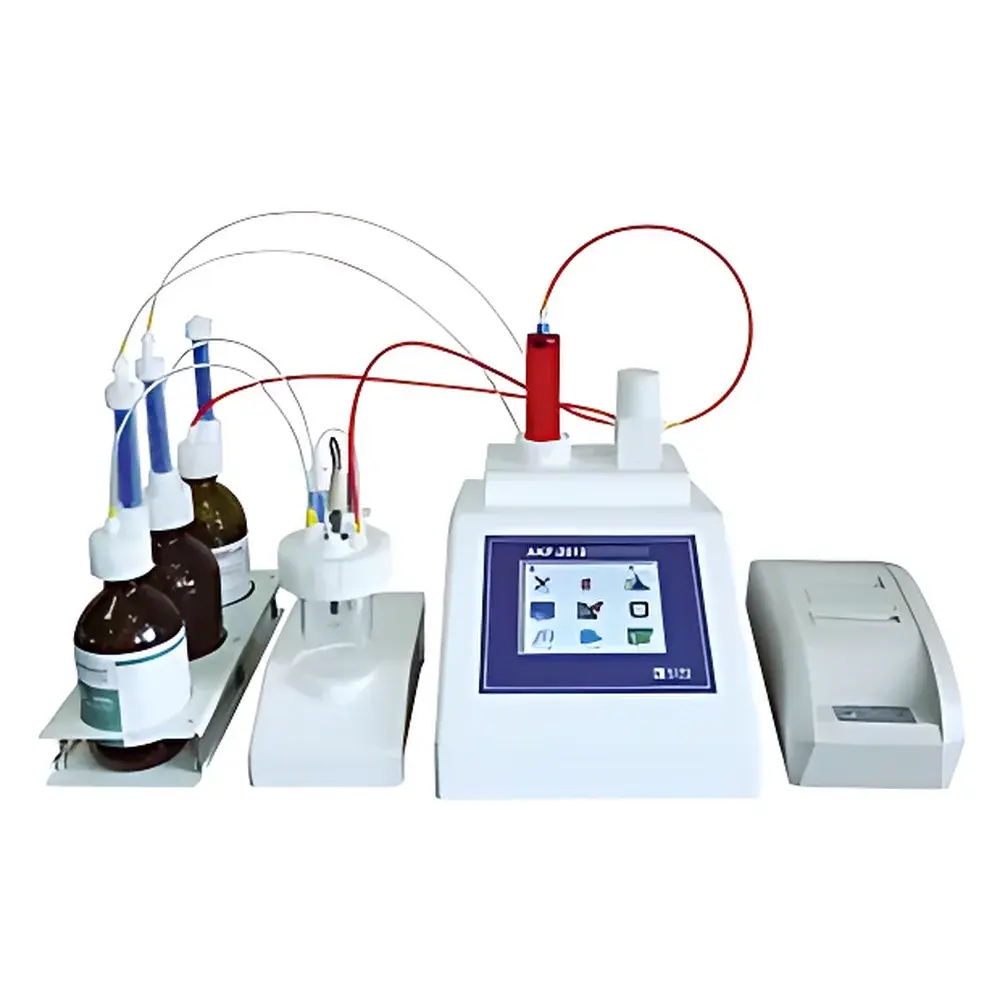
ZHONGKEHUIFEN AKF-2010 Intelligent Karl Fischer Coulometric and Volumetric Moisture Titrator
| Brand | ZHONGKEHUIFEN |
|---|---|
| Origin | Shanghai, China |
| Model | AKF-2010 |
| Moisture Range | 0.001–100% w/w |
| Resolution | 1 µg H₂O |
| Repeatability | ≥99.7% (at 10 mg water) |
| Max Error | ±0.3% |
| Titration Speed Control | 0.5 µL–0.1 mL adjustable |
| Display | 5.6" TFT LCD (640×480 px) |
| Data Storage | 100,000+ records (expandable) |
| Electrode | Dual-platinum electrode |
| Valve & Tubing Material | FEP-coated electromagnetic 3-way valve |
| Operating Temp | 5–40 °C |
| Humidity Limit | ≤80% RH |
| Power | 220 V / 50 Hz / 50 W |
| Interface Options | RS-232C, USB, Ethernet (Web-enabled) |
Overview
The ZHONGKEHUIFEN AKF-2010 is an intelligent dual-mode Karl Fischer titrator engineered for high-precision moisture quantification across pharmaceutical, chemical, polymer, food, and petrochemical laboratories. It supports both volumetric and coulometric titration principles—enabling trace-level (1 µg detection limit) to full-range (0.001–100% w/w) water analysis in solid, liquid, and gaseous samples. The system implements the electrochemical endpoint detection principle defined in ASTM E203 and ISO 8533, where iodine generation (coulometric mode) or iodine dosing (volumetric mode) is precisely controlled until stoichiometric reaction completion with water is confirmed by dual-platinum polarization current monitoring. Its closed-circuit titration cell architecture minimizes ambient moisture ingress and reagent exposure, ensuring analytical integrity and operator safety under routine GLP/GMP workflows.
Key Features
- 5.6-inch high-resolution TFT touchscreen interface with intuitive, icon-driven navigation—no prior training required for method setup, titration execution, maintenance scheduling, or result review.
- Adaptive titration control algorithm that dynamically adjusts delivery rate based on sample water content and KF reagent titer, optimizing speed without compromising accuracy.
- Real-time drift compensation: continuous background moisture tracking and automatic subtraction using dual-slope baseline correction per ISO 15512 Annex A.
- Integrated safety architecture: hardware-level fault detection halts operation upon motor stall, electrode open-circuit, or cell overpressure; all critical components feature fail-safe shutdown logic.
- FEP-lined fluidic path with UV-protective shielding on burette assemblies ensures long-term chemical compatibility with iodine-containing solvents (e.g., methanol, chloroform, imidazole-based reagents).
- Modular sample introduction system supporting solid (via oven coupling), liquid (syringe injection), and gas (flow-through cell) configurations—validated for moisture levels from 10 ppm to saturation.
Sample Compatibility & Compliance
The AKF-2010 accommodates diverse matrix types—including hygroscopic powders (e.g., APIs, excipients), viscous oils (lubricants, transformer fluids), volatile solvents (acetone, THF), and low-dielectric gases (SF₆, nitrogen)—without modification. All titration cells conform to ASTM D6304 requirements for sealed vessel design and electrode geometry. Instrument validation documentation supports IQ/OQ/PQ protocols aligned with FDA 21 CFR Part 11 (audit trail enabled), EU Annex 11, and ICH Q2(R2) guidelines. Built-in calibration verification routines include volumetric precision checks (gravimetric standardization per USP ) and endpoint reproducibility assessment using certified water standards.
Software & Data Management
Embedded firmware provides full data lifecycle control: automatic timestamped storage of method parameters, raw titration curves, drift values, reagent consumption logs, and calibration certificates. Data retention exceeds 100,000 entries with hierarchical search (by date, sample ID, operator, or batch number). Export formats include CSV, PDF (GLP-compliant report templates), and XML for LIMS integration. USB host port enables direct transfer to external drives; Ethernet interface supports remote monitoring via browser-based dashboard. Audit trail functionality records all user actions—including parameter edits, result deletions, and calibration events—with immutable timestamps and operator IDs.
Applications
- Pharmaceutical QC: Water content verification in lyophilized products (USP ), excipients, and sterile packaging headspace.
- Polymer manufacturing: Residual monomer moisture in polyamide resins prior to extrusion; hydrolysis risk assessment in PET preforms.
- Battery electrolyte analysis: Quantification of trace water in LiPF₆ solutions (ASTM D7622) affecting SEI layer formation.
- Fuel quality control: Detection of free water in aviation turbine fuel (ASTM D6304) and biodiesel blends (EN 14971).
- Food ingredient testing: Moisture profiling in dried dairy powders, starches, and hygroscopic sweeteners per AOAC 955.03.
FAQ
Does the AKF-2010 support both volumetric and coulometric titration modes?
Yes—the instrument is configured for switchable operation between volumetric (using pre-titrated KF reagents) and coulometric (electro-generated iodine) methods via software selection.
Can it be validated for regulated environments such as pharmaceutical GMP labs?
Yes—full 21 CFR Part 11 compliance is achieved with electronic signatures, audit trail logging, and password-protected access levels (admin/operator/technician). Validation templates are included.
What sample introduction options are available for solids?
A dedicated oven sampler (optional) enables automated heating and carrier-gas transfer of moisture from thermally labile solids into the titration cell at programmable temperatures up to 250 °C.
Is remote diagnostics supported?
Yes—via embedded web server accessible through standard browsers; firmware updates and real-time status monitoring can be performed over LAN/WAN without local PC dependency.
How does the system handle reagent degradation during extended use?
The firmware monitors reagent activity through periodic blank titrations and alerts users when drift exceeds configurable thresholds (e.g., >10 µg/min), prompting recalibration or reagent replacement.