
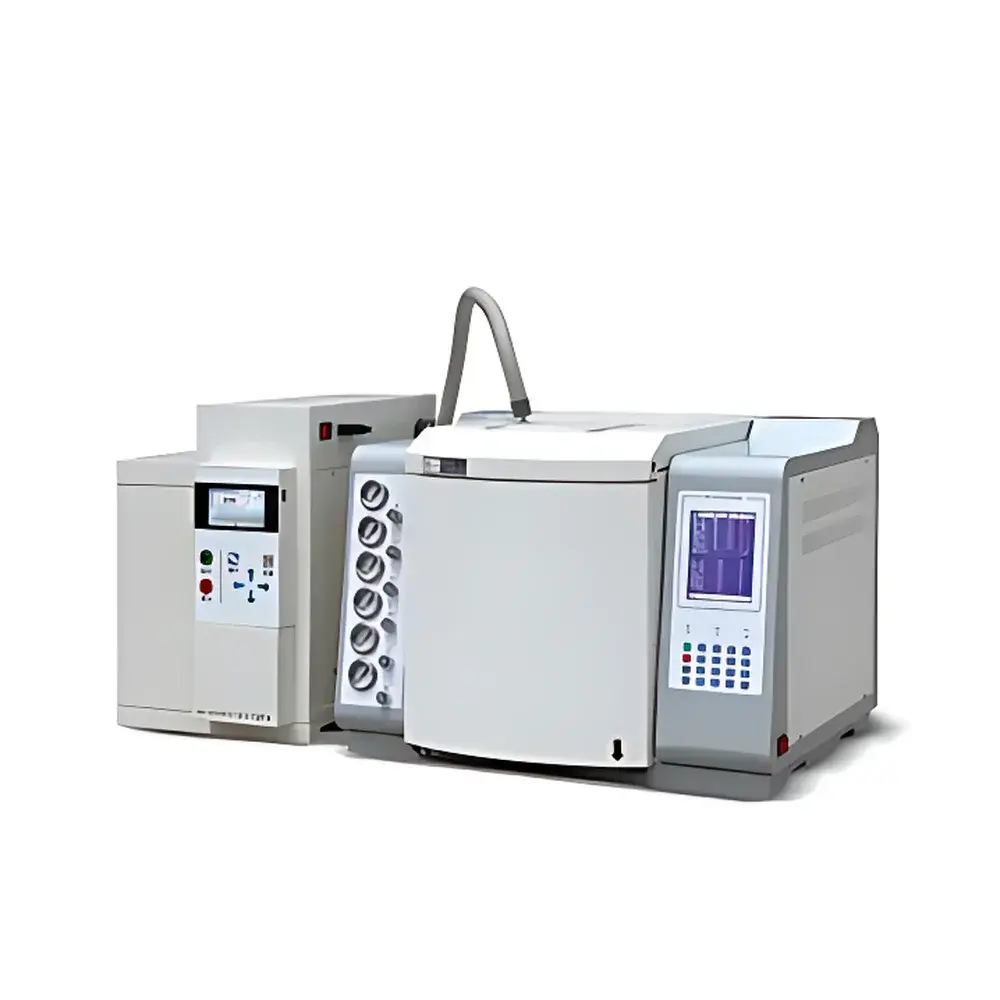
ZHONGKEHUIFEN GC-7820 Laboratory Gas Chromatograph for Water Quality Analysis
| Brand | ZHONGKEHUIFEN |
|---|---|
| Origin | Beijing, China |
| Instrument Type | Laboratory Gas Chromatograph |
| Application Field | Environmental Monitoring (Water Quality) |
| Temperature Control Range | Ambient + 3°C to 450°C |
| Oven Ramp Rate | 0.1–40°C/min |
| Cool-down Time | ~8 min (450°C → 50°C) |
| Carrier Gas Flow Range & Control | 0–1200 mL/min |
| Carrier Gas Pressure Range & Control | 0–970 kPa |
| Injector Maximum Operating Temperature | 450°C |
| Injector Pressure Setting Range | 0–970 kPa |
| Injector Total Flow Setting Range | 0–1200 mL/min |
Overview
The ZHONGKEHUIFEN GC-7820 is a dedicated laboratory gas chromatograph engineered for high-reliability analysis of volatile and semi-volatile organic compounds (VOCs and SVOCs) in aqueous environmental matrices—particularly drinking water, surface water, wastewater, and groundwater samples. It operates on the fundamental principle of gas-liquid partition chromatography, where analytes are volatilized, separated on capillary or packed columns under precisely controlled temperature gradients, and detected via selective, high-sensitivity detectors including FID, TCD, ECD, and FPD. Designed specifically for compliance-driven environmental testing laboratories, the GC-7820 meets methodological requirements aligned with EPA Methods 502.2, 524.2, 624, 8021B, and ISO 10301, supporting routine quantification of chlorinated hydrocarbons, BTEX, trihalomethanes, organophosphorus pesticides, and polycyclic aromatic hydrocarbons (PAHs) at sub-ppb levels.
Key Features
- Advanced thermal architecture: Independent triple-zone temperature control (oven, injector, detector) with ±0.1°C stability; oven dimensions (260 × 270 × 235 mm) accommodate dual 80 m capillary columns for parallel or backflush configurations.
- Enhanced detector performance: Electron Capture Detector (ECD) optimized for sub-picogram-level detection of halogenated compounds, validated against international sensitivity benchmarks (e.g., ASTM D5845, IUPAC traceability protocols).
- Modular inlet system: Dual-inlet capability (packed column + split/splitless capillary) with membrane purge function; single-hand replaceable liner, septum, and jet components; tool-free detector module exchange using one hex key.
- Intelligent thermal management: Variable-speed rear door ventilation system reduces post-run equilibration time by up to 40% versus fixed-airflow ovens; external cabinet surface temperature remains ≤40°C even during simultaneous 300°C operation across all zones.
- Digital precision control: Fully microprocessor-based firmware with real-time PID feedback loops; carrier gas pressure and flow digitally regulated via mass flow controllers (MFCs) compliant with ISO 8502-2 accuracy standards.
- Network-enabled operation: Integrated Ethernet interface supports TCP/IP communication for remote instrument control, firmware OTA updates, diagnostic logging, and secure data streaming to LIMS or ELN platforms.
Sample Compatibility & Compliance
The GC-7820 is validated for use with standard environmental sample preparation workflows—including liquid-liquid extraction (LLE), solid-phase extraction (SPE), purge-and-trap (P&T), headspace (HS), and thermal desorption (TD)—enabling seamless integration into accredited laboratory quality systems. Its hardware and software architecture support audit-ready data integrity per FDA 21 CFR Part 11 (electronic signatures, operator authentication, immutable audit trails), GLP/GMP documentation requirements, and ISO/IEC 17025:2017 clause 7.7 (data control and retention). All detector modules comply with IEC 61000-4 electromagnetic compatibility standards and meet CE marking directives for laboratory instrumentation.
Software & Data Management
The proprietary GC-7820 Control & Analysis Suite provides unified control of acquisition parameters, real-time status monitoring, peak integration (with baseline correction, retention time locking, and spectral deconvolution), calibration curve generation (linear, quadratic, weighted), and customizable report templates exportable in PDF, CSV, and XML formats. The software includes built-in method validation tools (precision, linearity, LOD/LOQ estimation), electronic lab notebook (ELN) synchronization, and optional LIMS API integration. Raw data files adhere to ANDI/NetCDF format for cross-platform compatibility with third-party chemometric packages (e.g., MATLAB, SIMCA, OpenChrom).
Applications
- Regulatory water testing: Quantification of regulated contaminants under EU Directive 2020/2184 and US EPA Safe Drinking Water Act (SDWA) criteria.
- Wastewater treatment plant effluent monitoring: Detection of industrial discharge markers (e.g., chlorobenzenes, phthalates, nitrosamines).
- Soil leachate and groundwater plume characterization: Targeted analysis of petroleum hydrocarbons (PHCs) and chlorinated solvents (PCE, TCE).
- Method development and validation studies: Support for ISO 17025-compliant uncertainty budgeting and robustness testing (DoE-based parameter variation).
- Academic and research labs: Flexible platform for coupling with ancillary modules—methanizer (for CO/CO₂ analysis), pyrolyzer (polymer degradation studies), or cryo-focusing units (for ultra-trace VOC preconcentration).
FAQ
Is the GC-7820 compatible with EPA Method 524.2 for VOC analysis in drinking water?
Yes—the instrument’s thermal stability, ECD/FID sensitivity, and autosampler-ready configuration meet all instrumental performance criteria specified in Method 524.2, including initial calibration verification (ICV), continuing calibration verification (CCV), and laboratory control sample (LCS) recovery requirements.
Can the GC-7820 be integrated into an existing LIMS environment?
Yes—via its RESTful API and configurable ODBC driver, enabling bidirectional transfer of method parameters, run logs, and analytical results while preserving chain-of-custody metadata.
What maintenance intervals are recommended for routine operation?
Injector liners and septa should be replaced every 100 injections; column trimming every 500 runs; detector cleaning (FID jet, ECD cell) every 1,000 runs or as indicated by signal drift >5% RSD over calibration check standards.
Does the system support unattended overnight operation?
Yes—equipped with power-fail resume functionality, automatic shutdown after final sequence completion, and continuous memory backup to preserve method settings and calibration history during unexpected outages.
Related Products





