
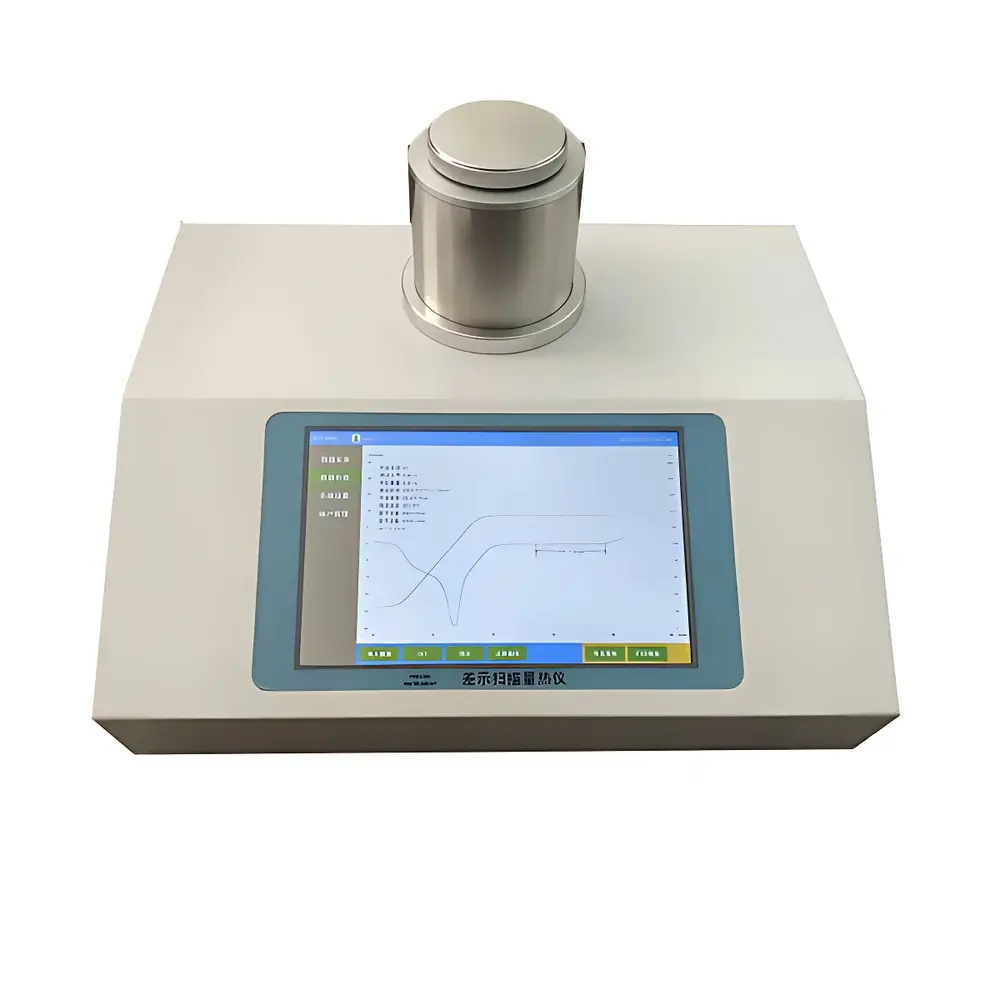
Zhonglu DSC-500ARD Microcomputer-Controlled Differential Scanning Calorimeter
| Brand | Zhonglu |
|---|---|
| Origin | Shanghai, China |
| Manufacturer Type | Direct Manufacturer |
| Product Category | Domestic |
| Model | DSC-500ARD |
| Price | USD 4,200 (approx.) |
| Temperature Range | Ambient to 500 °C ±0.1 °C |
| Heating Rate | 0.1–80 °C/min |
| Temperature Repeatability | ±0.1 °C |
| Temperature Accuracy | ±0.1 °C |
| Sample Capacity | 1 |
| Temperature Resolution | 0.01 °C |
| DSC Signal Range | ±200 mW / ±500 mW |
| Atmosphere Control | Dual-gas automatic switching |
| Display | 10.1-inch 24-bit color industrial touchscreen PC |
| Data Interfaces | USB, RS-232 |
| Calibration Standards | Indium and Tin reference materials included |
| Compliance | ISO 11357, GB/T 19466, ASTM D3417 |
Overview
The Zhonglu DSC-500ARD is a microcomputer-controlled differential scanning calorimeter engineered for precise thermal transition analysis of solid and semi-crystalline materials. It operates on the principle of differential scanning calorimetry (DSC), measuring the heat flow difference between a sample and an inert reference (typically α-Al2O3) as both are subjected to identical, programmable temperature profiles. Unlike classical capillary-based melting point apparatuses, the DSC-500ARD quantifies endothermic events—including melting onset (Tonset), peak temperature (Tpeak), and endset (Tend)—with high thermal resolution and reproducibility. Its integrated 10.1-inch industrial-grade touchscreen PC eliminates external computing dependencies, enabling real-time acquisition, visualization, and on-device processing of heat flow versus temperature curves. Designed for routine QC laboratories and R&D environments in polymer science, pharmaceutical development, and fine chemical synthesis, the instrument delivers traceable, standards-compliant thermal data without requiring optical transparency of samples.
Key Features
- Embedded 10.1-inch industrial touchscreen PC with native DSC software for autonomous operation—no external computer required for standard measurements.
- Dual platinum resistance temperature detectors (RTDs) ensure high spatial and temporal consistency in sample temperature monitoring, supporting repeatability of ±0.1 °C across repeated runs.
- Compact furnace architecture with mechanical-only mounting—eliminates adhesive-based thermal interfaces that may introduce spurious thermal lag or baseline drift.
- Programmable heating rates from 0.1 to 80 °C/min, with full auto-compensation of temperature calibration coefficients based on selected ramp rate.
- Two-channel gas control system enables automated switching between inert (N2) and oxidative (air/O2) atmospheres during a single run, supporting decomposition and oxidation onset analysis.
- Onboard calibration suite with certified indium (Tm = 156.6 °C) and tin (Tm = 231.9 °C) standards; one-touch calibration initiates automatic gain and offset correction.
- Three-tier user account system (Operator, Supervisor, Administrator) with audit-trail logging per ICH-GCP and FDA 21 CFR Part 11 alignment requirements.
- Direct thermal curve export via USB flash drive; optional serial (RS-232) interface for legacy lab network integration.
Sample Compatibility & Compliance
The DSC-500ARD accommodates standard aluminum crucibles (Φ6.7 × 3 mm) and supports sample masses from 1 to 10 mg. It is compatible with powders, granules, pellets, thin films, and pressed discs—including opaque or highly scattering materials such as polyethylene, polypropylene, PEEK, API intermediates, and excipient blends. No sample pretreatment (e.g., recrystallization or solvent casting) is required for basic melting characterization. The system complies with international thermal analysis standards including ISO 11357-1/3 (Plastics — Differential Scanning Calorimetry), GB/T 19466.1–3 (Chinese national standard equivalent), and ASTM D3417 (Standard Test Method for Melting Point of Plastics by DSC). All calibration and validation procedures follow GLP-aligned documentation practices, with electronic records retaining metadata such as operator ID, timestamp, instrument configuration, and raw thermogram checksums.
Software & Data Management
The embedded operating system hosts a dedicated DSC application built on deterministic real-time scheduling. It provides synchronized display of temperature, heat flow, and derivative (dH/dt) signals at 10 Hz sampling resolution. Peak identification algorithms apply tangent-onset and inflection-point methods per ISO 11357-3 Annex A. Data files are stored in vendor-neutral CSV format with embedded header metadata, ensuring long-term readability. Optional PC-based software (supplied on CD-ROM) extends functionality to multi-run comparative analysis, baseline subtraction, enthalpy integration, and report generation compliant with internal SOP templates. All data exports include digital signatures and time-stamped audit logs meeting FDA 21 CFR Part 11 requirements for electronic records and signatures.
Applications
- Pharmaceutical solid-state characterization: polymorph screening, eutectic detection, and thermal stability assessment of active pharmaceutical ingredients (APIs) and amorphous dispersions.
- Polymer quality control: determination of melting point, crystallinity %, glass transition (Tg), cold crystallization, and degradation onset in thermoplastics and elastomers.
- Chemical purity estimation using van’t Hoff relationship applied to melting point depression.
- Reaction enthalpy measurement for curing kinetics in epoxy resins and crosslinking systems.
- Regulatory submission support: generation of DSC thermograms and summary reports aligned with ICH Q5A(R2), Q5C, and USP <846> monographs.
FAQ
Does the DSC-500ARD require liquid nitrogen cooling?
No—it is a heat-flux DSC system with resistive heating only; no cryogenic cooling stage is integrated or supported.
Can the instrument perform isothermal holds?
Yes—programmable temperature control includes isothermal segments at any setpoint within the 0–500 °C range, with duration up to 999 minutes.
Is compliance with 21 CFR Part 11 achievable out-of-the-box?
The three-level user authentication, electronic signature prompts, and immutable audit trail meet core technical requirements; full Part 11 validation requires site-specific IQ/OQ/PQ protocols.
What is the maximum sample mass recommended for accurate melting point determination?
For optimal signal-to-noise ratio and thermal homogeneity, use 2–5 mg of finely ground, uniformly packed material.
Are crucibles reusable?
Aluminum crucibles are single-use per GMP guidance; reuse risks cross-contamination and baseline artifacts due to residual decomposition products.



