
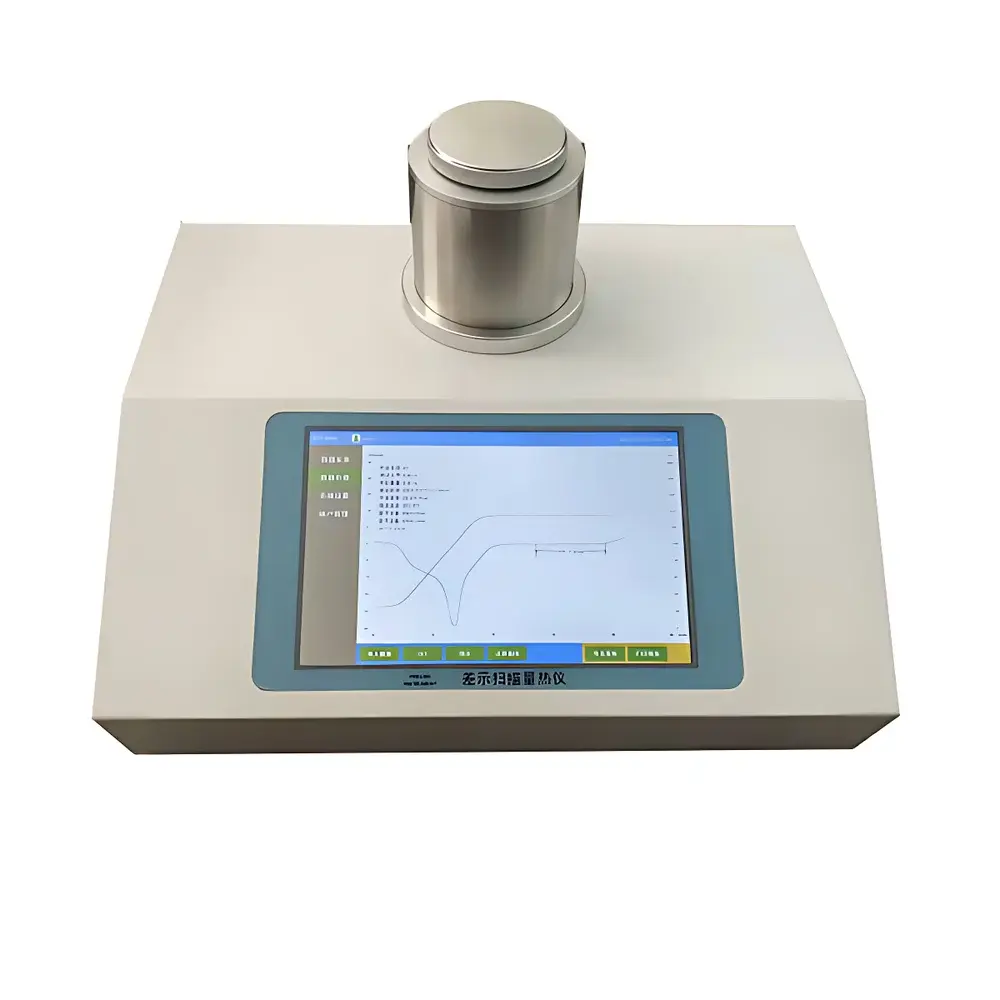
Zhonglu DSC-500ARD Resin Melting Point Analyzer
| Brand | Zhonglu |
|---|---|
| Model | DSC-500ARD |
| Type | Differential Scanning Calorimeter (DSC) |
| Origin | Shanghai, China |
| Manufacturer | Zhonglu Instrument Co., Ltd. |
| Temperature Range | Ambient to 500 °C |
| Heating Rate | 0.1–80 °C/min |
| Temperature Accuracy | ±0.1 °C |
| Temperature Repeatability | ±0.1 °C |
| Temperature Resolution | 0.01 °C |
| Sample Capacity | 1 position |
| DSC Signal Range | 0 to ±200 mW / 0 to ±500 mW |
| Atmosphere Control | Dual-gas automatic switching (e.g., N₂/air) |
| Display | 10.1″ industrial-grade capacitive touchscreen (24-bit color) |
| Data Interfaces | USB 2.0, RS-232 |
| Compliance | ISO 11357, GB/T 19466, ASTM D3417 |
Overview
The Zhonglu DSC-500ARD Resin Melting Point Analyzer is a benchtop differential scanning calorimeter engineered for precise thermal characterization of thermoplastic resins, polymer pellets, and other organic crystalline materials. It operates on the fundamental principle of differential scanning calorimetry—measuring the heat flow difference between a sample and an inert reference material as both are subjected to a controlled temperature program. Unlike optical melt-point apparatuses, this instrument quantifies enthalpy changes associated with phase transitions (e.g., melting onset, peak, and offset), enabling determination of melting point, melting range (melting interval), crystallinity, and thermal stability. Its design emphasizes metrological integrity: dual platinum resistance temperature detectors (RTDs) ensure high spatial and temporal consistency in sample temperature measurement; a mechanically anchored furnace eliminates adhesive-induced thermal drift or signal contamination; and a fully programmable heating profile supports method development aligned with international thermal analysis standards.
Key Features
- Integrated 10.1-inch industrial touchscreen PC with embedded real-time DSC data acquisition and on-board curve analysis—no external computer required for routine operation.
- Automatic calculation of onset, peak, and endset temperatures per ICH Q5C and ASTM E794 guidelines; supports user-defined baselines and tangent interpolation.
- Compact, rigid furnace architecture with mechanical fastening only—zero use of adhesives in sensor or heater assembly—to preserve baseline stability and minimize thermal lag.
- Dual independent RTD probes (sample + reference) calibrated against certified In and Sn standards, delivering ±0.1 °C accuracy and repeatability across the full 0–500 °C range.
- Programmable atmosphere control with automatic dual-gas switching (e.g., nitrogen purge followed by air oxidation), supporting oxidative induction time (OIT) and decomposition studies.
- Three-tier user account system with role-based access (Operator, Supervisor, Administrator), audit-trail logging of all parameter modifications and calibration events per FDA 21 CFR Part 11 requirements.
- On-device report generation with direct thermal printer support; raw DSC curves and metadata exportable via USB flash drive in CSV and native .dsc formats.
- Optical-transparency independence—suitable for opaque, colored, or filled polymer samples where capillary tube methods fail.
Sample Compatibility & Compliance
The DSC-500ARD accommodates standard 6.7 mm × 3 mm aluminum crucibles (included), compatible with solid granules, powders, films, and compression-molded discs up to 25 mg. It meets the essential performance criteria defined in ISO 11357-1 (General Principles), ISO 11357-3 (Melting and Crystallization Temperatures), GB/T 19466.3 (Chinese national DSC standard), and ASTM D3417 (Standard Test Method for Heat of Fusion of Thermoplastic Polymers). Its temperature calibration traceability is maintained using certified indium (156.6 °C) and tin (231.9 °C) reference materials, with one-click auto-calibration functionality. The system supports GLP/GMP-aligned workflows through configurable electronic signatures, session timestamps, and immutable method storage.
Software & Data Management
Local operation is managed via the embedded Windows-based HMI software, which provides live DSC thermogram visualization, real-time derivative (dH/dT) plotting, and integrated peak integration tools. For advanced post-processing, the optional PC software (supplied on CD-ROM) enables multi-curve overlay, baseline correction, kinetic modeling (e.g., Ozawa-Flynn-Wall), and compliance reporting templates aligned with regulatory submission formats. All data files contain embedded metadata: instrument ID, operator ID, date/time stamp, calibration status, atmospheric conditions, and raw thermocouple voltage traces. USB and RS-232 interfaces support bidirectional communication, enabling remote method upload, firmware updates, and centralized lab data archiving.
Applications
- Quality control of polyolefins (PP, PE), engineering thermoplastics (PA6, PBT, PC), and biopolymers (PLA, PHA) in polymer manufacturing.
- Batch-to-batch consistency verification of resin feedstock prior to extrusion or injection molding.
- Crystallinity assessment of semi-crystalline polymers via enthalpy-of-fusion normalization against 100% crystalline references.
- Thermal degradation onset detection under inert or oxidative atmospheres per ASTM D3895 and ISO 11357-6.
- R&D support for copolymer composition analysis, plasticizer migration studies, and nucleating agent efficacy evaluation.
- Regulatory documentation for pharmaceutical excipients (e.g., PEG, stearic acid) per USP <741> and Ph. Eur. 2.2.17.
FAQ
What standards does the DSC-500ARD comply with for polymer melting analysis?
It conforms to ISO 11357-3, ASTM D3417, and GB/T 19466.3 for melting point and enthalpy determination of thermoplastics.
Can the instrument perform isothermal holds or cooling scans?
Yes—it supports multi-segment temperature programs including isothermal stabilization, linear cooling (down to ambient), and modulated DSC (M-DSC) via firmware update.
Is calibration traceable to national metrology institutes?
Calibration uses NIST-traceable indium and tin standards; certificate of calibration is provided with each unit.
Does the system support 21 CFR Part 11 compliance?
Yes—electronic signatures, audit trails, and user-access controls meet core Part 11 requirements for regulated laboratories.
What sample preparation is required for resin pellets?
Pellets are loaded directly into aluminum crucibles without grinding; typical mass is 5–15 mg, ensuring representative thermal response without overheating artifacts.



