
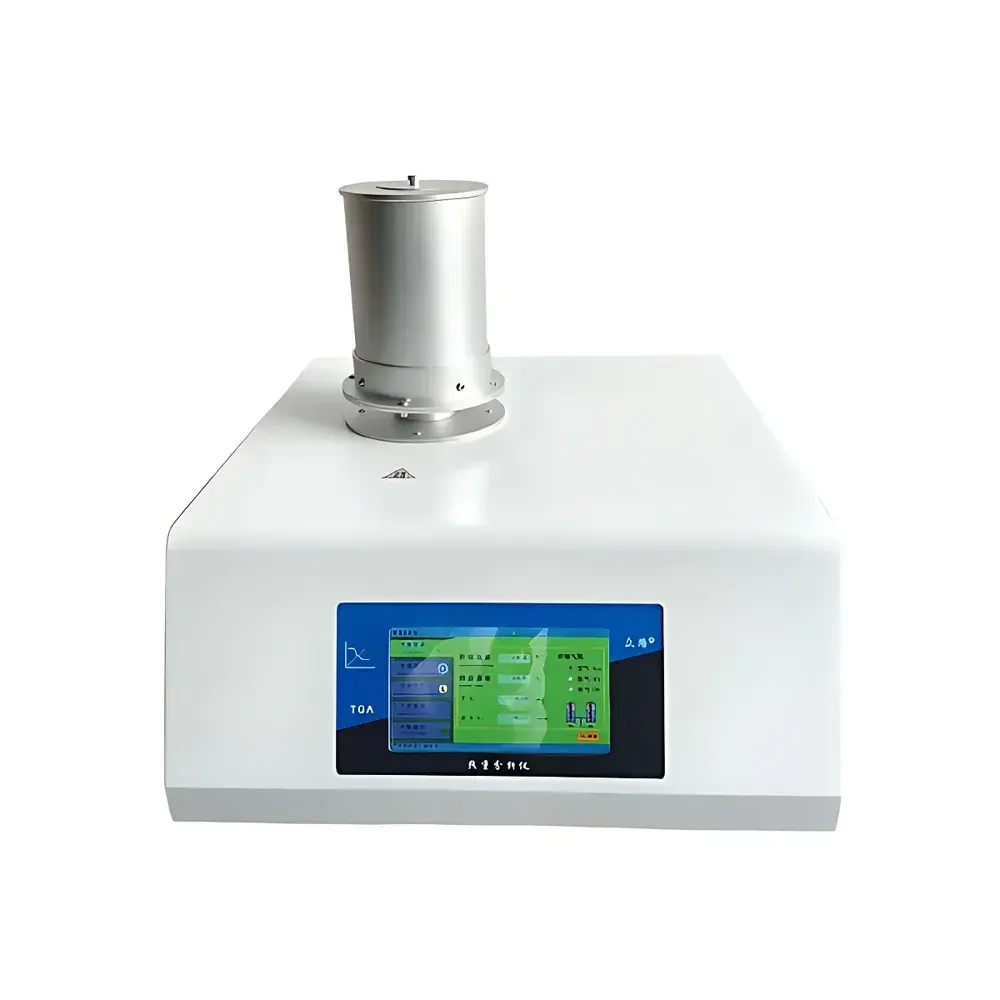
Zhonglu TGA-1250Q Thermogravimetric Analyzer
| Brand | Zhonglu |
|---|---|
| Model | TGA-1250Q |
| Origin | Shanghai, China |
| Manufacturer Type | Direct Manufacturer |
| Temperature Range | Ambient to 1350 °C |
| Temperature Accuracy | ±0.01 °C |
| Temperature Resolution | 0.1 °C |
| Dynamic Weighing Range | 0.01 mg to 30 g |
| Balance Sensitivity | 0.1 μg |
| Mass Accuracy | ±0.00001 g |
| Heating/Cooling Rate | 1–80 °C/min |
| Maximum Sample Mass | 30 g |
| Baseline Repeatability | 25 ppm/10 °C |
| Baseline Drift | 25 ppm/10 °C |
| Atmosphere Control | Dual-gas inlet with mass flow control (inert, oxidizing, reducing, static/dynamic) |
| Cooling Time | ≤15 min (1000 °C → 100 °C) |
| Data Interface | RS-232 |
| Compliance | Patented in China (CN Patent No. disclosed upon request) |
Overview
The Zhonglu TGA-1250Q Thermogravimetric Analyzer is a precision benchtop instrument engineered for quantitative measurement of mass change as a function of temperature or time under controlled atmospheric conditions. Based on the fundamental principle of thermogravimetry—where sample mass is continuously monitored during programmed thermal cycles—the system enables rigorous characterization of thermal stability, decomposition kinetics, moisture/volatile content, filler loading, oxidation behavior, and compositional evolution in solid and powdered materials. Its operational range extends from ambient to 1350 °C, supporting both dynamic (ramped) and isothermal (hold) thermal protocols with high reproducibility. The instrument integrates a high-stability microbalance with active drift compensation, coupled to a furnace featuring rapid thermal response and uniform temperature distribution across the sample zone. All thermal and mass data are acquired synchronously at user-defined intervals, ensuring temporal alignment critical for kinetic modeling (e.g., ASTM E1641, ISO 11358).
Key Features
- Patented dual-compartment furnace design with optimized gas flow dynamics, minimizing thermal lag and convective interference during mass measurement.
- High-resolution microbalance with 0.1 μg sensitivity and <25 ppm/10 °C baseline repeatability—calibrated traceably to NIST-traceable standards.
- Programmable heating/cooling rates from 1 to 80 °C/min, with precise isothermal holds up to 300 minutes and cooling recovery to 100 °C in ≤15 minutes.
- Integrated dual-channel mass flow controller supporting inert (N₂, Ar), oxidizing (air, O₂), and reducing (H₂/N₂ mixtures) atmospheres; flow rates adjustable from 0 to 200 mL/min per line.
- Automated sample handling interface: motorized furnace door actuation, real-time clamp force monitoring, and position-synchronized thermal shielding engagement.
- Embedded 7-inch TFT-LCD HMI with bilingual (English/Chinese) menu navigation, displaying real-time mass, temperature, gas flow, and derivative (DTG) curves simultaneously.
Sample Compatibility & Compliance
The TGA-1250Q accommodates standard ceramic, platinum, and alumina crucibles (100 included), supporting samples ranging from 0.01 mg to 30 g—including powders, granules, thin films, and irregular solids. Its modular sample pan holder ensures minimal thermal mass contribution and consistent heat transfer. The system complies with key international testing standards including ASTM E1131 (composition analysis), ASTM E1641 (decomposition kinetics), ISO 11358 (polymer thermal degradation), and USP <631> (residual solvents in pharmaceuticals). Full audit trail functionality—including user logins, method versioning, parameter locking, and electronic signature support—is implemented in accordance with FDA 21 CFR Part 11 requirements when used with validated software configurations. Routine calibration verification follows GLP/GMP-aligned procedures documented in the supplied SOP manual.
Software & Data Management
Zhonglu’s proprietary TGAControl v4.x software provides full instrument control, real-time visualization, and post-run analysis via Windows-based desktop application. It supports automated sequence execution (multi-sample batches), baseline correction (tangent, straight-line, polynomial), peak integration (mass loss steps, DTG maxima), and kinetic parameter extraction using Ozawa-Flynn-Wall or Kissinger methods. Raw data export is available in ASCII (.txt), CSV, and universal .tdms formats compatible with MATLAB, OriginLab, and Thermo Scientific™ Omnic. The software includes built-in report templates compliant with ISO/IEC 17025 documentation requirements—featuring automatic inclusion of instrument ID, operator name, calibration status, environmental conditions, and uncertainty estimates. Firmware and software updates are distributed free-of-charge via secure download portal with version-controlled release notes.
Applications
- Quantification of polymer degradation onset temperature, char yield, and filler content (e.g., CaCO₃, SiO₂) in composites per ISO 3451.
- Determination of moisture, solvent residue, and volatile organic compounds (VOCs) in pharmaceutical excipients and APIs per ICH Q5C guidelines.
- Analysis of catalyst deactivation mechanisms via coke burn-off profiles under controlled O₂ ramps.
- Thermal stability assessment of battery electrode materials (e.g., LiCoO₂, NMC) and solid electrolytes under inert and air atmospheres.
- Decomposition stoichiometry and reaction enthalpy estimation via coupling with DSC or evolved gas analysis (EGA) modules.
- Quality control of refractory ceramics, metal alloys, and carbon-based materials for aerospace and energy applications.
FAQ
What is the maximum recommended sample mass for optimal resolution and thermal homogeneity?
For routine high-sensitivity measurements (e.g., low-mass organics or trace additives), 5–20 mg is optimal. The 30 g upper limit applies to high-mass industrial samples where absolute mass loss—not fractional change—is the primary metric.
Can the TGA-1250Q be interfaced with FTIR or MS for evolved gas analysis (EGA)?
Yes—via optional heated transfer line (up to 300 °C) and standardized 6-mm OD quartz capillary port, enabling direct coupling to commercial FTIR (e.g., Thermo Nicolet iS50) or quadrupole MS systems.
Is the balance calibrated automatically during operation?
No—calibration is performed manually using certified weights prior to each test series; however, the system performs continuous internal reference checks and logs all zero-point deviations for traceability.
Does the instrument meet CE or UL safety certification requirements?
The TGA-1250Q carries CE marking (2014/30/EU EMC Directive and 2014/35/EU LVD Directive) and conforms to IEC 61010-1:2010 for laboratory electrical equipment safety.
How is data integrity ensured during long-duration isothermal experiments (e.g., >24 h)?
The firmware implements cyclic memory buffering, redundant checksum validation, and automatic power-fail recovery—retaining all acquired points up to the last confirmed write cycle.



