
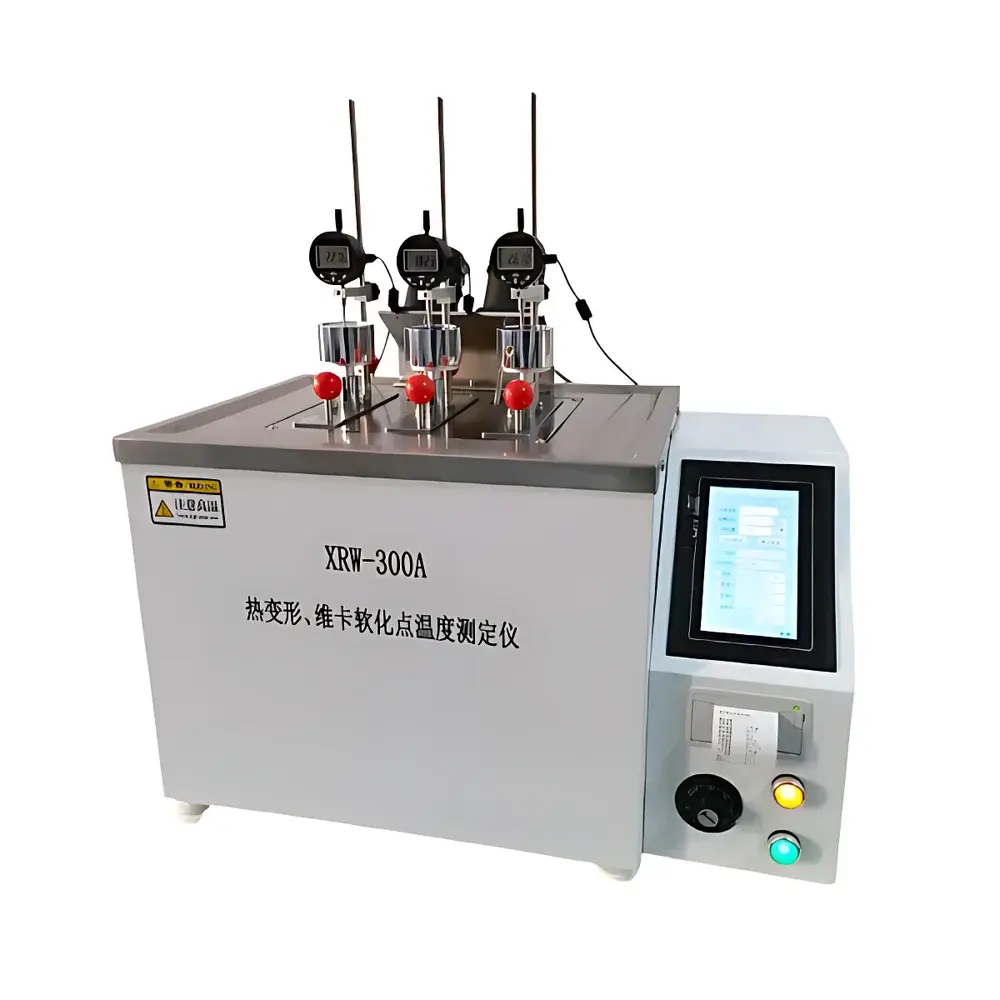
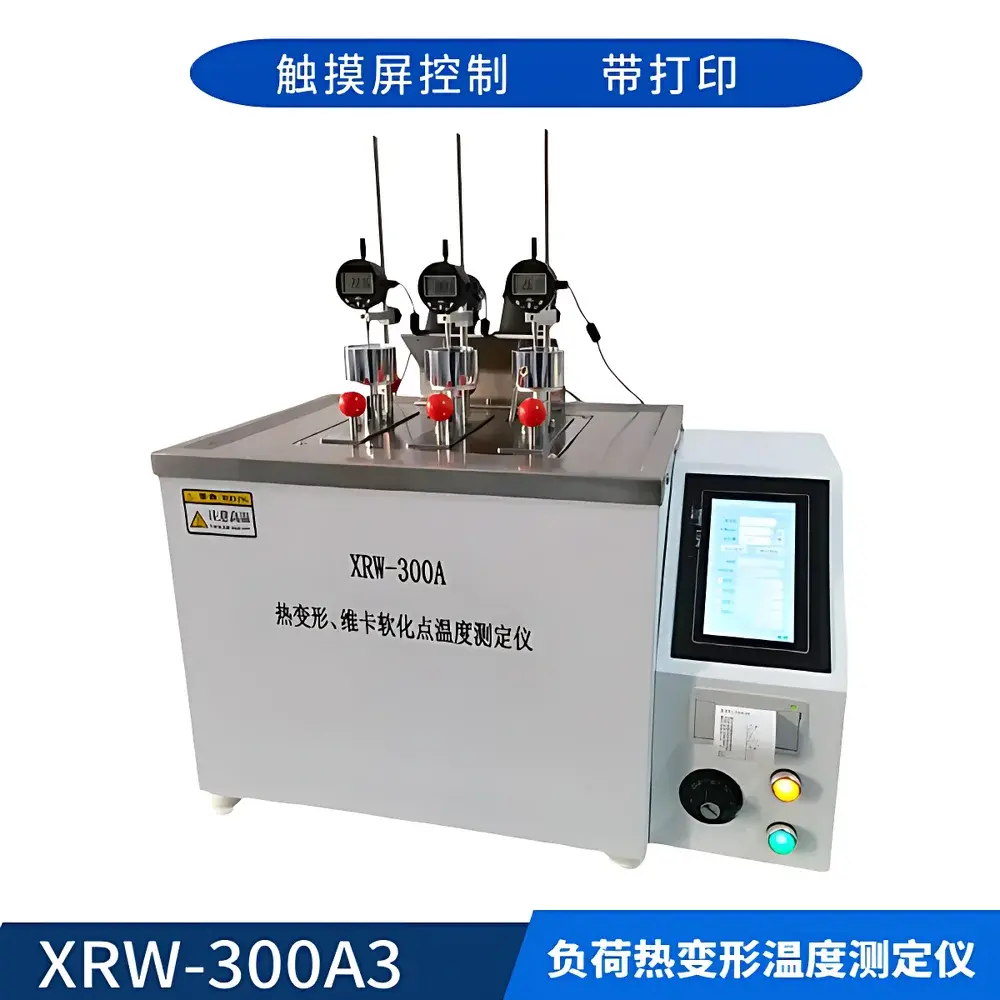
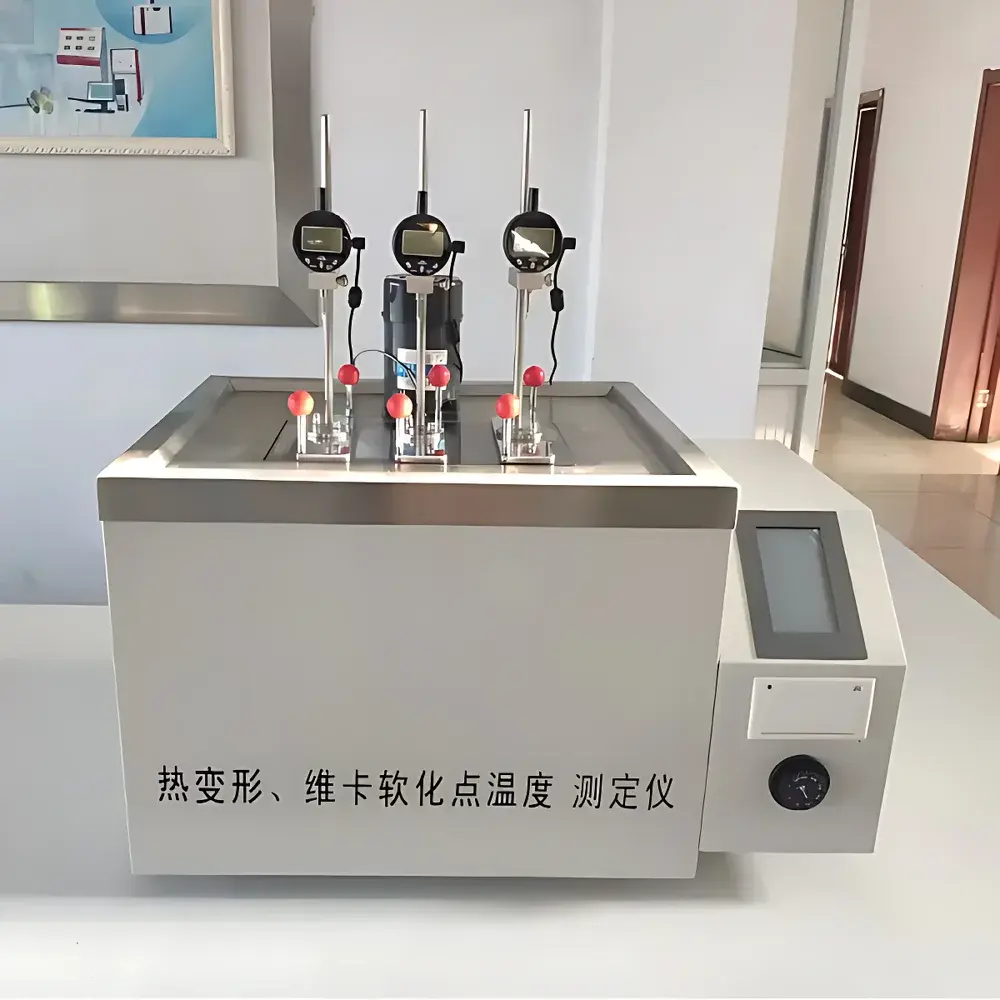
Zhonglu XRW-300A3 Load Deflection Temperature (HDT) & Vicat Softening Temperature (VST) Tester
| Brand | Zhonglu |
|---|---|
| Origin | Shanghai, China |
| Manufacturer Type | Direct Manufacturer |
| Model | XRW-300A3 |
| Temperature Range | 50–300 °C |
| Heating Rate Options | 120 °C/h and 50 °C/h |
| Temperature Accuracy | ±0.5 °C |
| Temperature Resolution | 0.01 °C |
| Specimen Stations | 3 |
| Deflection Measurement | Digital micrometer with 0.001 mm resolution and 0–13 mm range |
| Support Span Options | 64 mm and 100 mm (ASTM-compliant adjustable) |
| Heating Medium | Methyl silicone oil (flash point >300 °C, kinematic viscosity <200 cSt) |
| Control Method | Fuzzy PID + PWM modulation |
| Data Acquisition | 7 samples/sec, 4–8 channels per sample |
| Human-Machine Interface | 7-inch capacitive color touchscreen with bilingual (EN/CN) OS |
| Compliance Standards | GB/T 1633, GB/T 1634.1–1634.3, GB/T 8802, ISO 2507, ISO 75, ISO 306, ASTM D1525, ASTM D648 |
Overview
The Zhonglu XRW-300A3 Load Deflection Temperature (HDT) & Vicat Softening Temperature (VST) Tester is a precision-engineered thermal analysis instrument designed for standardized determination of thermomechanical behavior in non-metallic materials under controlled load and heating conditions. It operates on two fundamental test principles: (1) the load deflection temperature (HDT), defined as the temperature at which a standardized test specimen deflects by a specified amount (typically 0.25 mm or 0.32 mm) under a defined flexural stress; and (2) the Vicat softening temperature (VST), determined by measuring the temperature at which a needle of fixed cross-section penetrates a specimen to a depth of 1 mm under a prescribed load. These tests are essential for evaluating the upper service temperature limits of thermoplastics, thermosets, elastomers, fiber-reinforced composites, and electrically insulating polymers—particularly where dimensional stability under thermal and mechanical stress is critical.
Key Features
- High-precision dual-mode thermal control: Equipped with fuzzy PID algorithm and PWM-modulated power output, enabling stable, linear heating at user-selectable rates (50 °C/h or 120 °C/h per ISO 75 and ASTM D648), with temperature accuracy maintained within ±0.5 °C across the full 50–300 °C operating range.
- Multi-station parallel testing: Three independent specimen stations allow concurrent HDT or VST measurements, improving laboratory throughput without compromising repeatability or inter-test consistency.
- Sub-micron displacement resolution: Integrated B3-12W digital micrometer provides 0.001 mm resolution over a 0–13 mm measurement range, eliminating manual reading errors and supporting automated deformation threshold detection.
- Configurable support span: Dual-span fixture (64 mm and 100 mm) accommodates both ISO/GB and ASTM geometries, ensuring compliance with international standard requirements for beam geometry and stress distribution.
- Embedded ARM Cortex-M3 platform: 32-bit microcontroller running at 108 MHz enables real-time multi-channel data acquisition (7 Hz sampling, 4–8 channels), synchronized temperature–deflection logging, and deterministic response to thermal transients.
- Bilingual HMI with traceability support: 7-inch capacitive touchscreen interface supports English/Chinese language switching and records all test parameters—including specimen dimensions, applied load, span length, and calibration metadata—automatically in each test file.
Sample Compatibility & Compliance
The XRW-300A3 is validated for use with rigid and semi-crystalline thermoplastics (e.g., ABS, PC, PP, PA6/66), thermosetting resins (e.g., phenolics, epoxies), reinforced composites (including long-fiber and glass-filled systems), hard rubber formulations, and thermoplastic piping materials. Its mechanical and thermal architecture meets the physical configuration, loading, and instrumentation requirements of GB/T 1633 (VST), GB/T 1634.1–1634.3 (HDT for general plastics, rigid materials, and high-strength laminates), GB/T 8802 (thermoplastic pipe), ISO 2507, ISO 75-1/2/3, ISO 306, ASTM D1525, and ASTM D648. While not certified to GLP or 21 CFR Part 11 out-of-the-box, its audit-ready data structure—including timestamped raw curves, parameter logs, and operator ID fields—facilitates integration into validated QA/QC workflows under ISO/IEC 17025-accredited laboratories.
Software & Data Management
The embedded firmware captures time-synchronized temperature and deflection data at 7 Hz, storing full datasets—including real-time displacement–temperature curves—in non-volatile memory. Each test record includes metadata such as start/end time, operator ID (if configured), specimen ID, load mass, span length, heating rate, and environmental ambient reference (optional external sensor input). Up to 2000 test results can be retained chronologically for ≥3 years without degradation. Reports are exportable via USB to PDF or CSV format; historical queries support filtering by date range, material type, or pass/fail status. Optional PC-based analysis software (available separately) adds statistical trend analysis, batch comparison overlays, and customizable report templates compliant with internal SOPs.
Applications
- Quality assurance of injection-molded components subjected to elevated ambient temperatures (e.g., automotive under-hood parts, electrical housings).
- R&D evaluation of polymer formulation changes—such as plasticizer content, filler loading, or crystallinity modifiers—on heat resistance performance.
- Pre-certification screening for UL 746B Relative Thermal Index (RTI) assessments.
- Validation of processing parameters (e.g., annealing cycles) against final part thermal stability specifications.
- Comparative benchmarking of bio-based or recycled polymer blends versus virgin grades in academic and industrial research settings.
FAQ
What heating medium is required, and why is methyl silicone oil specified?
Methyl silicone oil with a flash point >300 °C and kinematic viscosity <200 cSt is mandatory to ensure thermal stability, low volatility, and uniform convective heat transfer across the 50–300 °C range. Mineral oils or glycols are unsuitable due to oxidation, vapor pressure, or thermal breakdown risks.
Can the instrument perform both HDT and VST tests without hardware reconfiguration?
Yes—the test head assembly is mechanically interchangeable between HDT bending fixtures and VST penetration needles; both configurations use the same temperature bath, controller, and data acquisition subsystem.
Is calibration traceable to national standards?
The system supports user-performed calibration using NIST-traceable PT100 reference sensors and certified gauge blocks; full calibration certificates require third-party metrology lab verification.
Does the device meet FDA or pharmaceutical regulatory requirements?
While not pre-validated for GMP environments, its deterministic firmware, immutable test logs, and configurable user access levels provide foundational elements for Part 11–compliant validation protocols when deployed in regulated polymer packaging labs.
What maintenance is required for long-term accuracy?
Routine tasks include periodic verification of micrometer zero-point drift, cleaning of oil bath contaminants, inspection of silicone oil viscosity degradation (annually or per 500 test hours), and recalibration of temperature sensors every 6–12 months depending on usage intensity.





