
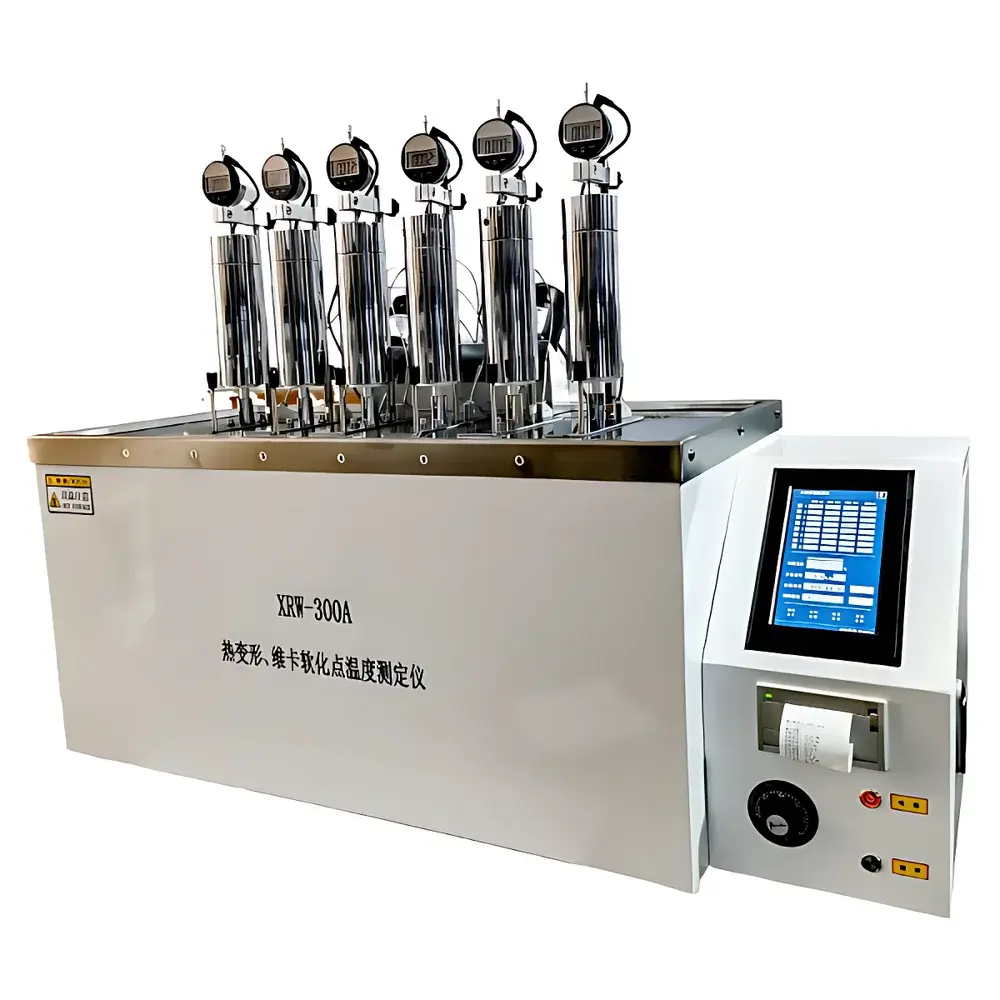
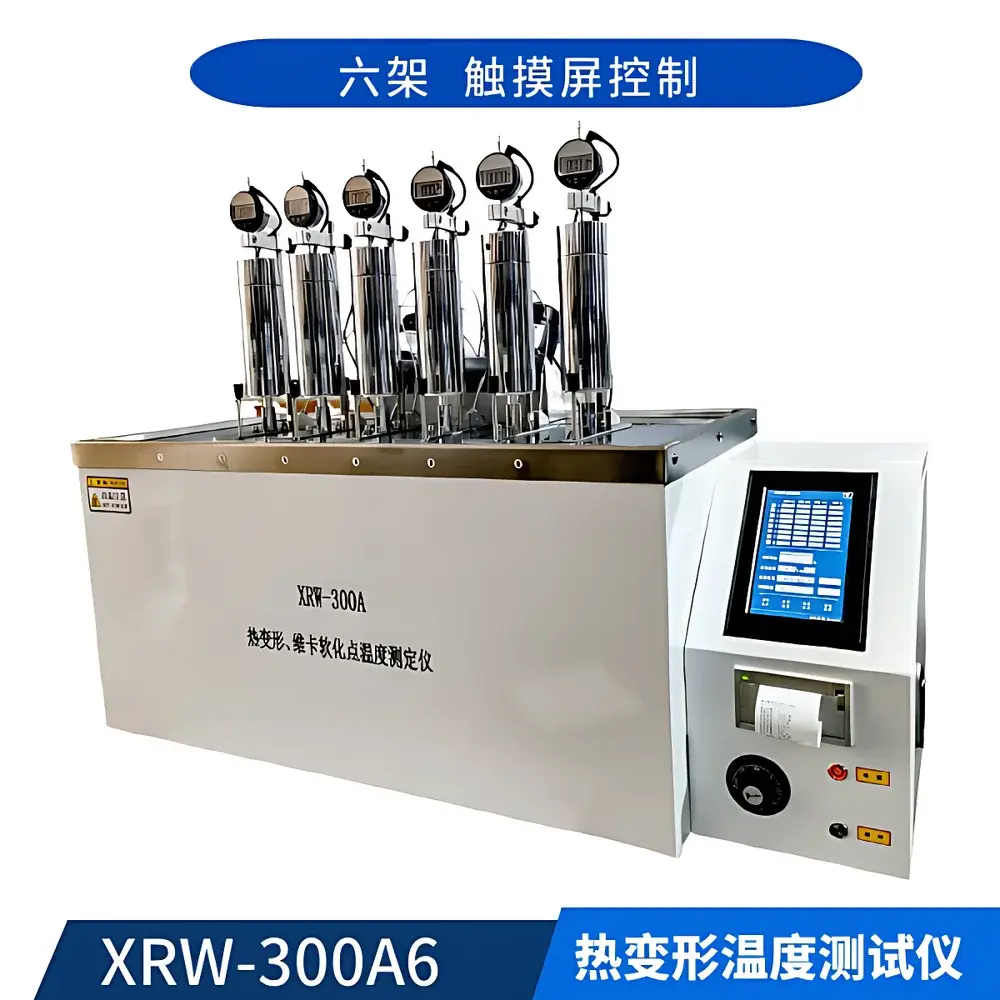
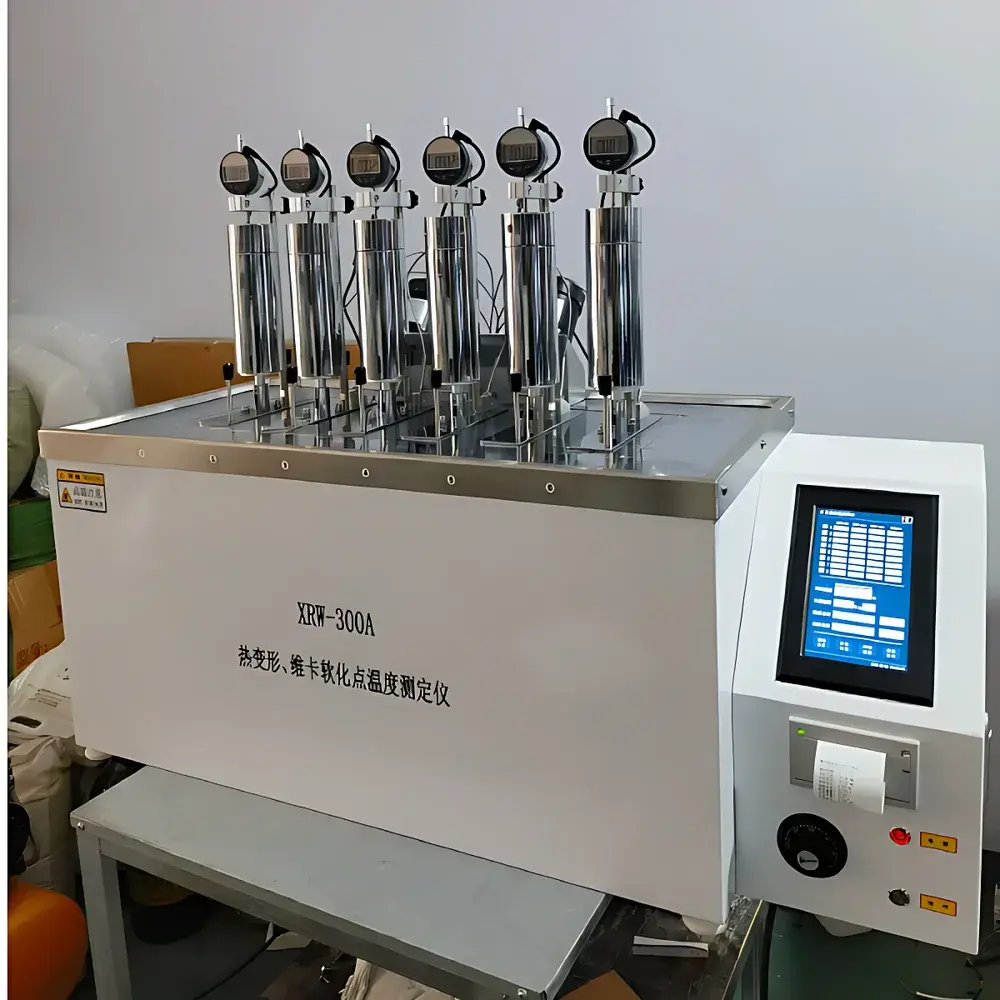
Zhonglu XRW-300A6 Load Deflection Temperature Tester for Rigid Rubber and Thermoplastics
| Brand | Zhonglu |
|---|---|
| Origin | Shanghai, China |
| Manufacturer Type | Direct Manufacturer |
| Model | XRW-300A6 |
| Temperature Range | 50–300 °C |
| Heating Rates | 120 °C/h or 50 °C/h (user-selectable) |
| Temperature Accuracy | ±0.5 °C |
| Temperature Resolution | 0.01 °C |
| Deflection Measurement | Digital micrometer with 0.001 mm resolution, 0–13 mm range |
| Specimen Span | 64 mm or 100 mm (ASTM-compliant adjustable) |
| Sample Stations | 6 independent test positions |
| Heating Medium | Methyl silicone oil (flash point >300 °C, kinematic viscosity <200 cSt, supplied separately) |
| Control Algorithm | Fuzzy PID with PWM output |
| Data Acquisition Rate | 7 samples/second per channel (4–8 channels simultaneously) |
| Human-Machine Interface | 7-inch capacitive color touchscreen, bilingual (English/Chinese) OS |
| Power Supply | 220 V AC, 50/60 Hz |
Overview
The Zhonglu XRW-300A6 Load Deflection Temperature Tester is a precision-engineered instrument designed to determine the Heat Deflection Temperature (HDT) and Vicat Softening Temperature (VST) of rigid thermoplastics, hard rubber, fiber-reinforced composites, and high-strength thermosetting laminates. It operates on the principle of controlled thermal loading under standardized mechanical stress—applying a specified bending load to a rectangular specimen while uniformly raising the temperature at a defined rate. The HDT is recorded as the temperature at which the specimen deflects by 0.25 mm (or 0.32 mm per ASTM D648), whereas the VST corresponds to the temperature at which a needle penetrates 1 mm into the specimen under a fixed load (per ISO 306 and GB/T 1633). This dual-capability design enables laboratories to comply with parallel regulatory and quality assurance requirements across global markets, including those governed by ISO, ASTM, and Chinese national standards.
Key Features
- High-precision temperature control system based on fuzzy PID algorithm with PWM output, ensuring uniform heating profiles and strict adherence to ISO 75 and ASTM D648 ramp-rate specifications (50 °C/h and 120 °C/h).
- Six independent test stations accommodate simultaneous evaluation of multiple specimens—enhancing throughput without compromising repeatability.
- Digital displacement measurement via calibrated digital micrometers (B3-12W type), delivering 0.001 mm resolution and zero drift over extended operation cycles.
- 7-inch capacitive touchscreen interface with real-time graphical monitoring of deflection vs. temperature curves during active testing.
- ARM Cortex-M3 32-bit microcontroller platform (108 MHz) ensures deterministic response, multi-channel synchronization, and robust data integrity.
- Bilingual firmware (English/Chinese) supports international deployment; configurable span options (64 mm and 100 mm) meet both ISO and ASTM specimen support requirements.
- Integrated voice alerts, visual status indicators, and audible beeper feedback provide immediate operational feedback during critical transitions.
Sample Compatibility & Compliance
The XRW-300A6 is validated for use with rigid polymeric materials including but not limited to polycarbonate, ABS, polypropylene, phenolic resins, epoxy laminates, vulcanized hard rubber, and long-fiber reinforced thermosets. Its mechanical and thermal architecture conforms to the dimensional, loading, and environmental stipulations of GB/T 1633, GB/T 1634.1–1634.3, GB/T 8802, ISO 2507, ISO 75-1/2/3, ISO 306, ASTM D1525, and ASTM D648. All temperature and displacement measurements are traceable to NIST-equivalent calibration protocols. The system supports GLP-compliant audit trails through timestamped test records, user login logs, and immutable result storage—critical for laboratories subject to FDA 21 CFR Part 11 or CNAS accreditation requirements.
Software & Data Management
Test execution, parameter configuration, and post-analysis are fully managed within the embedded firmware—no external PC dependency required. Each test generates a structured dataset containing time-stamped temperature, deflection, and calculated HDT/VST values. Historical results (up to 2,000 tests) are stored internally by date and retrievable for re-printing or export via USB. The system automatically computes required load masses based on user-input specimen dimensions and standard-defined stress levels (e.g., 0.45 MPa or 1.80 MPa per ISO 75), eliminating manual calculation errors. All reports include full metadata: operator ID, ambient conditions, calibration status, and compliance references—ensuring transparency in internal QA reviews and third-party audits.
Applications
This instrument serves critical roles in R&D labs evaluating thermal stability of new polymer formulations; QC departments verifying batch-to-batch consistency in automotive interior components, electrical insulators, and piping systems; and certification bodies conducting conformity assessments for CE, CCC, or UL recognition. Its ability to replicate standardized thermal-mechanical stress states makes it indispensable for validating material performance under end-use conditions—such as under-hood automotive applications, building envelope components, or medical device housings exposed to sterilization cycles.
FAQ
What heating medium is required for operation?
Methyl silicone oil with a flash point above 300 °C and kinematic viscosity below 200 cSt must be supplied by the user.
Can the instrument perform both HDT and VST tests in a single configuration?
Yes—the XRW-300A6 supports both test modes via software-selectable load fixtures and penetration probes, compliant with ISO 75 and ISO 306 respectively.
Is the system compatible with laboratory LIMS or ERP integration?
While standalone operation is native, raw data export via USB enables integration with external data management platforms using CSV or XML formats.
How often does the system require calibration verification?
Per ISO/IEC 17025 guidance, temperature sensors and displacement transducers should undergo annual traceable calibration; daily verification using reference standards is recommended before routine testing.
Does the instrument support automated report generation with company branding?
Yes—customizable report templates allow inclusion of lab logo, header/footer text, and signature fields for authorized personnel approval.




