
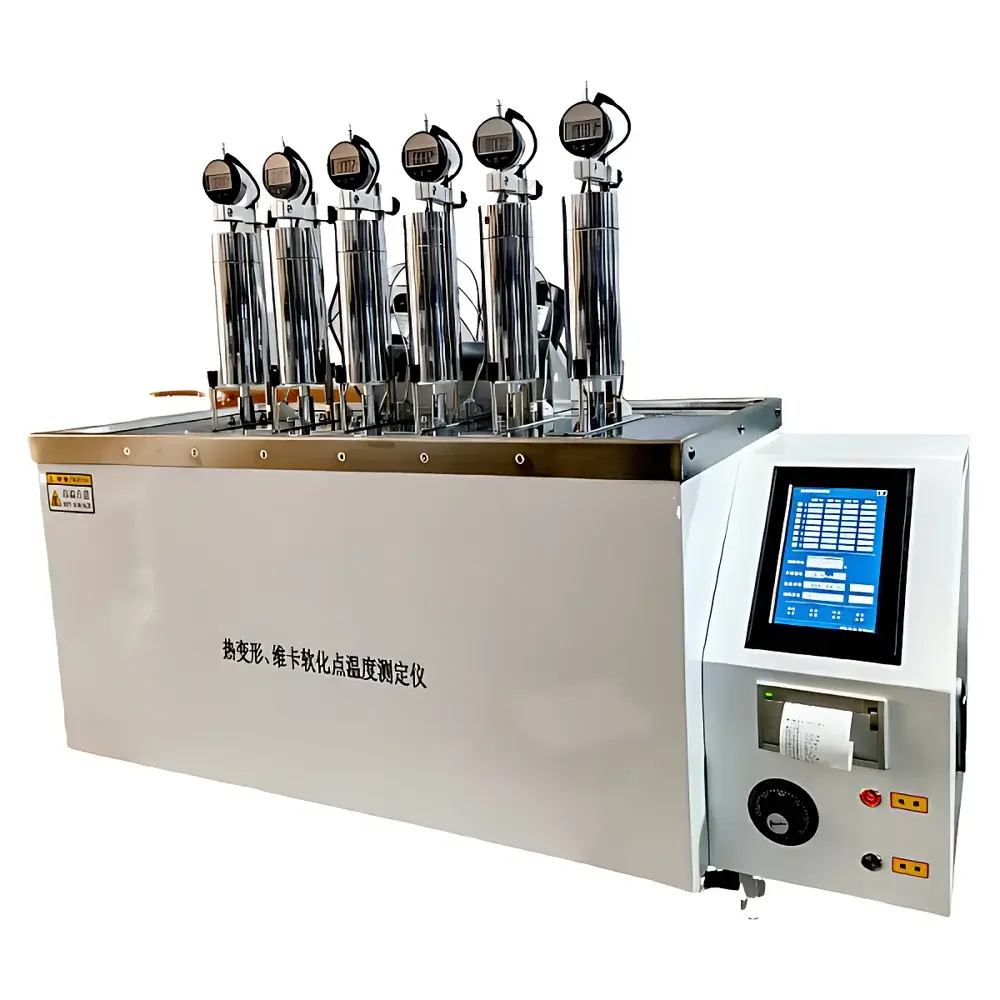
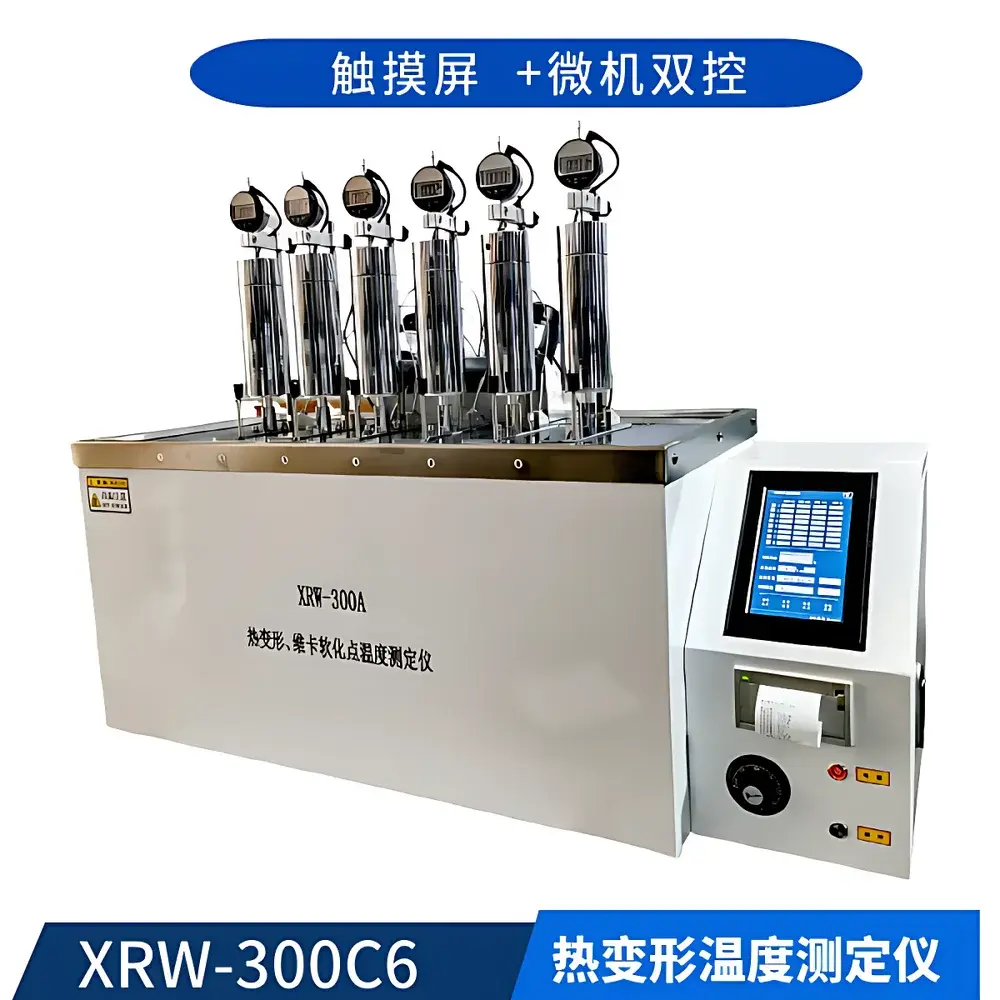
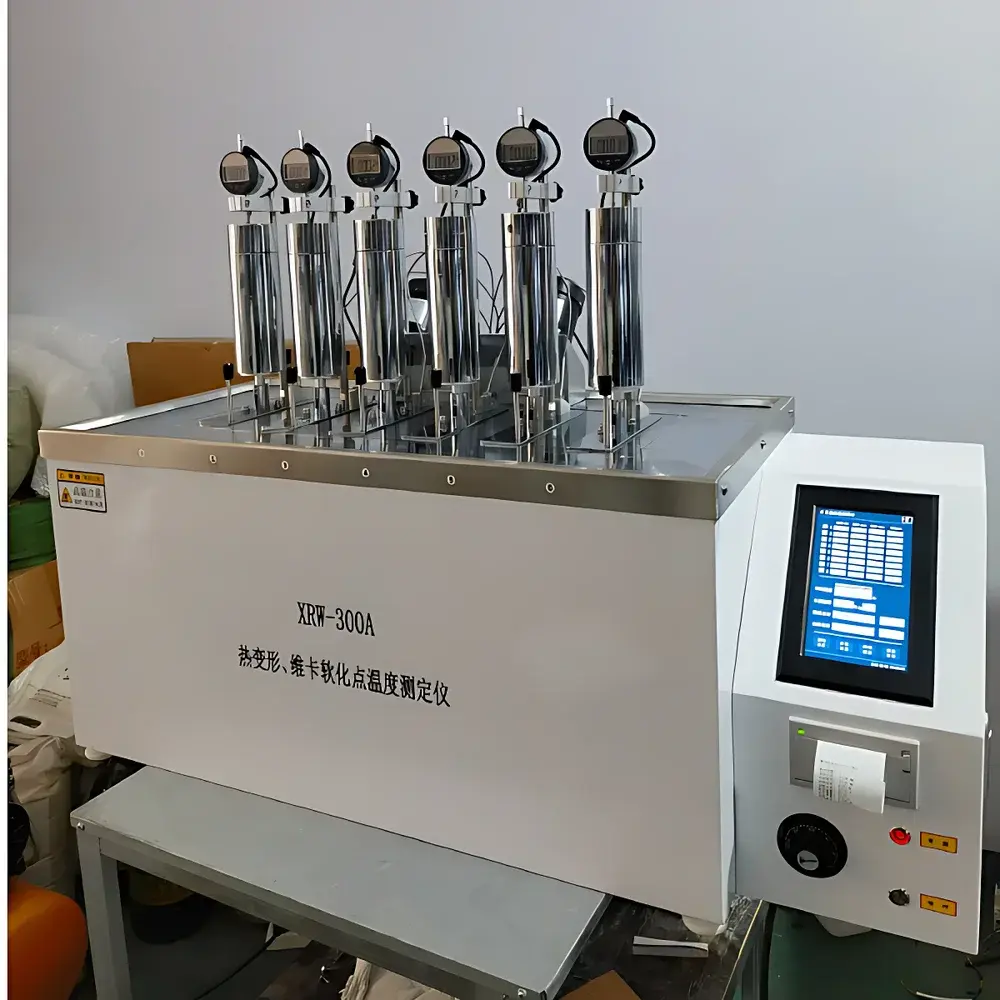
Zhonglu XRW-300C6 Load Deflection Temperature (HDT) and Vicat Softening Temperature (VST) Tester
| Brand | Zhonglu |
|---|---|
| Model | XRW-300C6 |
| Origin | Shanghai, China |
| Manufacturer | Zhonglu Instrument Co., Ltd. |
| Control Interface | 7-inch touchscreen + PC software |
| Test Frames | 6 |
| Temperature Range | Ambient to 300 °C |
| Max Temp Error | ±0.5 °C |
| Heating Rates | 50 °C/h, 120 °C/h, or user-defined between 50–120 °C/h |
| Deformation Range | 0–10 mm |
| Deformation Accuracy | ±0.005 mm |
| Resolution | 0.001 mm |
| Span Lengths | 64 mm and 100 mm |
| Thermal Medium | Methyl silicone oil or transformer oil (user-supplied) |
| Cooling | Natural cooling above 150 °C |
| Safety Protections | Dual hardware/software temperature limit switches, automatic test termination, administrator password lock |
| Compliance | GB/T 1633, GB/T 8802, GB/T 1634, ISO 2507, ISO 75, ISO 306, ASTM D 1525, ASTM D 648 |
Overview
The Zhonglu XRW-300C6 Load Deflection Temperature (HDT) and Vicat Softening Temperature (VST) Tester is a precision-engineered thermal-mechanical testing system designed for the quantitative evaluation of thermoplastic and thermosetting polymer performance under controlled thermal load conditions. It operates on two standardized principles: (1) HDT measurement per ASTM D 648 / ISO 75, where a specified flexural stress is applied to a simply supported beam specimen while uniformly heated at a defined rate, and the temperature at which the specimen deflects by 0.25 mm or 0.32 mm is recorded; and (2) VST determination per ASTM D 1525 / ISO 306, wherein a needle with defined cross-sectional area penetrates a flat specimen under constant load as temperature rises, and the temperature at 1 mm penetration depth is reported. The instrument integrates high-stability thermal control, sub-micron deformation resolution, and dual-platform operation—enabling both standalone touchscreen execution and synchronized PC-based data acquisition and analysis.
Key Features
- Dual-Mode Control Architecture: Embedded ARM-based real-time controller with 7-inch industrial-grade capacitive touchscreen interface, complemented by Windows-compatible PC software supporting concurrent monitoring and analysis of up to three test frames simultaneously.
- High-Fidelity Thermal Management: PID-controlled heating system with full-optical-isolation PWM output delivers precise ramp rates (50 °C/h or 120 °C/h, or any intermediate value), maintaining temperature deviation within ±0.5 °C across the full 0–300 °C operating range. Heating power: 4000 W; thermal medium compatibility: methyl silicone oil (flash point ≥300 °C) or transformer oil.
- Micrometer-Level Deformation Sensing: Six independent容栅 (capacitive grating) digital dial indicators (0–10 mm range), each calibrated to ±0.005 mm accuracy and 1 µm resolution, ensure traceable, repeatable detection of minute deflection events during HDT/VST transitions.
- Multi-Layer Safety Framework: Hardware-level thermal cutoff switch (Korean-sourced, 30 A rated), redundant software-set temperature ceiling, auto-halt upon test completion, and role-based access control via administrator password—meeting IEC 61000-6-2 EMC and ISO 13857 mechanical safety expectations.
- Configurable Mechanical Geometry: Adjustable support span lengths (64 mm and 100 mm) accommodate standard specimen dimensions per ISO 75-2 and ASTM D 648; interchangeable HDT loading pins and VST needles included for immediate method switching.
Sample Compatibility & Compliance
The XRW-300C6 is validated for use with rigid and semi-crystalline polymeric materials including but not limited to ABS, PC, PEEK, epoxy laminates, fiber-reinforced composites, and crosslinked rubber compounds. Its mechanical design conforms to dimensional tolerances specified in ISO 75-2:2013 (HDT) and ISO 306:2020 (VST). All thermal and displacement measurements are traceable to national metrological standards through factory calibration certificates. The system supports audit-ready documentation workflows aligned with GLP and GMP environments—data logs include timestamped raw sensor values, operator ID, environmental ambient readings, and full test parameter configuration history.
Software & Data Management
The bundled PC software provides ISO/IEC 17025-compliant data handling: real-time overlay of temperature–deflection curves for all six test frames; automated calculation of HDT (at 0.25 mm or 0.32 mm deflection) and VST (at 1 mm penetration); export of CSV, PDF, and XML reports with embedded digital signatures. Audit trail functionality records every parameter change, user login/logout event, and report generation action—fully compliant with FDA 21 CFR Part 11 requirements when deployed with network authentication and electronic signature modules. Raw data files are stored in non-proprietary binary format with metadata headers enabling third-party statistical analysis.
Applications
- Quality assurance laboratories validating batch-to-batch consistency of engineering thermoplastics used in automotive under-hood components.
- R&D departments assessing heat resistance improvements following polymer blending, filler addition (e.g., glass fiber, carbon nanotubes), or crosslinking optimization.
- Third-party certification bodies conducting accredited conformity assessments against UL 746B, EN 13477, or GB/T 1634 for electrical insulating materials.
- Academic institutions performing comparative studies on thermal transition behavior of biodegradable polymers (e.g., PLA, PHA) under standardized loading conditions.
- Contract testing service providers delivering ISO/IEC 17025-certified HDT/VST reports for regulatory submissions in medical device packaging validation.
FAQ
What standards does the XRW-300C6 fully support?
It complies with ASTM D 648, ASTM D 1525, ISO 75-1/-2, ISO 306, ISO 2507, GB/T 1633, GB/T 1634, and GB/T 8802—including mandatory specimen geometry, load application, and heating rate specifications.
Can the instrument perform both HDT and VST tests without hardware reconfiguration?
Yes—six independent test stations allow simultaneous HDT and VST runs using pre-installed dedicated fixtures; no tooling changes required between methods.
Is the temperature control system validated for linearity and repeatability?
Each unit undergoes NIST-traceable temperature uniformity mapping across the bath volume and includes a calibration certificate referencing DIN EN ISO/IEC 17025 procedures.
What cooling options are available, and how are they triggered?
Above 150 °C: passive natural convection only. Below 150 °C: programmable selection between water-cooling (via external chiller interface) or continued natural cooling—configured per test method in software.
Does the system support remote diagnostics or firmware updates?
Yes—Ethernet-enabled controller supports secure remote maintenance via SSH; firmware updates are delivered as signed binary packages with version rollback capability and integrity checksum verification.





